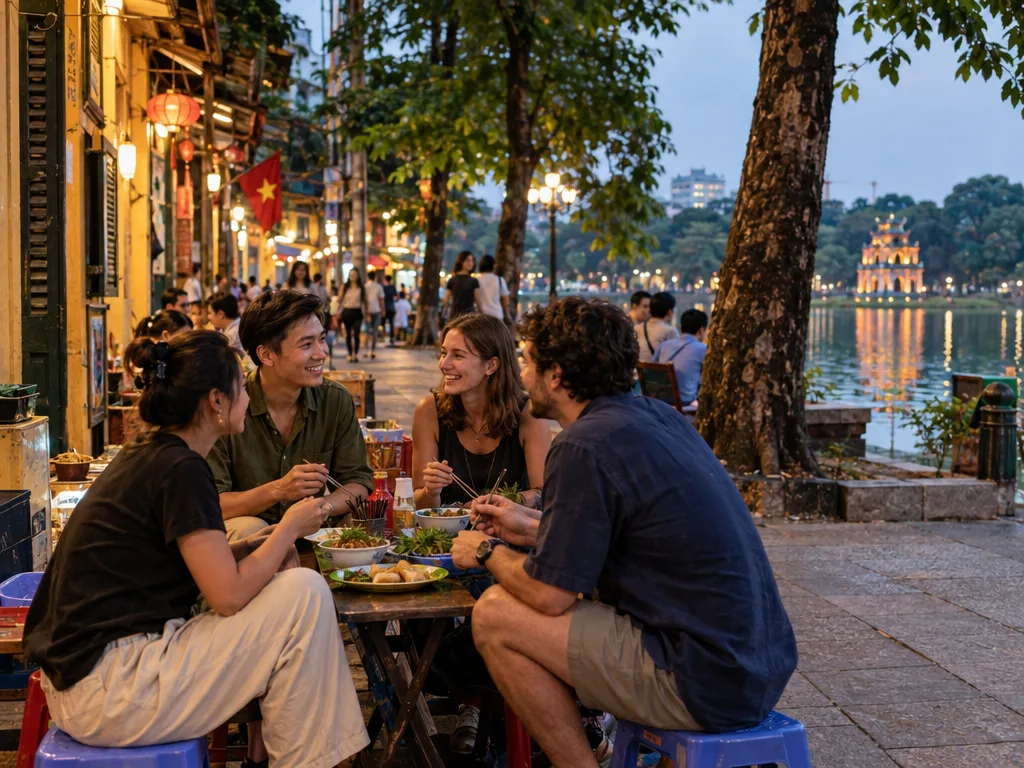
Hanoi nightlife does not have to mean a late club, a crowded bar, or an ambitious list of stops. For many visitors, the best evening is a flexible sequence: eat something local, walk where the city is lively, choose one cultural experience, then finish somewhere calm. That approach leaves room for conversation, weather, traffic, and the small surprises that make Hanoi memorable.
This guide is for travellers searching for relaxed Hanoi nightlife: evenings with atmosphere, local texture, and manageable decisions. It focuses on how to build a night rather than prescribing one perfect venue. Times and programmes change, so confirm current details directly with any theatre, museum, restaurant, or bar before setting out.
What Hanoi nightlife looks like beyond the party scene
Hanoi after dark is a collection of overlapping moods. The Old Quarter can feel energetic and social, while the edges of Hoan Kiem Lake invite a slower walk. Small food businesses bring people together around low tables, beer counters, noodle shops, and dessert stands. Elsewhere, a performance or museum visit gives the evening a clear purpose without requiring a full night out.
The city also rewards a mixed plan. You might begin with a meal, move through a busy street for ten minutes, and then turn into a quieter lane. You might choose a rooftop for the view but spend most of the night talking over a modest drink. The useful question is not “Where is the biggest nightlife?” but “What kind of energy do I want for the next two hours?”
- Choose lively streets when you want people-watching and easy food choices.
- Choose a lake or broad boulevard when you want space and a gentle pace.
- Choose a performance or museum programme when you want an organised cultural experience.
- Choose a café, bar, or rooftop when you want to sit and let the evening unfold.
Build your evening around one main anchor
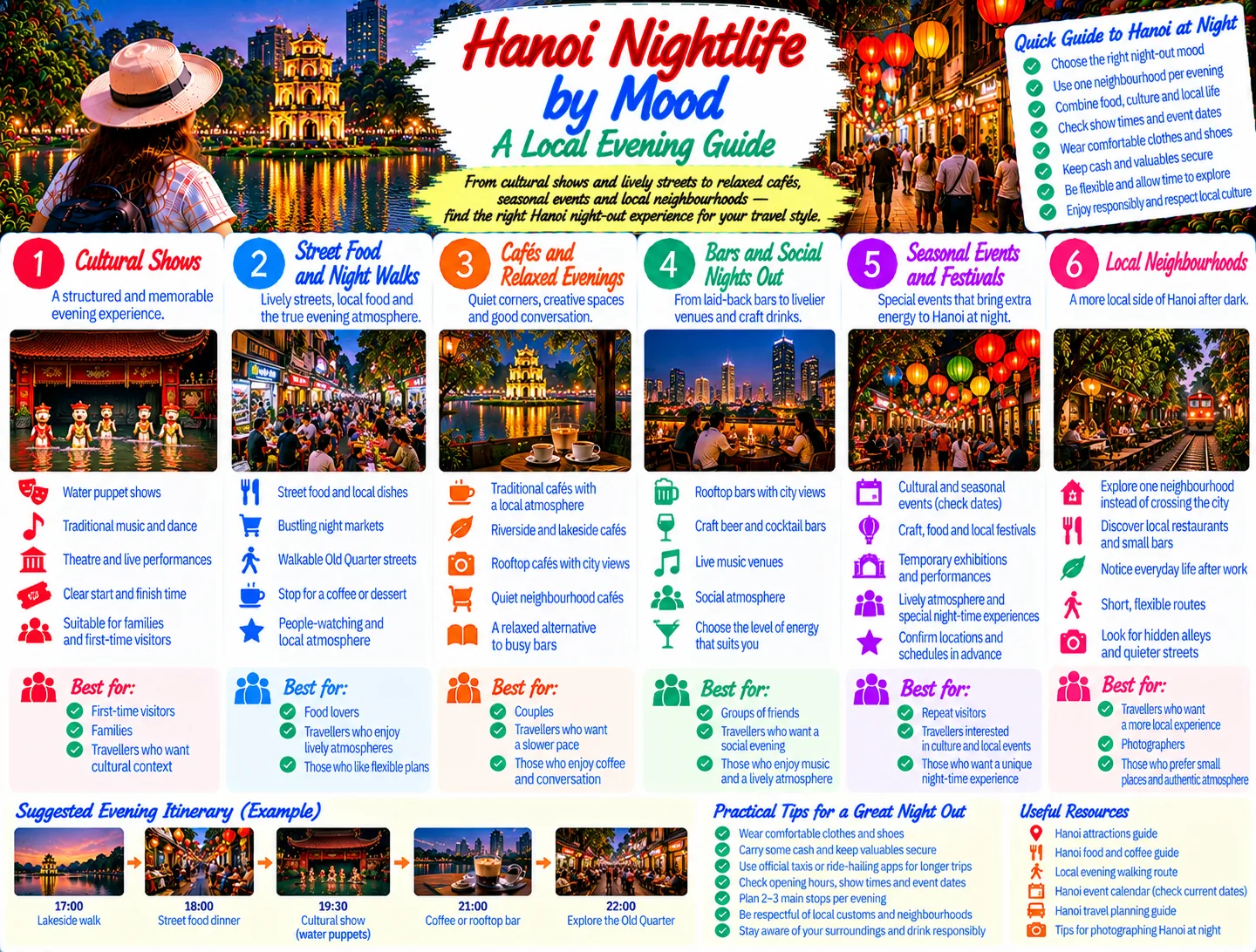
A common mistake is trying to combine every famous Hanoi night activity in one outing. A better local-minded strategy is to select one anchor, then add only one or two nearby pieces around it. Your anchor could be dinner, a water-puppet show, live music, a night-time heritage programme, or simply a walk around Hoan Kiem.
If you want culture
Start by checking a current programme at a theatre or cultural venue. Vietnam’s national tourism authority describes Hanoi as a city where traditional arts, historic architecture, and modern entertainment sit close together. Water puppetry is a classic choice for visitors who want a distinctly Vietnamese performance, while the Opera House area suits travellers interested in architecture and staged shows. Treat these as programme-led experiences: verify the date, start time, language, ticket process, and seating before travelling across town.
If you want food and conversation
Make the meal the anchor instead of treating it as a rushed stop between attractions. Begin with a dish you genuinely want to try, then stay alert to the rhythm of the place. A small restaurant or informal bia hoi can be social without being formal, while a more polished bar or rooftop offers a quieter setting for a long conversation. You do not need to order a large amount or stay until closing; an evening can feel complete after one good meal and a comfortable walk.
If you want movement
Plan a walk with a clear beginning and an easy exit. Hoan Kiem Lake is a natural reference point, and the Old Quarter offers dense streets, food, cafés, and changing views within a compact area. Rather than following a rigid route, choose two streets or landmarks as loose boundaries. If the pavement becomes tiring or the traffic feels stressful, stop, take a drink, and change plans.
A relaxed Hanoi evening route
The following route is a planning framework, not a timetable. It works because each stage can stand alone and because you can shorten it without losing the shape of the night.
1. Begin with an early meal
Choose a place that matches your appetite and tolerance for noise. A quick local meal makes sense if you have a performance reservation. A slower dinner works better if the evening is open-ended. Keep your first decision simple: pick a dish, understand the price before ordering, and leave enough time to notice the neighbourhood around you.
2. Add a short orientation walk
After eating, walk for a limited stretch rather than committing to a long city tour. Around central Hanoi, you can move from a busy commercial lane toward a lake edge, a historic building, or a quieter side street. This transition is important: it lets you experience the city’s sound and movement without making the whole evening feel like an exercise.
3. Choose one cultural or social stop
Now make the night distinctive. Book or attend a performance if you want structure. Visit a venue with live music if you prefer an informal setting. Choose a rooftop or neighbourhood bar if a view and conversation matter more than a packed dance floor. If you are considering a special museum programme, check whether it is currently running; an older article or travel memory is not a substitute for the venue’s present information.
4. Finish with something small
End with dessert, tea, a final walk, or a quiet seat near your accommodation. Late-night plans are easier when the last step is optional. You may discover that the most satisfying ending is not another attraction but watching the streets settle, sharing impressions with a companion, or returning to a café you noticed earlier.
Where to choose your evening mood
Hanoi’s neighbourhoods are not interchangeable at night, and choosing a setting is often more useful than choosing a single “best” venue.
Old Quarter: compact, social, and full of choices
The Old Quarter is useful when your group cannot agree on one activity. Food, informal drinking spots, cafés, souvenir shops, and busy lanes create many possible pivots. The trade-off is intensity: narrow streets, traffic, noise, and crowds can make a relaxed plan feel hurried. Go with a short list and allow yourself to step away from the busiest stretch.
Hoan Kiem: an easy centre point
The lake area works well as a meeting point or reset between activities. The Vietnam Tourism authority highlights the lake’s historic setting and the surrounding walkways as part of Hanoi’s appeal. Use it to connect dinner with a performance, or to give a group somewhere neutral to pause before deciding what comes next.
West Lake: more space and a longer sit-down
West Lake suits an evening built around a view, a slower meal, or a drink with room to talk. It is less useful when you are trying to move between several central attractions. If you choose it, make the neighbourhood itself the plan rather than assuming you can easily add multiple Old Quarter stops afterward.
French Quarter: architecture and formal culture
The French Quarter is a natural fit for travellers who enjoy streetscapes, grand buildings, and organised performances. It can pair well with a cultural booking and a meal, but confirm the venue location and access details in advance. A beautiful district is not automatically a convenient late-night route, especially when your group has different walking speeds.
How to choose between Hanoi evening activities
Search results often turn nightlife into a long inventory. A decision filter is more useful. Ask four questions before committing:
- Do I want participation, observation, or conversation?
- How much noise and crowding will I enjoy tonight?
- Do I need a fixed start time, or would flexibility feel better?
- What is my simplest route home if the plan changes?
For observation, select a performance, a lakeside walk, or a rooftop view. For conversation, prioritise a meal, café, or quieter bar. For participation, look for live music or a social food setting, but avoid assuming that every venue welcomes the same behaviour. Read current venue guidance and follow staff instructions.
Solo travellers can make the evening easier by choosing places with clear entrances, visible staff, and a straightforward way to leave. Couples may prefer one planned experience and an unplanned walk. Families or mixed-age groups should confirm whether a venue is suitable before arriving, particularly if the programme is late or the atmosphere is strongly adult-oriented.
Practical habits for a smoother night
Hanoi rewards flexibility, but flexibility is not the same as leaving every detail to chance. Save the address of your accommodation in a format you can show a driver or local helper. Keep your phone charged. Carry enough payment options for the places you expect to visit, and ask clearly about prices before ordering when a menu is not obvious.
Traffic and pavement conditions can change the feel of a route. Cross carefully, stay attentive at junctions, and do not let a group split across a busy road. If rain arrives, move the plan indoors rather than trying to preserve the original sequence. If a venue is full, treat that as a prompt to explore the nearby area, not as a reason to force the entire night into a backup list.
Respect the difference between a public street and someone’s everyday workplace or home. Keep voices reasonable in residential lanes, ask before photographing people, and avoid blocking shopfronts or narrow entrances. A considerate visitor gets more from Hanoi because the city remains comfortable to observe.
Using special night programmes responsibly
Some Hanoi attractions have offered night-time programmes, including heritage and museum experiences. Vietnam Tourism has described an immersive evening programme at Hoa Lo Prison, presenting the site through guided storytelling, lighting, sound, and historical interpretation. That kind of experience is very different from a bar stop: it asks for attention and may leave you reflective rather than energised.
Use older tourism coverage as background, not as a current booking notice. Before planning around any special programme, check the institution’s own current announcement for dates, duration, language, age guidance, ticketing, and availability. If the programme is not running, the daytime museum or another cultural venue may still fit your evening better than an invented substitute.
Common mistakes to avoid
- Trying to cross the city repeatedly for unrelated activities.
- Assuming a venue’s online listing reflects tonight’s programme.
- Choosing a famous bar when what you really want is quiet conversation.
- Ordering before confirming a price or portion when the menu is unclear.
- Turning a short walk into a late-night trek without planning the return.
- Judging an evening only by how many attractions you checked off.
The strongest Hanoi nights usually have a little structure and plenty of room. One meaningful anchor, one good meal, and one unhurried transition can be enough.
A simple decision guide for tonight
If you are tired, choose dinner near your accommodation and add a short walk. If you want culture, check a current performance or heritage programme first, then eat nearby. If you want to meet people, choose a social food or drink setting where staying for one round is acceptable. If you want a view, commit to one rooftop or lakeside area instead of chasing several. If the weather is uncertain, build an indoor-first plan with a flexible outdoor finish.
Hanoi nightlife is at its best when the plan leaves space for the city to be itself. Listen to the streets, notice how different neighbourhoods change after dark, and let the evening end before it becomes work. You do not need to party hard to experience Hanoi at night; you only need a route that fits your energy.
Final thoughts
A relaxed Hanoi evening is not a lesser version of nightlife. It can combine local food, historic streets, traditional performance, lake walks, and thoughtful conversation in a way that feels personal rather than programmed. Start with the mood you want, select one dependable anchor, verify any current programme, and keep the final step optional. That is enough to turn a night in Hanoi into a memory rather than a checklist.

JOIN THE CONVERSATION
Comments (0)
No comments yet. Be the first to share a thought.