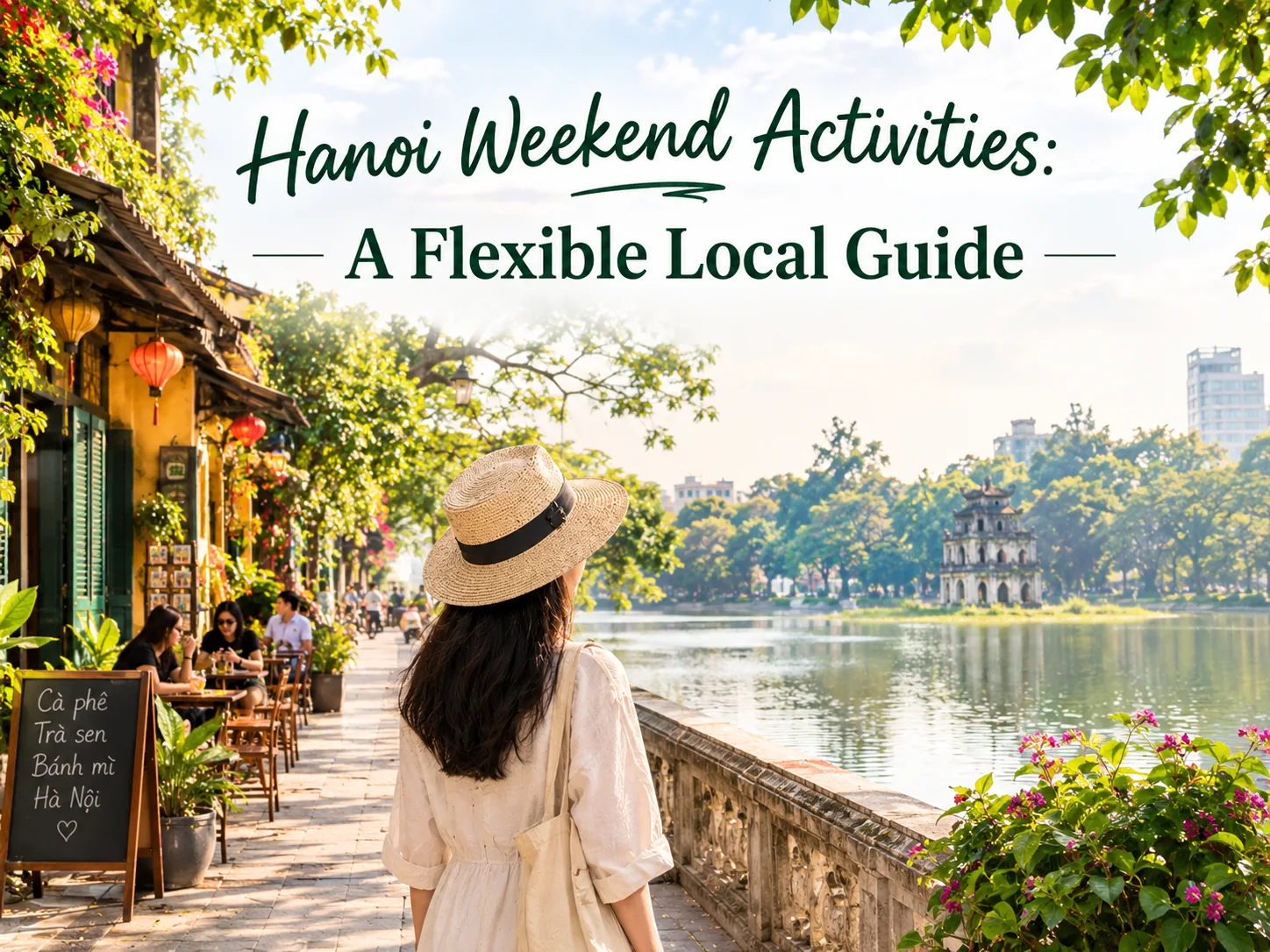
Hanoi is at its most rewarding when a weekend is treated as a rhythm rather than a checklist: one cultural stop, a long walk, a slow meal, and enough unplanned time to notice what is happening around you. If you are searching for Hanoi weekend activities, this flexible plan helps you build two days around places that work in different weather and energy levels while leaving room for temporary exhibitions and neighborhood discoveries.
Start with a simple weekend shape
The easiest mistake is to book or plan too much. Hanoi’s central areas can look close on a map, but crossing a busy street, finding a quiet entrance, or pausing for coffee changes the pace. Choose one anchor for the morning, one area for wandering, and one evening idea. This gives you a framework without turning local life into a timed tour.
For a first visit, make Saturday your culture-and-walking day and Sunday your slower neighborhood day. If rain arrives, swap outdoor time for a museum, gallery, or extended café stop. If you have already seen the famous landmarks, move farther from the busiest streets. Our guide to planning a Hanoi weekend around local events is useful when you want to add a concert, market, workshop, or temporary program without letting the event control the itinerary.
Saturday morning: choose one substantial cultural stop
A good Saturday begins with a place that gives the weekend a clear sense of place. Two practical options are the Vietnam National Museum of History and Van Mieu–Quoc Tu Giam. They suit travelers who want more than a photo stop, and both publish visitor information that can be checked before you leave.
Option one: the Vietnam National Museum of History
The Vietnam National Museum of History is a strong choice when you want a chronological introduction to the country before exploring the streets. Its official visitor information lists morning hours from 8:00 to 12:00 and afternoon hours from 13:30 to 17:00, with the museum open every day except Monday. The site lists locations at No. 1 Trang Tien and No. 216 Tran Quang Khai in Hoan Kiem, so check the exhibition or branch information carefully before setting out.
Allow yourself enough time to read rather than rushing from object to object. Select one theme—early cultures, royal history, or modern national history—and let the rest become a reason to return. Afterward, walk a short distance, find a drink, and talk through what you have seen. That pause turns a museum visit into part of a weekend rather than an isolated indoor stop.
Option two: Van Mieu–Quoc Tu Giam
Van Mieu–Quoc Tu Giam works well for visitors who prefer architecture, courtyards, and a more open-air experience. The official site describes it as a special national historical site and currently lists standard opening hours of 8:00 to 17:00 every day. It also lists evening programming from 18:00 to 22:00 on Wednesday, Saturday, and Sunday, so an evening visit may be possible when the program suits your plans. Confirm current visitor information before travelling because programs and access arrangements can change.
The site lists the entrance at No. 58 Quoc Tu Giam Street and gives additional exits toward Van Mieu Street and Giam Garden. Decide whether you want to continue toward the surrounding streets or return toward the center before you enter. Give the courtyards room to breathe, notice the gates and stone stelae, and avoid treating the visit as a quick dash for one familiar image.
Saturday afternoon: turn the walk into the activity
After a cultural stop, make the afternoon less structured. Hanoi walking routes are not only about reaching a landmark; they are about changing scale. Move from a broad avenue to a smaller lane, from a public building to a shaded café, or from a busy commercial street to a quieter edge. The point is to let the city provide the transitions.
Choose a route with three small objectives: a street you have not visited, a place where you can sit, and a food or drink stop you can decide on when you arrive. This is more resilient than a long list of venues whose hours may change. For route ideas, compare your plan with the best Hanoi walking routes for curious travellers, then shorten or combine sections to match the heat, rain, and your energy.
Keep the walk observational. Notice how shopfronts change between main roads and side streets, how residents use small public spaces, and how the soundscape shifts near lakes, markets, and traffic junctions. Ask before photographing people, homes, or private businesses. A considerate pace is one of the most useful local habits you can bring to a Hanoi itinerary.
Build in a weather-proof afternoon backup
Weather is not a reason to cancel a Hanoi weekend; it is a reason to keep the plan modular. Before leaving, identify one indoor alternative within reasonable reach of your route. The Vietnam Museum of Ethnology is useful for travelers who want a substantial cultural visit outside the central sightseeing loop. Its official site lists hours from 8:30 to 17:30 every day except Monday and the New Year holiday, and places it on Nguyen Van Huyen Street in Nghia Do.
The museum’s official overview describes permanent and temporary exhibitions, virtual exhibition content, research, and educational activities. That makes it suitable for different visitors: someone wanting a broad introduction, a family looking for a longer indoor stop, or a traveler who prefers objects and interpretation to a packed schedule. Check current visitor information before you go, especially around holidays and special exhibitions.
If you do not want another museum, use the same principle with a creative venue, bookstore, café, or covered market. The useful question is not “What can I squeeze in?” but “What nearby place lets me stay curious while the weather changes?” The Art & Creative Spaces category can help you find a different kind of indoor stop.
Saturday evening: choose atmosphere over a second checklist
For evening Hanoi weekend activities, decide what kind of night you actually want. A lively central walk, a low-key drink, live entertainment, or a meal followed by people-watching can all be good choices. You do not need to combine all four. Select one main mood and let the rest happen naturally.
If you want movement, begin with a familiar central area and walk only as long as it remains enjoyable. If you want a quieter evening, choose a neighborhood café or small restaurant away from the loudest road. The existing guide to the best things to do in Hanoi at night on a local route offers a starting point for building an evening without relying on a single venue.
For a more event-focused night, check the venue or organizer’s own listing on the day you plan to attend. Event times, ticket arrangements, and temporary programs are the details most likely to change. Avoid copying an old social post or assuming that a recurring event is running this weekend. If the main plan falls through, a walk, café, or early dinner is not a failed evening.
Sunday morning: explore a neighborhood at walking speed
Sunday is a good time to move away from a landmark-first plan. Pick one neighborhood and give it a morning rather than collecting several districts. Look for a practical combination: a market or local shopping street, a calm place to sit, and one small cultural or architectural detail. Choose a theme such as old shop signs, tree-lined streets, everyday breakfast, or independent cafés.
Do not assume that a neighborhood is an attraction designed for visitors. Keep entrances clear, keep your voice down in residential lanes, and buy something from small businesses when you use their space or time. If you are unsure where to begin, browse the Local Neighborhoods category for a starting point, then let the morning become less scripted once you arrive.
Sunday afternoon: add one creative or local-life layer
For the final substantial activity, choose something that changes the texture of the weekend. You might return to a museum topic that caught your attention, visit a creative space, browse a market, or settle into a café long enough to write notes and sort photographs. This is where a broad “things to do in Hanoi this weekend” search becomes a personal itinerary: select an experience that complements Saturday rather than repeating it.
Creative spaces are helpful when you want a less predictable afternoon. Look for exhibitions, workshops, independent design, or small cultural programs, but verify the current schedule with the venue. Do not assume that a place shown in an old guide still operates in the same format. If you want to continue exploring this theme, the site’s practical guide to art and creative spaces in Hanoi can help you compare options.
Alternatively, make the activity deliberately ordinary: choose a market, pick up a useful item, have a local drink, and watch the area change through the afternoon. Everyday choices are not filler between attractions. They are often what makes a weekend feel connected to the city rather than exported from a generic itinerary.
How to make the plan work in real life
Keep travel time honest
Group activities by area whenever possible. A shorter day with one coherent route is usually more enjoyable than a longer day built around repeated cross-city transfers. Leave buffer time for traffic, weather, queues, and the fact that you may want to stop.
Check the details that change
Before leaving, verify opening hours, temporary exhibitions, ticket arrangements, evening programs, and holiday notices on the official source for the venue. The official pages for the Vietnam National Museum of History, Van Mieu–Quoc Tu Giam, and the Vietnam Museum of Ethnology are useful because they publish visitor information directly. Use them as planning references, not as permission to assume every detail will remain unchanged.
Carry a flexible backup
Have one indoor alternative and one low-effort evening idea. A café, bookstore, museum, or neighborhood walk can rescue a rainy or tiring day without adding stress. Flexibility matters if you are travelling with children, older relatives, or anyone who needs regular breaks.
Leave room for local rhythm
Do not fill every hour with consumption. Sit down, observe, and allow a place to be more than a backdrop. Hanoi rewards visitors who notice ordinary details: a carefully arranged storefront, a family sharing a meal, a quiet courtyard, or a street that becomes lively only at a particular time.
A practical two-day template
Saturday morning: choose either the Vietnam National Museum of History or Van Mieu–Quoc Tu Giam as your cultural anchor.
Saturday afternoon: take a flexible walking route with one café or food stop and no more than two planned objectives.
Saturday evening: choose one atmosphere—central walking, entertainment, a quiet meal, or a relaxed drink.
Sunday morning: explore one neighborhood at walking speed, using a market, café, or local street as your loose focus.
Sunday afternoon: add a museum, creative space, market, or slow café session that complements the first day.
Make your Hanoi weekend feel personal
The best Hanoi weekend itinerary is not the one with the most stops. It balances a reliable cultural anchor with open time to respond to weather, energy, and curiosity. Use official visitor pages for details that can change, local guides for ideas, and events as optional layers rather than the entire plan. With that approach, a weekend can include history, walking, creative discovery, and everyday life without feeling rushed. The city remains open to surprise, which is exactly what a good local weekend should do.
JOIN THE CONVERSATION
Comments (0)
No comments yet. Be the first to share a thought.