Hanoi rewards walkers who leave room for small discoveries. A short turn from a famous lake can lead to a shrine, a narrow guild street, a shaded colonial boulevard or a café where the city’s rhythm becomes easier to read. The best Hanoi walking routes are not races between landmarks. They are practical sequences that connect places with different moods, allowing you to pause, eat, take photographs and change direction when the street becomes interesting.
This guide sets out three flexible walks: a compact Hoan Kiem and Old Quarter loop, a longer Old Quarter route for food and everyday street life, and a calmer French Quarter and lake walk. You can complete one in a morning, combine sections over a full day, or use the route logic to make your own itinerary. For a broader introduction to the city’s neighbourhoods, see this local guide to Hanoi neighbourhoods.
How to choose a Hanoi walking route
Start with your energy, not with a checklist. Hoan Kiem Lake and the Old Quarter are the easiest areas for a first Hanoi walking tour because sights, food, cafés and transport connections are close together. The streets are busy and the pavement is not always continuous, but the compact layout means you can stop often. The French Quarter feels more spacious, with broader streets, mature trees and architectural details that are easier to appreciate at a slower pace.
Use these simple choices:
- First visit: choose the Hoan Kiem and Old Quarter loop to understand Hanoi’s historic centre in a few hours.
- Street life and food: choose the Old Quarter route, especially if you enjoy markets, small shops and unplanned detours.
- Quieter streets: choose the French Quarter and lake route, with time for museums, gardens or a long coffee.
- Hot or rainy weather: shorten the route, begin early, and plan indoor pauses rather than trying to finish every section.
Walking distances in Hanoi can feel longer than they look on a map. Crossing a busy road, sharing space with parked motorbikes and stopping to navigate an alley all take time. Treat the estimates below as route shapes rather than strict schedules.
Route one: Hoan Kiem Lake to the Old Quarter
A compact introduction to central Hanoi
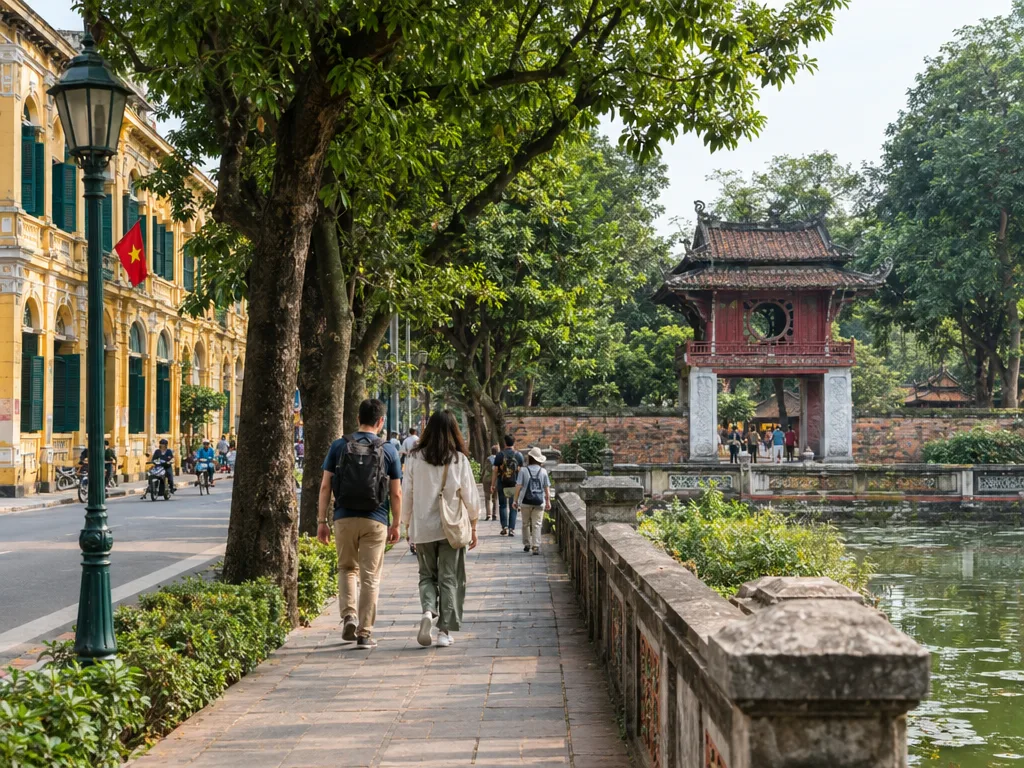
Begin at Hoan Kiem Lake, the natural meeting point between the Old Quarter and the French Quarter. Walk beside the water first instead of heading straight into the narrow streets. The lake gives you an open view of Hanoi and helps you understand the city’s centre: tree-lined paths, public exercise, quiet pauses and a steady flow of visitors and residents.
Continue towards Ngoc Son Temple on the lake’s northern side if you want a landmark-focused start. Leave enough time to look beyond the entrance: the lake, bridges and surrounding streets are part of the experience. Then move towards the Old Quarter through the lanes near Hang Be and Cau Go. The atmosphere changes quickly from open water to shopfronts, signs, food stalls and compressed streets.
From there, make a loose loop through Dinh Liet, Hang Bac and Ta Hien. These streets are useful for seeing how the Old Quarter shifts during the day. Silver shops, small restaurants, cafés, household goods and tourist-oriented businesses sit close to ordinary daily activity. Do not worry about following every street in order. Choose one side street, walk for ten minutes, and return to the main route when you need a clearer landmark.
Finish near St. Joseph’s Cathedral and Ly Quoc Su Street. This gives the walk a satisfying change of scale: a recognisable religious building, wider views and plenty of places to pause. Vietnam Tourism describes the Old Quarter as an area of ancient architecture, green spaces, shops and street food that is best explored on foot, but the useful lesson is to slow down rather than collect addresses.
Best way to pace it
Allow half a day if you want photographs, a temple visit, coffee and a meal. Go early for softer light and a less intense start. Late afternoon can be atmospheric, but traffic and crowds may make the same route feel much slower. Around the lake, observe any pedestrian-space rules and follow local instructions; the city’s regulations emphasise civilised public behaviour, safety and respect for the public setting.
Route two: the Old Quarter beyond the main streets
A route for details, detours and local rhythm
For a more immersive Hanoi Old Quarter walk, begin at the eastern edge near O Quan Chuong and work back towards Hoan Kiem Lake. The old gate is a useful starting marker, but the route is really about the streets around it. Move through Hang Chieu, Dao Duy Tu and the lanes leading towards Bach Ma Temple. The buildings are close together, shop uses change from block to block, and small signs of working life often appear beside places made for visitors.
Continue through Hang Buom, Ma May and the lanes near Hang Bac. This section works best when you pay attention to thresholds: a family business opening onto the pavement, a house reached by a narrow entrance, a vendor arranging fruit, or a café hidden above street level. Hanoi’s traditional street names reflect old trades, yet the modern streets are not museums. They are active neighbourhoods, so leave room for residents, deliveries and parked vehicles.
Take a detour towards the small lanes around Phat Loc if you want to explore a more intimate side of the centre. Return to the main streets before continuing south-west. When the noise becomes tiring, use a café as a reset point. A quiet twenty-minute pause can make the next hour more enjoyable than pushing on.
Finish at Hoan Kiem Lake or continue to the cathedral area. This route pairs well with the site’s guide to Hanoi markets and small shops, especially if you want to think about what you are seeing rather than simply shop. You can also browse the Local Markets & Shopping category for related ideas before choosing where to stop.
What this route answers
This is the best option if your search intent is “what can I see while walking around Hanoi Old Quarter?” It combines historic street patterns, food possibilities, independent shops and everyday scenes without pretending that the area is quiet or perfectly preserved. It also gives you more control: skip a crowded block, follow an interesting alley, or end early at the lake.
Route three: the French Quarter, lakes and shaded boulevards
A slower walk south of Hoan Kiem
Start at the southern end of Hoan Kiem Lake and walk towards the Opera House through the French Quarter. This route is a useful contrast to the Old Quarter. Streets are generally broader, building fronts have more breathing room, and the pleasure comes from façades, trees, museums and civic spaces rather than constant shopfront activity.
From the lake, consider a stop at the Vietnam National Museum of History. Check the museum’s official website before travelling for current opening information and exhibitions. Even if you do not enter, the surrounding streets make a good transition between the lake and the French Quarter. Continue towards the Opera House, then choose whether to turn towards Trang Tien Street or walk through quieter residential blocks.
A longer version continues south-west towards Thien Quang Lake and Reunification Park. Vietnam Tourism’s official walking-tour suggestions connect the French Quarter with Hoan Kiem Lake, Thien Quang Lake and Reunification Park, a useful reminder that Hanoi’s central walks do not need to stop at the Old Quarter boundary. The park offers a different rhythm: paved paths, open space and locals exercising or taking a break.
If you prefer a shorter route, stay between Hoan Kiem Lake, the Opera House and the museum district. If you have a full morning, continue towards Thien Quang Lake and finish with a taxi or a return walk depending on the heat. This is also a good route for travellers who enjoy architecture more than shopping.
For context on Hanoi’s creative side after your walk, explore the Art & Creative Spaces category. You can also pair the route with the Secret Cafes & Hangouts category when you want a deliberate place to rest instead of choosing the first café you see.
When to walk, pause and change direction
The best time for a Hanoi walking tour depends on the kind of experience you want. Early morning suits lakes, parks and photography. The city is already active, but the pace around open public spaces can feel gentler. Midday is better treated as a pause: choose lunch, a museum, a café or a hotel break rather than forcing yourself through exposed streets.
Late afternoon brings warmer light and more social energy. It can be a rewarding time for the lake and Old Quarter, although roads and pavements may feel busier. On evenings when pedestrian areas are active, follow signs, barriers and local directions. Do not assume that every street is closed to traffic at all times; arrangements can change for events, maintenance or city management.
Build the walk around three anchors:
- A beginning: a lake, museum, gate or major street that is easy to identify.
- A middle pause: food, coffee, shade or an indoor attraction.
- An exit: a main road, hotel area or landmark where a taxi or ride-hailing pickup is practical.
This structure matters more than a perfect route line. It lets you adapt to rain, heat, crowds or tired feet without losing the character of the neighbourhood.
Practical walking tips for Hanoi
Crossing streets and sharing space
Cross at a visible point, walk predictably and keep your attention on the traffic around you. Hanoi’s streets involve motorcycles, cars, bicycles, vendors and pedestrians using limited space. Do not step into the road while looking only at your phone. At junctions, wait for a natural gap and move steadily rather than making sudden changes of direction.
What to carry
Wear comfortable shoes with grip, carry water, and bring a light layer for changing weather. A small bag is easier than a large backpack in narrow streets. Keep cash and phone secure without making them the focus of the walk. If you plan to visit religious sites, choose respectful clothing and follow any signs about photography or behaviour.
How to be a considerate visitor
Remember that the Old Quarter is a working neighbourhood. Ask before photographing people closely, do not block shop entrances, and step aside when a delivery or motorbike needs to pass. At temples and museums, follow posted rules rather than relying on assumptions. In pedestrian spaces around Hoan Kiem Lake, behave as you would in any shared public place: keep noise reasonable, dispose of rubbish properly and respect organised activities.
For more everyday context, read these small Hanoi habits that make a visit feel easier. The advice is useful because a good walk is not only about where you go; it is also about noticing how the city works.
How to turn one route into a personal itinerary
Choose one main route and one optional extension. For example, start with the Hoan Kiem loop, add the eastern Old Quarter if you still have energy, and stop before the walk becomes a test of endurance. Or begin in the French Quarter, visit a museum, then cross towards the lake for dinner. Combining every route in a single day usually produces less insight and more fatigue.
Use the Hanoi Walking Routes category as a starting point for related ideas, then build around your interests: architecture, coffee, markets, public life, history or photography. A route becomes memorable when it has a reason, not when it contains the highest number of landmarks.
Final thoughts
The strongest Hanoi walking routes connect contrasts: water and narrow streets, grand buildings and improvised businesses, famous sights and ordinary routines. Begin with a clear anchor, leave space for detours, and plan a pause before you need one. Whether you choose the Old Quarter, Hoan Kiem Lake or the French Quarter, walking slowly will show you more of Hanoi than a checklist ever can.
JOIN THE CONVERSATION
Comments (0)
No comments yet. Be the first to share a thought.