Hanoi is easiest to understand on foot when the route has a clear idea behind it. Instead of trying to cover every landmark, this architecture-focused Hanoi walking tour follows the city from grand civic buildings to museum collections and quieter streets where French-colonial, Art Deco and Vietnamese details sit side by side. It is designed for curious travellers who want context, photographs and time to notice how the city changes from one block to the next.
The route works best as a flexible half-day or full-day plan. Begin around the French Quarter, pause at the Vietnam National Museum of History, continue through the streets around the Opera House and finish with a slower café or meal stop. The distances below are planning estimates rather than official measurements, so use a map on the day and shorten the walk in hot, wet or crowded conditions.
Why choose an architecture walking tour in Hanoi?
Hanoi architecture is not a single style. In a short walk you can see formal boulevards, tree-lined institutional compounds, narrow commercial streets, restored public buildings and houses adapted for modern life. The interest is in the transitions: a monumental façade can lead to a small lane, while a historic building may now contain a shop, office or café.
This route also gives the walk a practical rhythm. You are not moving between isolated photo stops. You have indoor options, shaded streets, museum time and places to sit. That makes it more comfortable for travellers who prefer a thoughtful city walk to a fast checklist.
- Choose early morning for softer light and a calmer start.
- Allow extra time for museum visits rather than treating them as quick photo stops.
- Wear shoes with grip: pavements can be uneven, and weather can change quickly.
- Keep the route flexible around traffic, ceremonies, construction and local activity.
Route overview: French Quarter buildings to museum collections
A useful sequence is the area around the Hanoi Opera House, the Vietnam National Museum of History, nearby French Quarter streets and a final extension towards Hoan Kiem Lake. If you want a longer day, continue north-west through central streets and connect with another cultural stop. If you want a compact walk, make the museum the centrepiece and explore only the surrounding blocks.
The route is less about a fixed number of kilometres than about four kinds of pause: look up at façades, step inside a museum, sit in a public or café setting, and observe ordinary street life. A realistic plan is to spend one to two hours walking between stops and another one to three hours inside museums or taking breaks, depending on your interests.
Best route shape
- Start near the Opera House area.
- Walk towards the Vietnam National Museum of History.
- Take a museum break and check the current visitor information before entering.
- Continue through the French Quarter, looking for changes in street scale and building use.
- Finish near Hoan Kiem Lake or choose a nearby meal and café stop.
Stop 1: Begin around the Hanoi Opera House
The Opera House area is a strong opening because it gives the walk an immediate sense of scale. Wide streets, formal façades and civic buildings create a different atmosphere from the dense lanes of the Old Quarter. Rather than rushing straight to the next landmark, spend ten minutes making a visual inventory: where are the entrances, how do balconies and windows repeat, which buildings have been repainted, and where has street life softened the formality?
Walk slowly around the surrounding blocks instead of standing in one traffic-heavy spot. Look for the relationship between the Opera House precinct and nearby hotels, offices, embassies and residences. Some buildings may be closed, privately occupied or changed from their original use, so appreciate them from public space and do not enter courtyards without permission.
This is also a good place to set your pace. The first section should feel observational, not rushed. Take wide street photographs only when safe, keep entrances clear and avoid photographing people closely without consent.
Stop 2: Make the Vietnam National Museum of History the route anchor
The Vietnam National Museum of History provides the walk with historical depth. Its official visitor information lists two Hanoi addresses, including 1 Trang Tien and 216 Tran Quang Khai, and gives visitor hours with a morning session, an afternoon session and a weekly closing day. Because museum schedules and displays can change, check the official site before leaving your accommodation and confirm which building or exhibition you want to visit.
Use the museum as more than an indoor break. Let the collections answer questions raised by the streets: how did political power, trade, craft, belief and daily life shape the city? Notice how an object’s material, scale and decoration can change the way you read a building outside. A museum visit can turn an attractive façade into part of a longer story rather than a disconnected image.
How to visit without rushing
- Choose one theme before entering, such as urban history, state power, trade or material culture.
- Take notes on two or three objects that change your understanding of Hanoi.
- Leave time for a drink and a short reset before returning to the street.
- Follow current photography and visitor instructions displayed by the museum.
If you are travelling with children, invite them to find repeated shapes, animals, materials or symbols. If you are travelling alone, sketching a doorway or writing a few observations can make the visit more memorable than photographing every room.
Stop 3: Read the French Quarter through details, not labels
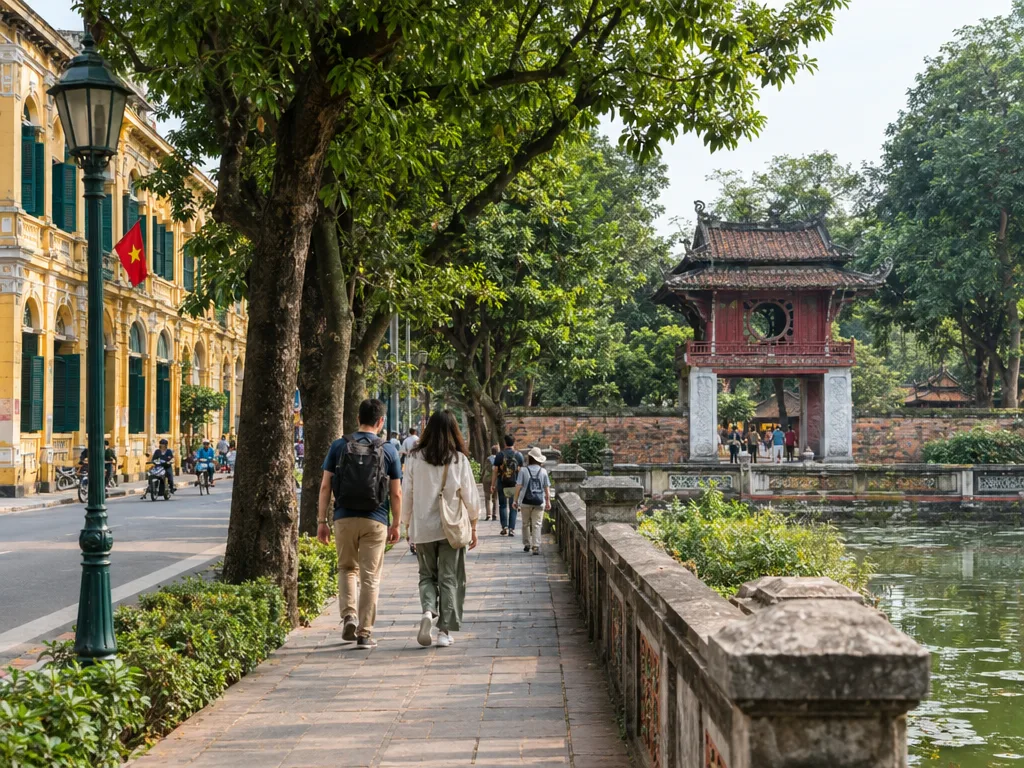
After the museum, continue through the French Quarter with a narrower question: how do buildings communicate their original purpose? Government offices, residences, commercial premises and cultural institutions often use different proportions and entrances. Look at corner buildings, staircases, shutters, rooflines, balconies and the way trees frame the street.
Do not assume every building with a colonial appearance has the same history. A streetscape can contain several periods of construction and repeated renovations. For a responsible walking tour, describe what you can observe rather than making a confident claim about a building’s date or former owner without a reliable plaque or source.
The best photographs often come from transitions: a formal wall beside a repair shop, a mature tree over a narrow pavement, or a carefully maintained entrance next to a building adapted for everyday commerce. These juxtapositions are part of contemporary Hanoi, not imperfections to be edited out.
A simple architecture checklist
- Street edge: is the building set back, flush with the pavement or behind a wall?
- Openings: how do windows, shutters, arches or balconies control light and air?
- Materials: what looks original, repaired, repainted or newly added?
- Use: does the current activity reveal how the building has adapted?
- Context: how does traffic, shade, greenery and signage change the experience?
Stop 4: Add a cultural extension only if your energy allows
A walking route should leave room for judgement. If you still have energy, extend towards another cultural or historic stop in central Hanoi. If the heat is intense, the pavement is crowded or the museum visit took longer than expected, finish with lunch, a café or a shaded walk instead. The value of the route comes from attention, not from collecting a maximum number of pins.
One useful extension is to connect the French Quarter with Hoan Kiem Lake. The lake offers a change of scale and a chance to sit, watch local routines and review the photographs you took earlier. You can also use the final section to compare formal civic streets with the more compressed rhythms of nearby commercial lanes.
For travellers who want a longer heritage day, the Temple of Literature–Quoc Tu Giam is a separate destination rather than a quick add-on. Its official site describes the complex as a special national relic, provides visitor information, and lists daytime access as well as selected evening programming. Check the current programme and access details before making it part of the same day; a ride between areas may be more sensible than forcing a long walk in the afternoon.
Planning the walk by time of day
Early morning
Morning is usually the most comfortable choice for a longer outdoor section. Start with exterior architecture, then move indoors before the day becomes tiring. Morning light can reveal relief, balconies and tree cover without requiring you to stand in the road for a photograph.
Midday
Make midday your museum and meal period. Use the official visitor pages for current opening information, and keep a backup café or indoor stop in mind. Avoid turning an uncertain opening time into the single point on which the whole day depends.
Late afternoon
Late afternoon works well for the final French Quarter loop or Hoan Kiem section. Keep the route shorter if traffic and pedestrian density increase. Golden light is useful, but safety and courtesy matter more than a perfect photograph.
Practical etiquette for walking Hanoi respectfully
Architecture walks pass through working neighbourhoods, not open-air sets. Stay on public pavements, keep voices low near homes and institutions, and do not block entrances while composing a photo. Ask before photographing vendors, residents or staff. If a security guard or official asks you to move on, do so without argument.
Cross roads patiently and predictably. Carry water, protect your phone from sudden rain and keep small essentials secure in busy areas. If you stop for a drink, choose a table that does not obstruct circulation. A good walking day should leave the streets as comfortable for residents as they were when you arrived.
How to turn this route into your own Hanoi walk
Use the route as a framework rather than a test. Architecture lovers can spend longer on façades and museum displays. Families can shorten the exterior sections and build in a snack break. Travellers returning to Hanoi can reverse the route and look for details they missed on a first visit. If you prefer local life to formal landmarks, spend more time on the connecting streets and less time trying to enter every major building.
Before setting out, save the official museum and Temple of Literature pages, check the day’s access information, and mark one indoor alternative. Then choose one question to carry through the walk: how has Hanoi adapted old buildings to new life, how do public spaces shape movement, or what does the city choose to preserve? A route with a question usually produces better memories than a route with the most stops.
Final thoughts
This Hanoi architecture walking tour is a way to read the city in layers: civic grandeur near the Opera House, historical depth inside the national museum, adaptive everyday use in the French Quarter and a calmer finish around the lake or another cultural site. Keep the distances flexible, verify current visitor information and let the street decide when to slow down. The most rewarding Hanoi walks are not always the longest; they are the ones that leave you noticing more than you expected.
JOIN THE CONVERSATION
Comments (0)
No comments yet. Be the first to share a thought.