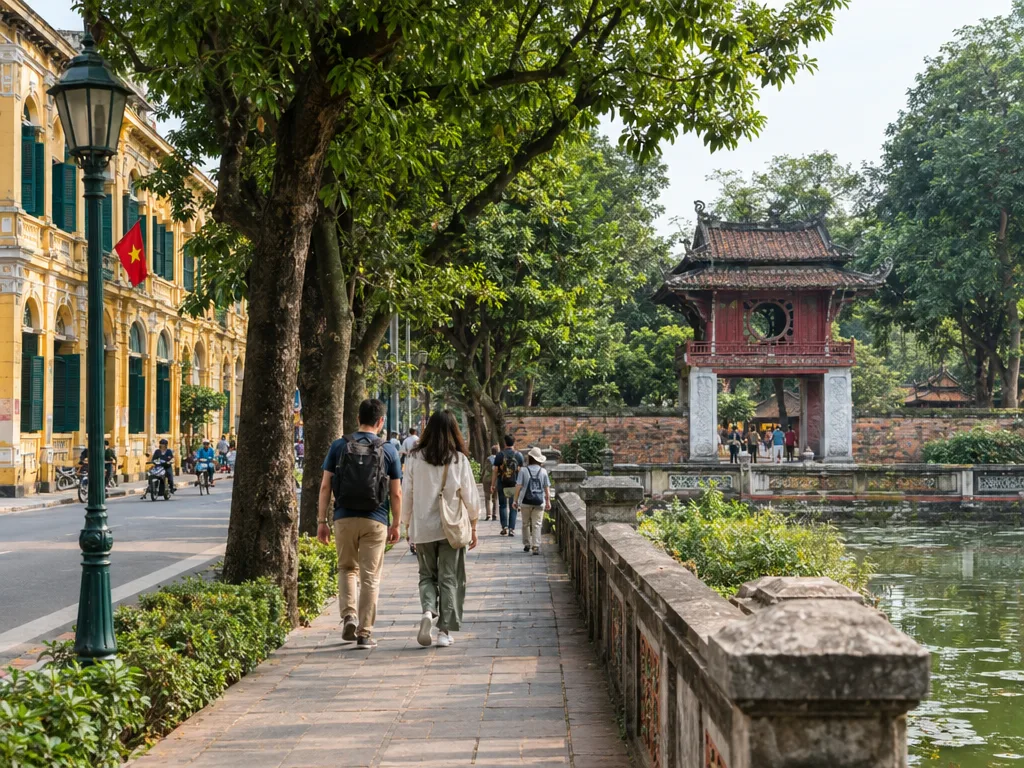
Hanoi rewards walkers who are willing to connect its grand façades with the smaller signs of daily life. This self-guided heritage route moves from the French Quarter toward the Temple of Literature, using museums, civic buildings, shaded streets, and quiet pauses to create a fuller day than a checklist of landmarks. It is designed for curious travellers who want an architecture-and-history walk, but also need a route that can flex around weather, museum interest, and the pace of the city.
The route works best as a loose sequence rather than a race. Begin in the French Quarter, spend time with one substantial indoor stop, continue through streets where Hanoi’s colonial-era planning meets contemporary life, and finish at Van Mieu–Quoc Tu Giam. You can walk the whole outline in a half day at a brisk pace, or turn it into a relaxed full-day itinerary by lingering at the museum, taking a café break, and allowing time inside the heritage site.
What makes this Hanoi heritage walk different
Many first walks in Hanoi concentrate on the Old Quarter’s narrow lanes and Hoan Kiem Lake. This route takes a different angle: it follows the city’s institutional and educational heritage from the French Quarter toward one of Vietnam’s best-known historic sites. The change in atmosphere is part of the experience. Broad avenues, formal buildings, tree-lined streets, embassy walls, schools, small businesses, and residential lanes gradually replace the tight commercial rhythm of the Old Quarter.
The route is also deliberately modular. You do not need to enter every stop to enjoy it. A traveller interested in architecture may spend more time observing façades and street proportions. A history-focused visitor may choose the Vietnam National Museum of History as the central indoor visit. Someone travelling with limited energy can shorten the walk, use a taxi or ride-hailing car between sections, and keep Van Mieu as the main destination.
- Best for: architecture, history, cultural context, photography, and thoughtful neighbourhood walking.
- Plan for: a flexible half day, or most of a day with museum and heritage-site visits.
- Bring: water, comfortable shoes, sun protection, and a phone map for checking your position at quieter intersections.
- Mindset: treat the route as a way to notice how Hanoi’s layers sit together, not as a challenge to collect landmarks.
Start in the French Quarter with a slow visual scan
Begin around the southern and eastern side of Hoan Kiem, where the French Quarter offers a useful introduction to Hanoi’s formal urban character. Instead of rushing directly to a named attraction, take ten minutes to look at the relationship between the street, the pavement, mature trees, balconies, shutters, institutional gates, and newer shopfronts. The value of this opening is comparative: the city becomes easier to read when you notice how different building types share the same streets.
Walk at a pace that lets you pause without blocking doorways or entrances. Look up, but also look across the road: many of the most interesting details are visible as a group rather than from one perfect viewpoint. Notice how cafés, offices, homes, and public-facing businesses adapt older structures for present-day life. This is a living district, so the best photographs are often made from public space without stepping into private courtyards or lingering in front of working entrances.
How to make the opening section useful
- Choose one street with a strong architectural rhythm and follow it for several blocks before turning.
- Use intersections as reset points: check the map, drink water, and decide whether to continue or take a short break.
- Keep the route observational. Avoid presenting every building as a formal attraction when its history or access is not publicly explained.
- Save the most detailed note-taking for places with visitor information, such as museums and heritage sites.
Make the Vietnam National Museum of History your main indoor stop
The Vietnam National Museum of History is a natural anchor for this walk because it gives the surrounding streets a wider national and historical frame. The museum’s official English website identifies its address as No. 1 Trang Tien and No. 216 Tran Quang Khai in Hoan Kiem, Hanoi, and presents permanent and special exhibitions alongside research and educational material. That makes it more than a weather break: it is a place to slow down and build context before continuing through the city.
Allow enough time to choose rather than trying to absorb everything. A useful approach is to enter with one question, such as how objects, images, or displays connect political history with everyday life. After your visit, spend a few minutes outside comparing the museum’s institutional setting with the smaller commercial streets nearby. The contrast helps you see Hanoi as a city where national narratives, local routines, and changing urban uses occupy the same compact area.
Practical planning for the museum section
Check the museum’s own visitor information before setting out, especially if your walk depends on a particular exhibition or service. Its official accessibility page lists buses serving the museum, including routes 02, 34, 44, 49, and 51, while its general information page gives the museum’s Hoan Kiem addresses. Use those details as a transport reference rather than assuming a route or display will remain unchanged. If the weather is hot or wet, make the museum the route’s fixed appointment and let the outdoor sections expand or contract around it.
Walk west by choosing the quieter connection
From the French Quarter and museum area, continue westward in stages rather than forcing one straight line. The most enjoyable connection is usually the one that lets you alternate between a recognisable avenue and a calmer side street. Hanoi walking routes are rarely about perfect pedestrian separation; you will share space with motorbikes, deliveries, residents, and people going to work. Stay alert at crossings, keep your direction predictable, and use a wider road when you need a simpler, more comfortable passage.
This middle section is where the route becomes less about attractions and more about urban texture. Watch for small shrines, school walls, repair shops, tree shade, apartment entrances, and the changing sound of traffic. A short pause beside a wall or in a café can be as valuable as another landmark if it helps you understand the neighbourhood’s rhythm. Keep food and drink stops flexible. Rather than naming a single venue that may change, choose a clean, welcoming place with visible local trade and enough room to rest without occupying a busy table for too long.
A decision point for different walking styles
- For architecture lovers, take the longer connection and focus on façades, rooflines, gates, and street trees.
- For history-focused travellers, shorten the outdoor section and preserve energy for Van Mieu’s internal courtyards and displays.
- For families, add a clear rest stop before the final heritage-site visit.
- For photographers, return in softer light rather than trying to record every detail during the hottest part of the day.
Finish at Van Mieu–Quoc Tu Giam
Van Mieu–Quoc Tu Giam gives the walk a strong ending because it is designed to be experienced as a sequence of spaces rather than a single façade. The official visitor-information page lists regular opening hours of 8:00 AM to 5:00 PM every day, with a separate evening experience from 6:00 PM to 10:00 PM on Wednesday, Saturday, and Sunday. It also identifies the main entrance at No. 58 Quoc Tu Giam Street and additional exit points on Van Mieu Street and near Ton Duc Thang Street.
Inside, resist the temptation to move straight through the central axis. Use the site map and let the gates, courtyards, pavilions, gardens, wells, stelae, halls, and academy area unfold in order. The official page names zones and features including Khue Van Pavilion, the Doctoral Stele Garden, Thien Quang Well, Dai Thanh Hall, and Thai Hoc House. These details give you a useful viewing framework without requiring a rushed historical lecture at every stop.
Respectful visiting matters here
Van Mieu’s visitor regulations ask guests to protect the site, avoid touching or writing on artefacts and buildings, stay off lawns, follow fire-safety rules, and wear respectful attire in shrine areas. Keep voices low in sacred spaces and avoid turning the route into a photo session that blocks other visitors. The official visitor page also lists facilities such as information support, restrooms, a tea house, audio guidance, and on-site commentary, so you can plan a slower finish rather than leaving as soon as you have seen the most recognisable structures.
Use the official details to plan your timing
The route is easiest when you choose a fixed anchor and treat everything else as adjustable. If Van Mieu is the priority, start early enough to arrive while you still have energy for the full complex. If the museum matters most, begin there and walk outward afterward. A morning start generally gives you more room for pauses, but the best time also depends on heat, rain, personal energy, and the day’s opening information.
Build in three kinds of breaks: a short shaded pause, a seated drink or meal, and a transition pause before entering a major site. These are not wasted minutes. They reduce the temptation to cross roads carelessly, photograph private spaces, or hurry through places that deserve attention. If conditions become uncomfortable, split the route into two walks and use local transport for the gap. A good Hanoi itinerary is one you can finish with curiosity intact.
- Before leaving: confirm museum and Van Mieu visitor information on the official websites.
- During the walk: keep water accessible and check the map at natural stopping points.
- At busy crossings: wait for a clear, predictable opportunity and avoid sudden changes of direction.
- At heritage sites: follow posted regulations and staff guidance even when a route looks open.
- Afterward: note which section you would revisit at a different hour, rather than trying to complete every possible detour.
How to walk this route responsibly
A heritage walk passes through places that are both visitor destinations and working parts of Hanoi. Keep voices low outside homes, do not photograph people closely without consent, and leave doorways, shop entrances, and narrow pavements clear. Buy something when you use a small café, dispose of rubbish properly, and avoid treating residential lanes as a backdrop without noticing the people who live there.
Responsible walking also means being honest about what you are seeing. Not every attractive building has a public history, and not every quiet alley is a hidden attraction. Let the city remain ordinary in places. The route is most rewarding when you combine documented visits at the museum and Van Mieu with open-ended observation between them.
Final thoughts
This Hanoi heritage walking route connects two kinds of discovery: the planned knowledge of museums and historic sites, and the unplanned observations that appear between them. Begin with the French Quarter’s formal streets, use the Vietnam National Museum of History to deepen the story, walk west through changing urban texture, and end at Van Mieu–Quoc Tu Giam with time to move respectfully through its spaces. Keep the route flexible, verify practical details before leaving, and allow the city to set part of the pace.
JOIN THE CONVERSATION
Comments (0)
No comments yet. Be the first to share a thought.