Rain does not have to cancel a day on foot in Hanoi. It simply rewards a route with shorter outdoor sections, meaningful indoor stops, and places where you can pause without turning the day into a race. This flexible Hanoi walking route for rainy days links the Vietnam Women’s Museum, Hoa Lo Prison Relic, the French Quarter, and the Vietnam National Fine Arts Museum. You can walk the whole route when the weather is light, or use it as a choose-your-own sequence when showers arrive.
Why this rainy-day Hanoi walking route works
The route is built around a simple principle: walk between destinations, not for the sake of accumulating distance. Hanoi’s central districts are compact enough for a visitor to combine cultural stops with short street sections, but rain changes the practical priorities. You need somewhere to dry off, an indoor activity that can hold your attention, and a route that can be shortened without losing its character.
This plan also avoids repeating the most common Old Quarter loop. Instead, it uses the southern edge of Hoan Kiem and the French Quarter as a bridge toward Ba Dinh. The result is a day with local street texture, historic institutions, changing architecture, and several natural break points. Treat the walking times as planning estimates rather than promises: puddles, traffic, umbrellas, and the pace of a museum visit all change the day.
- Best for: culture-minded travellers, first visits, and weather-flexible half days.
- Suggested rhythm: one indoor anchor, a short walk, a second indoor stop, then an optional extension.
- What to carry: a compact umbrella, shoes with dependable grip, a phone with offline maps, and a small bag that closes securely.
Start at the Vietnam Women’s Museum
Begin at the Vietnam Women’s Museum on Ly Thuong Kiet Street. Its official visitor information places the museum in central Hanoi, about 500 metres from Hoan Kiem Lake and the Old Quarter, making it a practical opening point before or after time around the lake. The museum presents stories about Vietnamese women through history and culture, with permanent displays and collections that give the day a strong human focus rather than a purely architectural one.
Give yourself enough time to look beyond the headline objects. The museum’s themes connect everyday lives, family traditions, work, clothing, and wartime experience. That variety makes it useful on a rainy morning because you can spend a substantial period indoors without needing to rush through every gallery. The museum lists daily opening from 08:00 to 17:00 on its official site; check the current visitor information before setting out, especially around public holidays.
How to use the first stop
- Use the museum as your weather check. If the rain is heavy, stay longer and delay the outdoor section.
- Note one story or object that changes how you see Hanoi’s streets, homes, or neighbourhood life.
- Use the museum’s central location to make a calm decision about lunch before moving on.
Walk north-west through the French Quarter
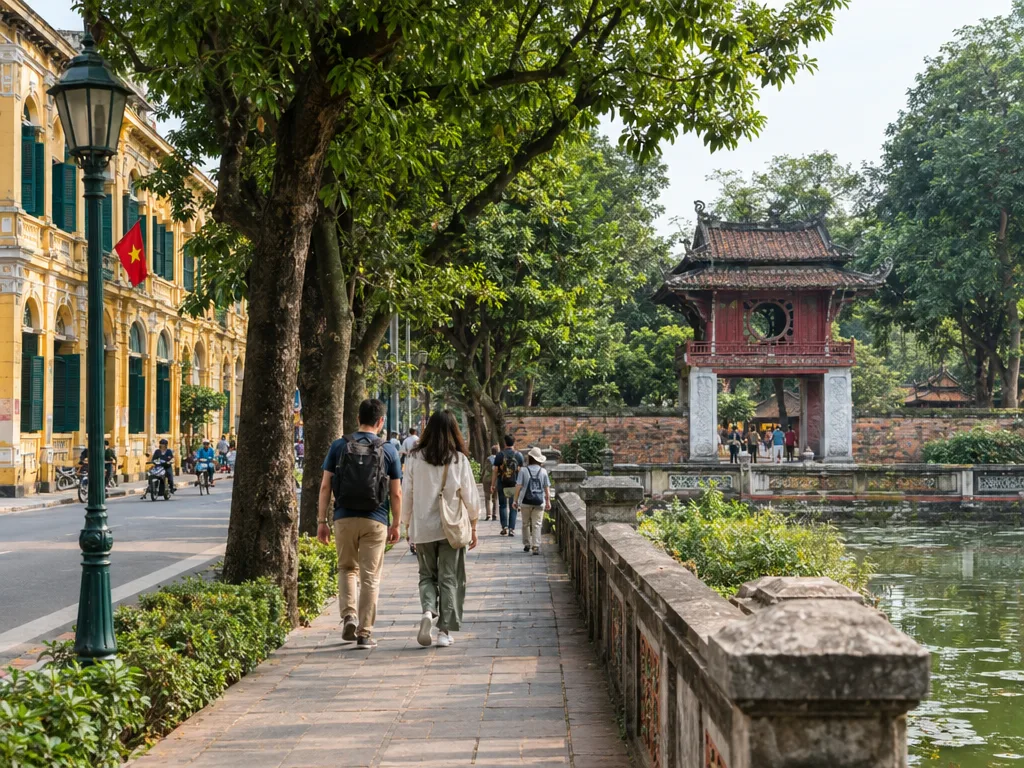
When the rain eases, leave the museum and take a short, unhurried walk through the French Quarter toward Hoa Lo Prison Relic. This section is less about following a perfect line and more about noticing how Hanoi’s urban layers sit beside one another. Look for older façades, institutional buildings, narrow shopfronts, mature trees, and the constant negotiation between pedestrians, motorbikes, deliveries, and rainwater.
Do not treat the pavement as a single uninterrupted walking surface. In wet weather, shop entrances, parked motorbikes, construction edges, and open drains can narrow the usable path. Cross at visible junctions, keep your pace predictable, and let local traffic set the rhythm. If a shower becomes intense, step into a legitimate café or public entrance rather than sheltering in a doorway that blocks someone’s work.
This is also a good point for a flexible food break. Choose somewhere with indoor seating and clear ordering rather than trying to protect a takeaway meal under an umbrella. A short break now makes the next museum more comfortable and keeps the route from becoming a test of endurance.
Make Hoa Lo Prison Relic the historical anchor
Hoa Lo Prison Relic is an especially useful rainy-day stop because its official site describes a substantial permanent exhibition system, including the site’s formation, the detention of political prisoners, the role of the prison as a school of patriotic and revolutionary activity, and later displays connected with American pilot prisoners. The site identifies the relic at No. 1 Hoa Lo Street and lists opening from 08:00 to 17:00 every day, including holidays and Tet. Confirm the latest visitor information before travelling because schedules and access arrangements can change.
Allow the visit to be thoughtful rather than rushed. The material is serious, and the experience is stronger when you give yourself time to read context instead of treating every room as a photo stop. Audio or guided options may be available, but do not assume a particular programme is running unless the official site confirms it for your date.
A respectful way to visit
- Read the introductory context before moving quickly toward the most photographed spaces.
- Keep voices low and follow any photography or visitor instructions on site.
- Build in a quiet pause afterward; a difficult historical visit deserves a little transition time.
Choose your next indoor direction
After Hoa Lo, the route can split according to your energy and the weather. For a compact day, stay near the French Quarter and spend time over lunch, coffee, or a second cultural stop. For a longer cultural walk, continue north-west toward Ba Dinh and the Vietnam National Fine Arts Museum. The choice is more useful than a fixed timetable because rain often arrives in waves.
Option A: stay central
Choose this option when the pavement is flooded, the rain is persistent, or you prefer a slower half day. Walk only as far as the next comfortable indoor stop, then return toward Hoan Kiem by taxi or another suitable transport option if needed. You will still have experienced two substantial museums and a piece of the French Quarter without turning weather into a problem to solve.
Option B: continue to the Fine Arts Museum
When conditions are manageable, continue toward the Vietnam National Fine Arts Museum at 66 Nguyen Thai Hoc in Ba Dinh. The museum’s English-language site says it displays approximately 2,000 special objects and artworks representing Vietnamese art from prehistoric times to the present, while its wider collections contain around 20,000 objects and artworks across different types and media. That makes it a strong second anchor for visitors who want art history after the social and political history of the morning.
Finish with art, architecture, or a short extension
The Fine Arts Museum gives the route a different pace. Rather than asking you to understand one site’s history, it lets you compare materials, periods, and visual traditions. The museum also highlights education activities and a café, which can make the final stop practical as well as cultural. Use the permanent displays as your core visit and treat temporary events as optional; programmes change, so rely on the museum’s current listings rather than an old itinerary.
If the rain has stopped and you still have energy, make a short outdoor extension around Ba Dinh or toward the Temple of Literature area. Keep this part deliberately loose. The value is in seeing the city transition from museum interiors to broad streets, civic buildings, tree-lined edges, and neighbourhood life. If the ground is slippery or visibility is poor, end indoors instead. A good rainy-day route finishes before everyone is cold, wet, and impatient.
Practical planning for a wet-weather walk
Plan by anchors, not by exact minutes
Build the day around two or three destinations and leave open space between them. A route that looks short on a map can feel slow when you are avoiding puddles, waiting at crossings, or drying an umbrella. If you have only half a day, choose the Vietnam Women’s Museum plus Hoa Lo. Add the Fine Arts Museum only when the weather and your attention span support it.
Dress for changing conditions
Quick-drying clothes are more useful than elaborate rain gear, and shoes with traction matter on polished paving. Keep electronics in a sealed inner pocket. An umbrella is helpful, but it should not prevent you from seeing traffic or holding a handrail. If thunder, strong wind, or standing water makes the walk uncomfortable, switch to indoor time and use a short vehicle transfer.
Use food and café stops as recovery points
Choose places where you can sit without blocking service or occupying a table far longer than your order reasonably allows. A bowl of noodles, a simple rice meal, or a coffee break can reset the day. Ask about ingredients when you need to, pay clearly, and keep the route flexible rather than chasing a single famous stop across wet streets.
Sample half-day and full-day versions
For a half day, start at the Vietnam Women’s Museum, take a short French Quarter walk, visit Hoa Lo, and finish with lunch nearby. This version keeps the outdoor exposure manageable while still giving the day a clear beginning, middle, and end.
For a fuller day, add the Vietnam National Fine Arts Museum after Hoa Lo, then choose a short Ba Dinh extension only if the pavement is comfortable. Take a break before the final walk instead of stacking three museum visits without pause. Families and slower walkers may prefer to choose two museums and keep the third as a backup.
For intermittent showers, reverse the order: begin at the Fine Arts Museum, move south when the sky clears, and keep the Vietnam Women’s Museum or Hoa Lo as a later indoor anchor. The route works because each stop is meaningful on its own; you are not dependent on completing every metre.
Rainy-day etiquette and safety
Hanoi remains active in wet weather, so pedestrians share limited space with motorbikes, cars, street vendors, and shop activity. Cross calmly and consistently rather than making sudden movements. Keep umbrella tips away from other people’s faces, avoid photographing people closely without permission, and do not step into homes, temples, museums, or businesses as if they were scenery. If a lane looks flooded, turn around early instead of testing the depth.
Most importantly, let the city be a city. Rain may reveal covered balconies, quieter galleries, steaming kitchens, and small routines that a bright-weather checklist can hide. The goal is not to defeat the weather but to make a route that remains enjoyable when conditions change.
Final route at a glance
- Start: Vietnam Women’s Museum, Ly Thuong Kiet Street.
- Walk: a short French Quarter section, adapting to rain and pavement conditions.
- Anchor: Hoa Lo Prison Relic for a substantial historical visit.
- Optional extension: Vietnam National Fine Arts Museum in Ba Dinh.
- Finish: lunch, café time, or a short outdoor walk only if conditions are comfortable.
This is one of the most useful ways to experience Hanoi on a wet day: combine indoor depth with small outdoor transitions, keep the route reversible, and leave enough room for the city to set the pace.
JOIN THE CONVERSATION
Comments (0)
No comments yet. Be the first to share a thought.