If you want to understand Hanoi on foot, start with a route that is compact enough to follow but loose enough to leave room for discoveries. This Hanoi Old Quarter walking route begins beside Hoan Kiem Lake, threads through the historic street grid, pauses at the covered market, and finishes with a choice of coffee, food, or a longer walk toward the French Quarter. It is designed for first-time visitors who want more than a checklist of famous sights.
Allow roughly half a day at an unhurried pace, or make it a full day by lingering at the lake, eating along the way, and adding one museum or heritage stop. The exact distance depends on your detours, but the core route is manageable without transport. Wear shoes that can handle uneven pavements, keep your route flexible, and remember that Hanoi is experienced as much through its small street scenes as through its headline landmarks.
At a glance: the Hanoi Old Quarter walking route
Start: Hoan Kiem Lake, near the northern shore
Finish: Dong Xuan Market or St Joseph’s Cathedral, depending on your chosen extension
Best for: First-time visitors, photographers, food-minded travellers, and anyone who wants a self-guided Hanoi walking tour
Time: About three hours without long stops; five to six hours with food, coffee, and sightseeing
Style: A flexible loop through lakefront landmarks, craft streets, market lanes, and quieter residential corners
The Old Quarter is often described as a compact historic area of 36 streets, a pattern linked to the trades once concentrated along individual lanes. The idea is more useful than trying to memorise every street name: look for the changes in shop signs, building fronts, smells, and activity as you move between blocks. For more route inspiration, compare this focused walk with our wider guide to Hanoi walking routes before deciding how much time to set aside.
1. Begin at Hoan Kiem Lake
Take a slow first circuit
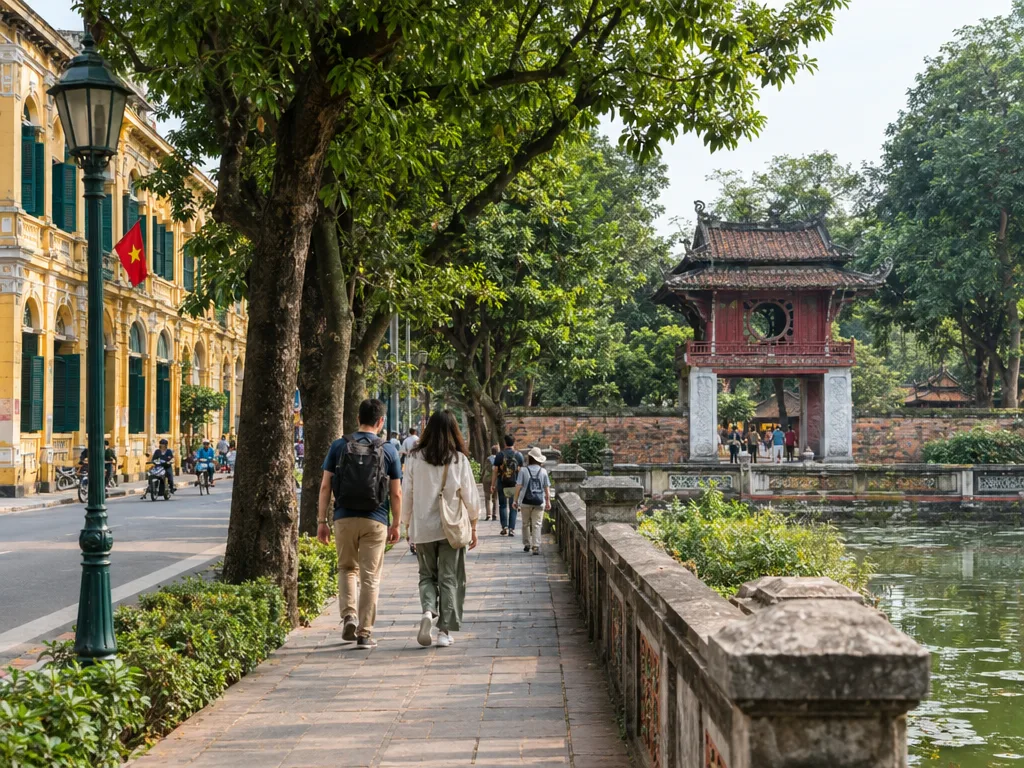
Start at the northern end of Hoan Kiem Lake, where the water, mature trees, and constant movement create an easy introduction to the city. Walk along the eastern shore first, keeping the lake on your right. This opening section gives you a chance to adjust to Hanoi’s traffic and notice how many different activities share the same public space: exercise groups, older residents talking on benches, couples taking photographs, and commuters crossing toward the surrounding streets.
Do not rush straight to the next landmark. The lake is one of the best places to observe Hanoi’s daily rhythm before the lanes become busier. If you are walking early, the light is softer and the pavement is often more comfortable. Later in the morning, the lake remains useful as a visual anchor whenever the Old Quarter’s streets begin to feel confusing.
Choose your first landmark
On the northern side, look toward Ngoc Son Temple and its red bridge on the lake. You can visit if it is open and you want a short cultural stop, or simply continue around the water for photographs. The official Vietnam Tourism guide identifies Ngoc Son Temple as a small, tree-covered island site associated with the lake’s legends and with national hero Tran Hung Dao. Treat the visit as an optional pause rather than the main purpose of the walk: the route works even if you prefer to stay outdoors.
From the lake, head north toward Dinh Tien Hoang Street and then west into the Old Quarter. This is the point where a polished waterfront gives way to tighter streets, low shopfronts, tangled signs, and a more immediate sense of city life.
2. Cross the historic lanes toward Bach Ma Temple
Use the street grid as your guide
Walk west and north through the lanes around Hang Bac, Hang Bo, and Hang Buom. You do not need to follow every named street in order. Instead, use three simple rules: stay generally north-west, pause whenever a lane looks interesting, and return to a larger street if you lose your bearings. The Old Quarter rewards small detours, especially where a busy commercial road opens into a quieter residential passage.
Look up as you walk. Narrow tube houses, balconies, faded painted signs, and newer shopfronts often sit on the same block. At street level, you may see metalwork, snacks, household goods, shoes, flowers, or small shrines. The most revealing moments are not always photogenic: a delivery being unloaded, a family shop opening, or a cook preparing ingredients in a doorway can tell you more about the neighbourhood than another formal viewpoint.
Pause at Bach Ma Temple
Bach Ma Temple is a worthwhile heritage stop in the northern part of the Old Quarter. Its setting is easy to miss among the commercial activity, which is exactly why it works well on a walking route. Spend a few minutes observing the entrance, interior details, and the change in atmosphere from the street outside. Keep your voice low and follow any local instructions about photography or access.
This section is also a good place to take a short refreshment break. Rather than choosing the first large café you see, look for a small place with a steady local turnover and enough space to sit without blocking the pavement. Vietnamese coffee, tea, or a simple cold drink can reset the pace before the market section.
3. Explore Dong Xuan Market without rushing
What to notice inside and around the market
Continue north toward Dong Xuan Market, the route’s busiest visual change. The market and its surrounding streets are useful for travellers who want to understand how Hanoi shops and supplies itself, not just where visitors take photographs. Browse slowly, but remember that this is a working market. Avoid stopping in doorways, ask before taking close-up portraits, and keep bags secure in crowded areas.
Inside, you may see wholesale-style displays, stacked household products, clothing, accessories, dried goods, and other merchandise arranged for speed rather than decoration. Around the market, the streets become a useful lesson in how indoor and outdoor commerce overlap. A market visit does not need to become a shopping mission. Sometimes the best approach is one full circuit followed by a snack on a nearby lane.
If markets are a major reason you travel, continue with our Local Markets & Shopping category for more ideas beyond this route. If the crowds feel intense, step away for ten minutes before deciding whether to continue; Hanoi walking is more enjoyable when you change pace rather than forcing yourself through every busy section.
Choose a food detour
From Dong Xuan, you can make a short food-focused detour through the streets south of the market. Look for a place that is busy at the time you arrive and order what the room appears to be serving most confidently. A small bowl, a grilled snack, or a plate shared at a low table can turn the route into a proper Hanoi Old Quarter itinerary without requiring a reservation.
Keep expectations practical. Street-food stalls change, seating can be limited, and a dish that looks perfect in a photograph may not be available when you arrive. The point of this stop is to eat where the neighbourhood is active, then move on before the route becomes a sequence of meals.
4. Walk south through craft streets and hidden corners
Follow the contrast from busy to atmospheric
Leave the market by walking south through streets such as Hang Ma, Hang Luoc, or Hang Bo, choosing the one that best matches the activity you want to see. Some lanes are strongly associated with particular products, while others have become a mix of cafés, services, residences, and tourist businesses. That mixture is part of the Old Quarter’s character. You are not walking through a preserved film set; you are moving through a living commercial neighbourhood that keeps adapting.
At this point, turn off your map for a few minutes if you feel comfortable. Walk one block parallel to your planned direction, notice the architecture, and then reconnect with a main street. This small experiment often reveals courtyards, repair shops, family altars, and quieter scenes that a point-to-point itinerary misses. It is also a useful way to make the walk feel personal rather than copied.
Add a quieter coffee stop
For a break, head toward the lanes around Hang Trong, Nha Chung, or the southern edge of the Old Quarter. The area offers more chances to find a small café where you can sit above street level or in a tucked-away room. If you want a more detailed approach to choosing a local-feeling stop, read our guide to finding a café that feels like your Hanoi regular.
Use the break to check your energy. If the weather is hot, finish at the cathedral and lake. If you still want another heritage stop, continue beyond the Old Quarter toward the French Quarter or the Vietnamese Women’s Museum. A walking route is successful when it leaves you curious, not exhausted.
5. Finish at the cathedral or extend into the French Quarter
St Joseph’s Cathedral and the southern lanes
St Joseph’s Cathedral makes a natural finish because its open square and surrounding streets feel distinct from the market end of the route. The official Vietnam Tourism guide includes the cathedral among Hanoi’s major sights and notes its Neo-Gothic inspiration. Whether you visit inside or admire it from the surrounding cafés, give yourself time to notice the scale of the building against the narrow streets around it.
From here, you can walk back toward Hoan Kiem Lake in a few minutes, making the route a loop. This is the best option if you began early, have an evening booking, or want to keep the walk to half a day. Alternatively, continue south toward the French Quarter for broader streets, colonial-era façades, and a calmer final section. For a different perspective on combining landmarks and everyday scenes, see this walk balancing Hanoi landmarks with local life.
Optional cultural extension
If you are building a full day, consider using a short taxi or ride-hailing transfer rather than walking every kilometre to reach the Temple of Literature. It is outside the compact Old Quarter loop, but it pairs well with a day focused on Hanoi’s history. The official Van Mieu–Quoc Tu Giam site currently lists the main visitor hours as 8:00 AM to 5:00 PM and gives the entrance at 58 Quoc Tu Giam Street. Check the venue’s own information before going, especially if you are interested in an evening programme.
How to make this Hanoi walking route work well
- Start early or late: Morning brings a calmer lake and active local routines; late afternoon gives you softer light and an easy transition into dinner.
- Carry small cash and water: You will have more flexibility at small stalls and cafés, while water helps on hot, humid days.
- Cross roads patiently: Walk at a steady, predictable pace and avoid sudden stops in the middle of the street.
- Dress for mixed spaces: Light clothing works for walking, but bring something modest for temples or religious sites.
- Save the route offline: The lanes are close together, and a saved map is useful when mobile coverage or attention is limited.
- Respect working streets: Ask before photographing people, do not block shop entrances, and leave room for deliveries and motorbikes.
For more ideas that fit naturally around this route, browse the Hanoi Walking Routes category and the Secret Cafes & Hangouts category. You can also adapt the route around the city’s pedestrian areas and your own interests rather than treating it as a fixed tour.
Final thoughts
This self-guided Hanoi Old Quarter walking route works because it moves through several versions of the city in one outing: the reflective edge of Hoan Kiem Lake, the dense craft streets, the practical energy of Dong Xuan Market, and the more spacious southern lanes. Follow the sequence, but leave room for a snack, a doorway, a small temple, or a street that looks too interesting to ignore. Hanoi is easiest to remember when the route gives you structure without taking away your sense of discovery.
JOIN THE CONVERSATION
Comments (0)
No comments yet. Be the first to share a thought.