Hanoi is easiest to understand on foot when you stop treating the centre as a list of attractions. This slow walking route links the lake, the Old Quarter, a quieter edge of the French Quarter and a short heritage extension. It is designed for travellers who want useful landmarks without rushing from one photo stop to the next. Follow it as a half-day walk, or split it into two gentle outings with a long café break.
Route at a glance: what this Hanoi walk covers
The route begins at Hoan Kiem Lake, threads through the Old Quarter, pauses at the French Quarter and finishes near Hoa Lo Prison Relic. If you still have energy, continue west towards the Temple of Literature. The main walk is best understood as a sequence of changing streets rather than a fixed-distance challenge: open water becomes crowded lanes, then broad colonial-era avenues and finally a quieter cultural district.
Allow roughly four to six hours if you stop for food, coffee and visits. The walking itself is only one part of the experience. The useful question is not “How quickly can I complete Hanoi?” but “Where does the character of the city change?” For a second perspective, compare this route with our guide to the best Hanoi walking routes before choosing your pace.
- Start: the north or east side of Hoan Kiem Lake.
- Core route: lake, Old Quarter lanes, Dong Xuan area, French Quarter and Hoa Lo.
- Optional extension: Hoa Lo to the Temple of Literature.
- Best rhythm: walk for 30–45 minutes, then pause before changing neighbourhood.
1. Start slowly around Hoan Kiem Lake
Begin with one circuit or half-circuit of Hoan Kiem Lake rather than heading straight into the narrow streets. The water gives you a useful orientation point, and the broad public space makes an easier start than a busy lane. Notice how the city gathers here: residents exercising, people meeting, visitors taking photographs and traffic moving around the perimeter. The lake is not merely a landmark to tick off; it is the calmest way to read the centre before the route becomes more intense.
What to notice before leaving the lake
Look for the contrast between open space and dense frontage. The streets around the lake are visually legible, while the Old Quarter quickly becomes a network of short blocks and overlapping signs. Use the lake to decide your walking direction and to set a realistic pace. If the pavement is crowded, stay patient and keep your route flexible rather than stepping unpredictably into traffic.
Hoan Kiem’s pedestrian spaces can operate under temporary adjustments for holidays or civic events. A district notice dated April 25, 2026, shows why visitors should check a current local announcement when a car-free or walking-space schedule matters to their plans: special periods may bring changes. Treat the lake as an adaptable starting point, not a promise of identical conditions every day.
2. Enter the Old Quarter through a useful loop
From the lake, walk north into the Old Quarter and choose a loose loop instead of trying to cover every famous street. A practical sequence is to move through the areas around Hang Bac, Ta Hien, Ma May and Hang Ma, then angle towards Dong Xuan Market. The point is not to memorise street names. It is to watch the urban pattern change: shopfronts become workshops, homes sit above businesses, and a short lane can feel entirely different from the parallel street.
Give yourself permission to turn around. Hanoi’s most rewarding walking moments often come from a small change of direction: a courtyard glimpsed through an open doorway, a quiet residential stretch behind a commercial road, or a row of repair shops that would disappear if you followed only the main sightseeing line. Keep entrances private and avoid blocking narrow lanes while taking photographs.
How to walk the lanes without getting overwhelmed
- Use one major street as your anchor, then explore one or two side lanes.
- Pause at corners rather than stopping in the middle of a shopfront or alley.
- Carry water, but plan drink stops instead of treating the whole route as a timed hike.
- Expect scooters, deliveries and changing pavement conditions; walk predictably.
This is also the section where a market detour makes sense. The site’s Local Markets & Shopping category is a useful companion if you want more context on small shops, bargaining and everyday retail rather than only landmark photography.
3. Use Dong Xuan as the route’s change of scale
Dong Xuan gives the walk a clear middle chapter. Even if you do not shop, the market area helps explain how Hanoi’s Old Quarter works as a working district. Come here to observe movement and supply: people carrying goods, narrow approaches opening into busier commercial spaces, and the way food, household items and travel necessities overlap.
Do not force a long visit if the market feels too crowded. Walk its outer streets, take a short break and continue south or east according to your energy. The best walking route is one that leaves you curious, not exhausted. If you want a more detailed local-life angle, read A Local’s Approach to Markets and Small Shops in Hanoi before turning this section into a shopping mission.
A good break here
Choose a seated stop before leaving the Old Quarter. A short rest makes the next transition easier because the streets begin to feel less compressed. Keep the break practical: refill water, check the next landmark and decide whether you want the French Quarter or the heritage extension. You can also use this moment to shorten the route without losing its main idea.
4. Walk south into the French Quarter
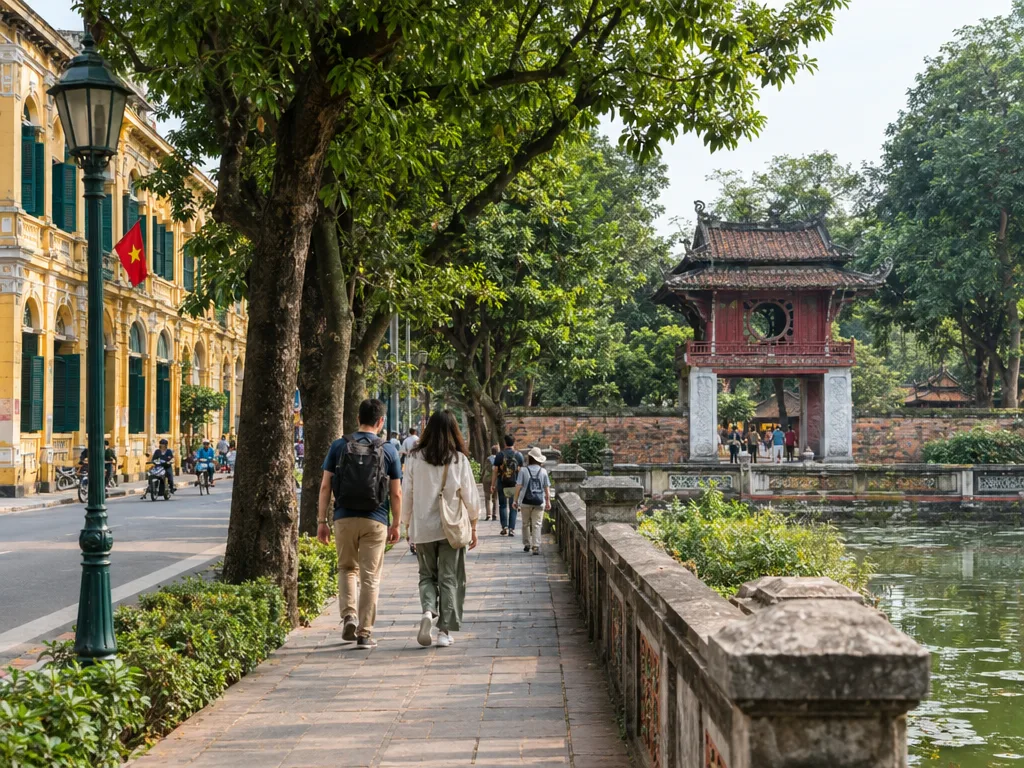
Leaving the Old Quarter towards the French Quarter is one of the most satisfying changes on this Hanoi walking route. The streets generally feel broader, building lines open up and the atmosphere becomes less dominated by tightly packed trade. Walk without chasing a single “best” road. Instead, notice the shift in scale, façades, mature trees and institutional buildings. The route works because the city’s layers sit beside one another rather than being separated into a museum district and a living district.
Use the transition to slow your eyes down. In the Old Quarter, you may focus on signs and doorways; here, look upward and across the street. Observe balconies, gates, setbacks and the relationship between older buildings and newer businesses. This is a good place for a quieter coffee stop, but do not assume every attractive frontage is open to visitors or available for photographs.
Why this section matters
A walking itinerary should explain not only where to go but why the order works. Moving from lake to lanes to wider avenues gives you a visual grammar for Hanoi. You feel the difference in traffic, frontage and public space, and you begin to understand why a short map distance can contain several distinct urban experiences.
5. Finish with Hoa Lo Prison Relic
Hoa Lo Prison Relic makes a strong final stop because it changes the mood of the walk. The official site describes it as a historical relic and lists the address as No. 1 Hoa Lo, Tran Hung Dao, Hoan Kiem District, with opening times of 8:00 to 17:00 every day, including festivals and holidays. Confirm details directly before visiting, but the published information makes it a practical anchor for the southern part of the route.
Allow time to read rather than treating Hoa Lo as a quick photograph. A heritage site carries more weight when you arrive after walking through ordinary streets and commercial areas. The contrast can make the visit feel connected to the city around it, while the exhibits provide a more focused historical experience than the open-ended observations of the Old Quarter.
Check your energy before entering. If you have spent the morning in crowds, a slower, attentive visit will be more rewarding than trying to rush through the displays before another appointment. Keep voices low, follow visitor directions and give yourself a quiet transition afterwards.
6. Optional extension to the Temple of Literature
If you want a longer cultural walk, continue west from Hoa Lo towards Van Mieu–Quoc Tu Giam, the Temple of Literature. This extension changes the route again: the central commercial core gives way to a more spacious heritage setting. The official Van Mieu site identifies the complex as a special national historical site and lists its standard daytime opening hours as 8:00 to 17:00, all days of the week. It also gives the entrance at No. 58 Quoc Tu Giam Street and additional exit points, which is useful when planning the walk rather than relying on a single map pin.
Because opening details and programmes can change, check the official visitor information on the day. The same site also lists evening programming on selected days, but do not build your itinerary around a programme unless the current schedule confirms it. The strongest reason to add Van Mieu is its architecture, courtyards and historical atmosphere, not the promise of a particular event.
When to skip the extension
Skip it if heat, rain, traffic or tired feet are already shaping the experience. A shorter route completed attentively is better than a longer route completed as a march. You can return to the Temple of Literature on another day, perhaps alongside the site’s Art & Creative Spaces recommendations for a broader cultural itinerary.
Practical planning for a comfortable Hanoi walking route
Choose your starting time carefully
Earlier starts usually make the lake and first Old Quarter section easier to enjoy, while later walks may suit travellers who prefer a livelier atmosphere. Avoid assuming that every pedestrian space follows the same timetable. Holiday notices, public events and local arrangements can alter access or crowd levels, so check official district updates when timing is important.
Plan around pauses, not just distance
Hanoi walking is more enjoyable when the route includes deliberate pauses. Use the lake for orientation, the Old Quarter for short observational stops, Dong Xuan for a reset, the French Quarter for a longer drink break and Hoa Lo or Van Mieu for focused visiting. This structure prevents the common mistake of spending all your energy before reaching the quieter, more reflective parts of the walk.
Keep the route flexible
Rain, heat, pavement congestion and unexpected street activity are normal reasons to change direction. The city is easy to experience in sections. If you finish at Hoa Lo, you have still completed a coherent route. If you continue to Van Mieu, you have added a distinct heritage chapter. For more ideas on adjusting your pace and noticing daily details, see this walk balancing landmarks and local life and browse Local Neighborhoods for another day.
Conclusion: walk Hanoi as a sequence of neighbourhoods
This route works because it does not ask one neighbourhood to represent the whole city. Hoan Kiem offers orientation and public space; the Old Quarter brings density and working streets; the French Quarter opens the scale; Hoa Lo adds historical focus; and Van Mieu provides an optional cultural finish. Take the route slowly, check current visitor information for formal sites and walking-space changes, and leave room for the unscripted details that make Hanoi memorable. The best Hanoi walking route is not the one with the most stops, but the one that helps you notice how the city changes under your feet.
JOIN THE CONVERSATION
Comments (0)
No comments yet. Be the first to share a thought.