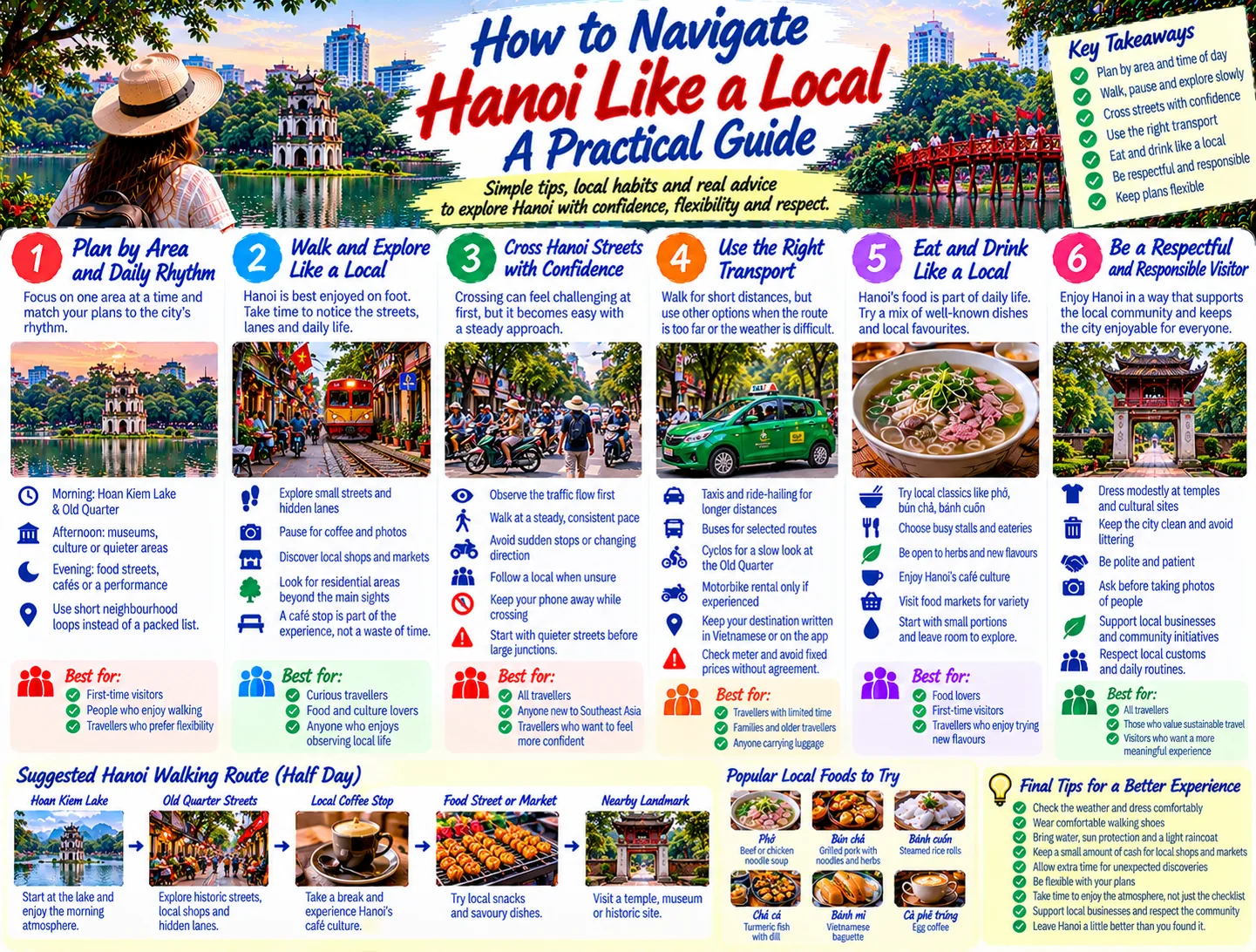
Hanoi becomes easier when you stop treating it as a list of sights and start reading its daily rhythm. The best local-style visit is not about copying every habit or rushing between landmarks. It is about making small decisions well: when to walk, when to pause, how to cross a busy street, which areas deserve a slow morning, and how to leave room for the city’s unplanned moments. This practical guide explains how to navigate Hanoi with more confidence while keeping your plans flexible, respectful, and enjoyable.
Start with the city’s rhythm, not a packed itinerary
Hanoi rewards travellers who divide the day by energy and atmosphere. The centre is most inviting when you give yourself a clear anchor and let the surrounding streets fill in the gaps. Hoan Kiem Lake and the Old Quarter work well as an orientation point because they connect historic streets, food, cafés, cultural sites, and pedestrian-scale walks. The official Vietnam Tourism destination guide describes Hanoi as a capital where old architecture, lakes, street culture, and modern city life sit close together. That mix is exactly why a rigid checklist can feel less satisfying than a loose route.
Choose one main area for each part of the day. A morning can focus on the lake and nearby heritage streets; an afternoon can move towards museums, the Temple of Literature, or a quieter café; an evening can return to the Old Quarter or follow a preselected dinner and performance plan. For a first overview, our guide to experiencing Hanoi like a local in one day is a useful companion. This approach reduces backtracking and leaves enough time to notice details that never appear on a map.
Plan Hanoi by area and walking effort
Use short neighbourhood loops
Think in loops rather than points. A loop might begin beside Hoan Kiem Lake, pass through a few Old Quarter streets, pause for coffee, and finish near a museum or dinner address. Another could pair the Temple of Literature with nearby residential streets and a calmer meal. The goal is not to cover the whole city on foot; it is to create a route with a beginning, a middle, and an easy exit.
Hanoi’s streets change quickly. A broad avenue can lead into a narrow lane, a tourist-heavy corner can become quiet one block later, and a short distance on a map can take longer than expected because of traffic, pavement, heat, or stops. Build in pauses every hour or two, especially if you are travelling in warmer months. A café stop is not wasted time; it is part of the way to experience the city.
Match the route to your interests
Travellers who care about history should prioritise fewer sites and read the context around them. Those interested in daily life may enjoy markets, small food streets, and residential edges more than a long sequence of formal attractions. Creative travellers can use our Art & Creative Spaces category to add galleries, studios, and cultural venues without abandoning a central route. If you want a more deliberate walking plan, see our Hanoi walking routes guide before choosing where to spend your steps.
Learn the practical art of crossing Hanoi streets
Crossing a busy Hanoi street can feel like the first major test of a visit. The most useful mindset is steady observation rather than sudden movement. Find a place where the road is visible, watch the flow, and cross at a consistent pace when there is a reasonable gap. Avoid stepping backwards or changing direction halfway through simply because a motorbike appears; predictable movement makes it easier for road users to read you.
Start with quieter side streets before attempting a large junction. Follow a local pedestrian’s example when the situation is unclear, but do not assume that every crossing is identical. At night or in rain, visibility and stopping distances can change, so slow down and choose a better-lit route. Keep your phone away while crossing, and finish navigating before you step into traffic. This is less about mastering a trick than about giving yourself time to observe.
Walking shoes with a secure sole help because pavements may be uneven, occupied by parked motorbikes, or interrupted by driveways. Treat the pavement as shared space: move around obstacles without blocking entrances, and be patient when a shop or home is using the edge of the street.
Choose transport according to the journey
Walking is often the best choice for short central hops, but it should not become a rule. The official Vietnam Tourism transport guide notes that cities offer taxis, buses, and cyclos, while also warning that transport choices require planning around distance and road conditions. In Hanoi, use a car or taxi-style ride when the route is too far, the weather is difficult, or you are carrying luggage. A short ride can protect your energy for the neighbourhood you actually came to explore.
Make transfers simple
Keep the next destination written in a form a driver or app can recognise, and check the route before you leave. If you are using a traditional taxi, confirm the company and meter rather than accepting an unclear fixed price. The official tourism safety guidance specifically warns travellers about rigged meters, overcharging, confusing currency, and fixed-price taxi scams, so clarity is a sensible habit, not an accusation.
Cyclo rides can suit a slow look at the historic centre, but agree on the route and total price before starting. Motorbike rental is a different decision: the official transport guidance advises wearing a helmet, securing the vehicle, and checking the ticket number when parking. If you are not already comfortable riding in dense urban traffic, choose a car, taxi, or guided option instead of turning your holiday into a driving lesson.
Use food and coffee as navigation anchors
One of the easiest ways to make Hanoi feel less confusing is to plan around meals. Instead of searching for a single “best” restaurant across town, choose a dish or food style you want to try and look for a convenient stop near your route. This keeps eating integrated with the neighbourhood rather than forcing a long detour for every meal.
For a first day, think in contrasts: a quick breakfast, a substantial lunch, an afternoon drink, and a lighter evening snack. Small stools and counter seating can be part of the experience, but choose places where the setup feels clean and the turnover is healthy. Vietnam Tourism’s safety advice recommends using judgement with street food, favouring freshly cooked food and places with a strong flow of customers, and staying hydrated.
Coffee is also a useful pause between decisions. A local café may be tiny, tucked upstairs, or easy to miss from the street. Do not judge every place by its exterior. Enter politely, check whether there is seating, and keep your visit relaxed rather than treating the room as a photo set. Our Secret Cafes & Hangouts category can help you build a slower café-focused detour.
Handle markets, shops, and small purchases calmly
Local shopping is more enjoyable when you separate browsing from buying. Walk through a market once before committing to a purchase, notice the range of products, and compare quality rather than reacting to the first quoted price. A friendly question about material, size, or how an item is made often creates a better conversation than immediately bargaining.
Keep cash organised and avoid displaying a large wallet in crowded lanes. The official safety page identifies petty theft as a concern in big cities and advises keeping cameras and phones close to the body, particularly near busy streets. Carry only what you need for the outing, use a zipped bag, and pause at the side of the pavement before checking directions or money.
When entering a small shop, greet the seller and ask before photographing people, displays, or work in progress. If you decide not to buy, a clear thank-you is enough. For a broader approach to independent shops and market browsing, read our local markets and small shops guide.
Respect the difference between a public street and a cultural site
Hanoi’s daily life often unfolds in public view, but not every visible scene is an invitation to participate. At temples, memorials, religious sites, and historic buildings, lower your voice, dress with awareness, and watch what residents are doing before taking photographs. If a sign or staff member gives a specific instruction, follow it even when another visitor is ignoring it.
The official Hanoi destination page highlights places such as Hoan Kiem Lake, the Temple of Literature, the Ho Chi Minh Mausoleum Complex, and the Imperial Citadel of Thang Long as distinct parts of the city’s heritage landscape. Treat them as places with their own atmosphere rather than interchangeable photo stops. Remove hats when appropriate, do not touch objects, and ask before photographing ceremonies or workers.
At the same time, do not over-romanticise ordinary life. A family eating dinner, a person working, or a school group passing by does not automatically make a good social-media subject. A respectful visitor notices first and records less.
Adjust your day for season, heat, and air quality
Hanoi has four distinct seasons, and the official tourism guide identifies September to November as a particularly favourable period, with cooler and drier autumn conditions. It also describes hot, humid summers and cool, drizzly winters. Use that broad pattern to plan effort, but check the forecast close to your trip because daily conditions can vary.
In warm weather, place your longest outdoor walk early, take a real midday break, and carry water. Sun protection matters even when the sky looks hazy. In cooler or rainy weather, allow more time for pavements and traffic, and keep one indoor alternative ready. Travellers with asthma or allergies should take air quality seriously; the official health guidance notes that pollutants can aggravate symptoms in metropolitan areas.
Do not make the itinerary prove your stamina. A comfortable day with two memorable areas is better than a hot, hurried day that turns every later decision into a chore.
Build an evening plan with an easy way home
Hanoi after dark can be lively, but a good evening is easier when the final transfer is decided before dinner. Pick one main activity—food, a performance, a night walk, or a neighbourhood drink—and keep the route compact. Our guide to things to do in Hanoi at night can help you compare a few evening styles without overloading the plan.
Keep valuables out of sight, especially near busy roads, and avoid using your phone at the kerb. Vietnam Tourism advises travellers to keep cameras and phones close to the body because drive-by snatchings can occur in crowded cities. If you are tired, travelling alone, or returning late, choose the straightforward ride rather than adding one more stop.
Small habits that make the whole visit smoother
Save your accommodation address offline before leaving for the day.
Carry tissues, water, and a small amount of cash, but keep valuables discreet.
Confirm meeting points using a recognisable landmark, not only a street name.
Leave extra time when crossing the city for a reservation or timed entry.
Ask before photographing people, homes, workshops, or religious activity.
Keep one flexible block in the day for a café, market, or unexpected street.
These habits are simple because they reduce friction rather than trying to control Hanoi. They also leave you more attentive to the city’s details: a quiet lane behind a busy street, a family-run counter, a lakeside pause, or a conversation that changes your plan.
Conclusion: travel like a considerate regular
To navigate Hanoi like a local, you do not need perfect Vietnamese, expert traffic instincts, or a schedule filled with hidden spots. You need a manageable route, steady attention, sensible transport choices, and respect for the people who live around the sights. Plan by neighbourhood, pause often, protect your energy, and let food, coffee, and everyday streets shape the day. The result is a visit that feels more connected—and usually more memorable—than one spent racing from landmark to landmark.

JOIN THE CONVERSATION
Comments (0)
No comments yet. Be the first to share a thought.