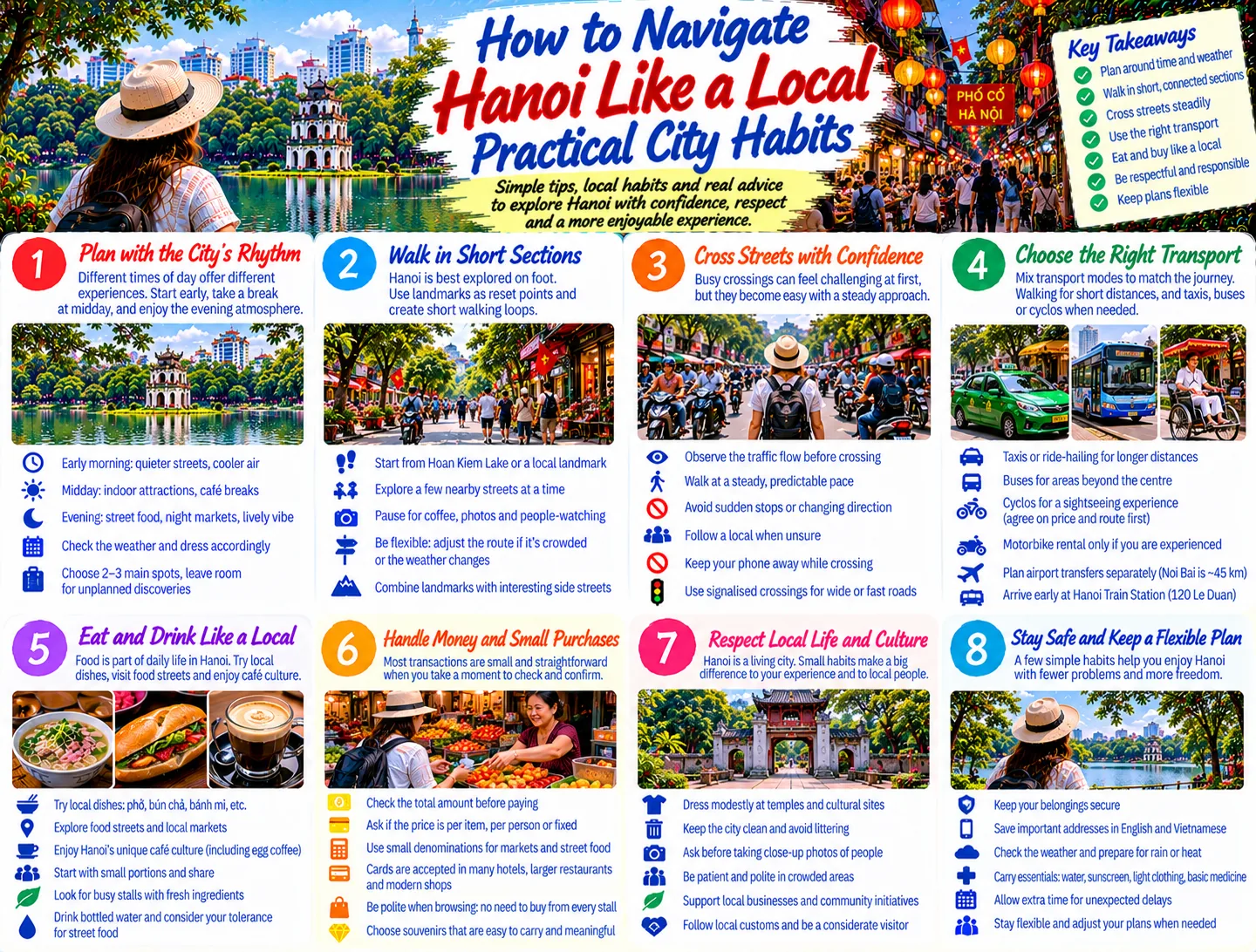
Hanoi is easier to enjoy when you stop treating it as a checklist of sights and start noticing how the city moves. Breakfast happens early, narrow streets change character by the hour, and a short walk can be more useful than a long transfer. This practical guide explains how to navigate Hanoi like a local: when to walk, how to cross busy streets, how to choose transport, how to behave in shared spaces, and how to plan your day around heat, rain, meals, and neighbourhood rhythm.
Start with the right Hanoi rhythm
The most useful local habit is to plan around time rather than distance. Hanoi’s centre is compact on a map, but the experience of the same street can be completely different in the morning, at midday, and after dark. Begin early if you want quieter lanes, cooler air, and a better chance to see ordinary routines before the sightseeing crowds arrive. Save indoor attractions, longer café stops, or a slower lunch for the hottest part of the day, then return outside later.
The official Vietnam Tourism page describes Hanoi as a city of historic streets, lakes, shaded boulevards, street culture, and four distinct seasons. That combination rewards flexible planning. Autumn is commonly presented as a particularly comfortable period, but visitors should still check the forecast for their dates rather than assume every day will be cool or dry.
A good first-day pattern is simple: choose one central area, explore it on foot, pause often, and leave room for an unplanned turn. The existing guide to experiencing Hanoi like a local in one day is useful for a broad itinerary; this guide focuses on the small decisions that make that itinerary work in real streets.
Walk in short, connected sections
Walking is often the best way to understand central Hanoi, but “walkable” does not mean you should cover the whole city in one push. Build short loops around a landmark, lake, market, or cluster of side streets. A 20-minute walk followed by a drink or snack is usually more enjoyable than forcing a long route through traffic and heat.
Use landmarks as reset points
Hoan Kiem Lake is a natural orientation point. From there, you can decide whether to continue into the Old Quarter, move towards the French Quarter, or stop and reassess. The official destination guide identifies the lake, Ngoc Son Temple, the Old Quarter, the Temple of Literature, the Imperial Citadel of Thang Long, and the Ho Chi Minh Mausoleum Complex as major points of interest. You do not need to combine all of them in one day. Choose two or three that fit your energy and interests, then let the streets between them be part of the experience.
For route ideas, compare this approach with the site’s Hanoi walking routes for curious travellers. The practical difference is to treat each route as a set of optional segments. If rain starts, your feet are tired, or a street feels too crowded, end the segment and continue by car or taxi without considering the day a failure.
Cross streets steadily, not dramatically
Busy crossings can feel intimidating because motorbikes flow around pedestrians rather than stopping in the same way drivers may at home. Look carefully, choose a visible gap, walk at a steady and predictable pace, and avoid sudden reversals. Follow a local’s example when you can, but do not step out while looking only at your phone. If the crossing feels too wide or fast, wait for a calmer moment or use a signalised crossing. Confidence comes from predictability, not from rushing.
Choose transport by the task
Hanoi rewards mixing transport modes. Walking suits central sightseeing; a taxi or ride-hailing car is useful when rain, heat, luggage, or distance changes the calculation; buses can make sense when you are travelling beyond the centre and have time to learn the route. Cyclos can be a sightseeing experience, but clarify the route, duration, and total price before setting off rather than treating the ride as an informal negotiation after arrival.
Vietnam Tourism’s transport guidance notes that cities offer taxis, buses, and cyclos, while motorbikes are a common way to cover short distances. The same page advises novice motorists to be careful, wear a helmet, and never leave a motorbike unattended. For most first-time visitors, renting a motorbike is not necessary to experience Hanoi well. If you are not already comfortable riding in dense urban traffic, walking and booked car rides are the lower-stress choice.
Plan airport and station transfers separately
Do not judge every Hanoi journey by your first airport transfer. The official Hanoi destination page places Noi Bai International Airport about 45 kilometres from the centre and lists airport bus, taxi, and ride-hailing as options. That is a different problem from moving between central neighbourhoods. Arrange enough time for the airport journey, keep your accommodation address saved in both English and Vietnamese if possible, and confirm where a booked vehicle will meet you.
For trains, Vietnam Tourism lists Hanoi Train Station at 120 Le Duan and recommends researching current conditions before travel because rail infrastructure changes over time. If you are catching a train, arrive with time to locate the correct entrance and platform rather than assuming the station experience will resemble an airport. Keep your ticket and destination details accessible offline.
Handle money, meals, and small purchases calmly
Daily life in Hanoi involves many small transactions: a coffee, a bowl of noodles, a short ride, a market purchase, or a drink at a pavement table. The easiest habit is to slow down before paying. Check the amount, clarify what you are buying, and keep smaller notes available. If a price is unclear, ask before ordering. A polite question is easier than trying to resolve a misunderstanding after the meal.
Street food is part of Hanoi’s identity, and the official tourism guide highlights pho, bun cha, cha ca, banh mi, egg coffee, and bia hoi among the city’s signature flavours. You do not need to find every famous dish in one day. Instead, choose places that look busy with local customers, observe how the seating and ordering work, and begin with a modest portion if you are unsure what you will enjoy.
Respect the pace of a pavement meal
Small stools and low tables are not a performance staged for visitors; they are part of how many people eat, meet, and take a break. Keep bags close without blocking the footpath, leave room for people to pass, and avoid turning a compact table into a photo set. If you want a picture, ask permission when another person is clearly in the frame. The goal is to participate lightly, not to make ordinary life stop for your camera.
For more context on everyday routines, the site’s guide to experiencing everyday life in Hanoi pairs well with this practical approach. You can also browse the Local Lifestyle & Daily Life category for stories about how neighbourhood habits shape the visitor experience.
Dress and behave thoughtfully at cultural sites
Hanoi mixes lively commercial streets with temples, memorial sites, museums, and historic compounds. Treat each setting according to its character. At religious or formal heritage places, choose clothing that covers shoulders and knees when practical, lower your voice, and follow posted instructions. Remove hats or footwear when a sign or staff member asks you to do so. Do not climb on monuments, lean across barriers, or touch objects simply because other visitors are taking photographs nearby.
At busy attractions, patience is a practical skill. Join the visible queue, allow people to exit before entering, and keep your group from spreading across a doorway. If photography is restricted, accept the rule rather than trying to find an angle around it. These behaviours are small, but they make interactions with staff easier and reduce the chance that a rushed visit becomes uncomfortable.
Hanoi’s creative and cultural life extends beyond major landmarks. When you want a quieter indoor stop, explore the site’s Art & Creative Spaces category, which can help you build a day around exhibitions, studios, and independent cultural places rather than only headline attractions.
Protect your comfort without overplanning
Local-style travel is not the same as ignoring your needs. Hanoi can be hot, humid, rainy, or cool depending on the season and the day. Carry water, protect yourself from the sun, and keep a light rain layer available when the forecast is uncertain. Build in shade and indoor pauses instead of waiting until you are exhausted. If air quality affects you, shorten long roadside walks and choose quieter streets or indoor stops.
Vietnam Tourism’s health and safety guidance advises travellers to prepare for heat, dehydration, pollution, food-related illness, and petty theft. It specifically recommends keeping cameras and phones close to the body on busy streets because drive-by snatching can occur. That is useful advice for Hanoi’s traffic: avoid holding a phone out over the road while standing at the curb, and secure your bag before entering a crowded lane or sitting on a motorbike.
Use a simple evening safety routine
Before going out, save your accommodation name and address, charge your phone, and decide how you will return. If you use a taxi, check the vehicle and the destination before leaving. The official safety page discusses taxi overcharging and recommends established operators; for any ride, confirm the quoted fare or app details and keep your belongings with you. When returning late, choose a well-lit route and a direct ride rather than adding a long walk because it looks short on a map.
These are not reasons to avoid Hanoi at night. They are ways to keep your attention on the food, music, markets, and street life. For a route-based evening plan, see the local Hanoi night route, then adjust it to your energy and transport options.
Build a local-feeling day from decisions, not rules
A local-feeling Hanoi day is less about copying a perfect routine and more about making sensible choices as conditions change. Start with one clear anchor, such as the lake, a museum, a market, or a meal. Add one nearby activity, then leave an open block for wandering, resting, or following a street that looks interesting. This prevents the common mistake of spending the entire day crossing town between disconnected stops.
Choose a neighbourhood cluster before choosing a long list of attractions.
Walk in short sections and use a ride when distance, weather, or luggage makes it sensible.
Order slowly, confirm unclear prices, and watch how locals use a space before joining in.
Keep phones, cameras, and bags secure near busy roads.
Leave extra time for transfers, queues, rain, and the simple pleasure of sitting down.
For a broader collection of practical ideas, browse the site’s Insider Tips & Local Stories category. It complements the more specific advice here without turning your trip into a rigid schedule.
Conclusion: let Hanoi set the pace
The best way to navigate Hanoi like a local is to stay observant and adaptable. Walk when the streets are the destination, choose transport when it solves a real problem, eat with curiosity, and treat shared spaces with care. Keep your plans loose enough for weather and neighbourhood life to change them. With those habits, Hanoi becomes easier to read: a city of short journeys, layered routines, and rewarding details that rarely appear on a checklist.

JOIN THE CONVERSATION
Comments (0)
No comments yet. Be the first to share a thought.