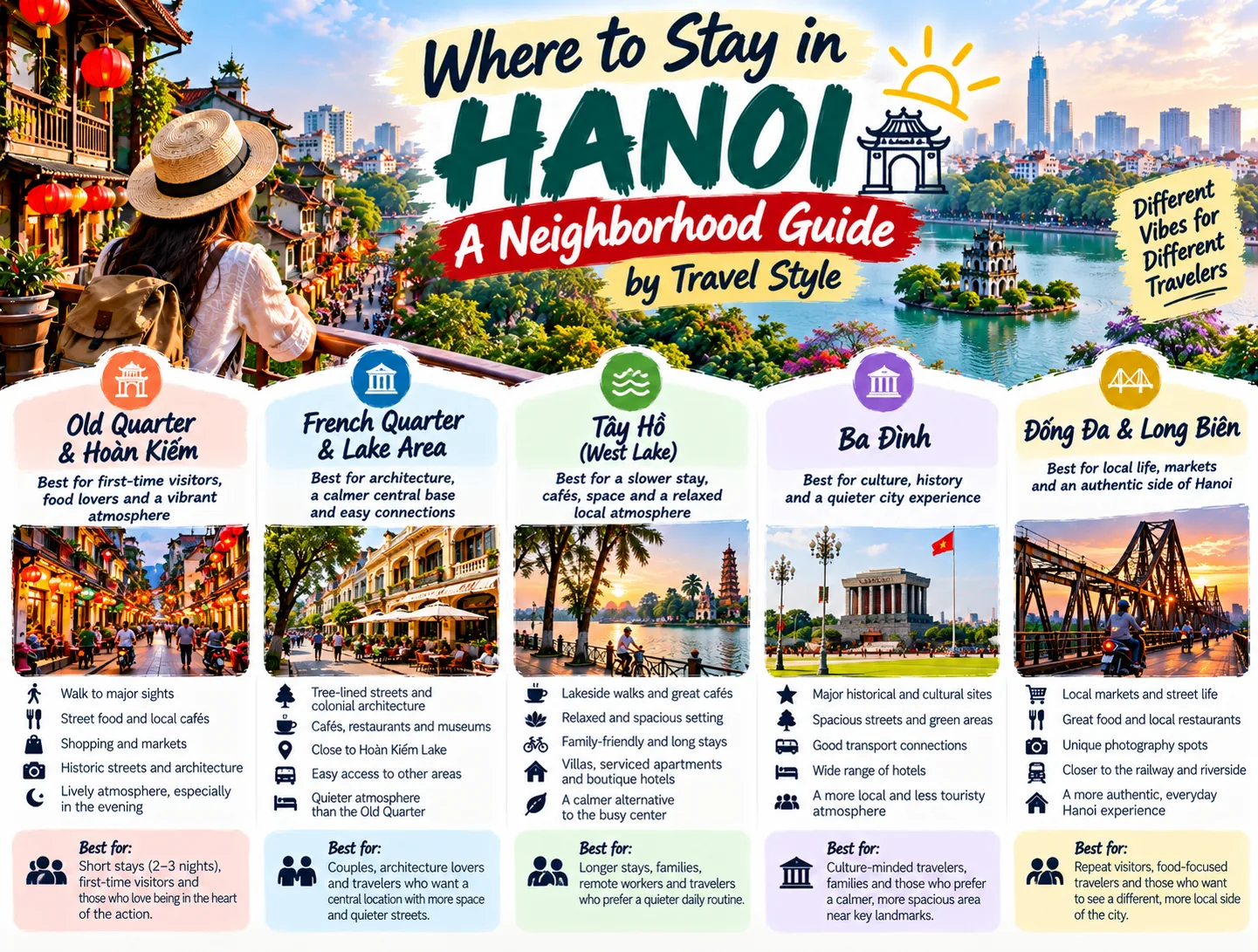
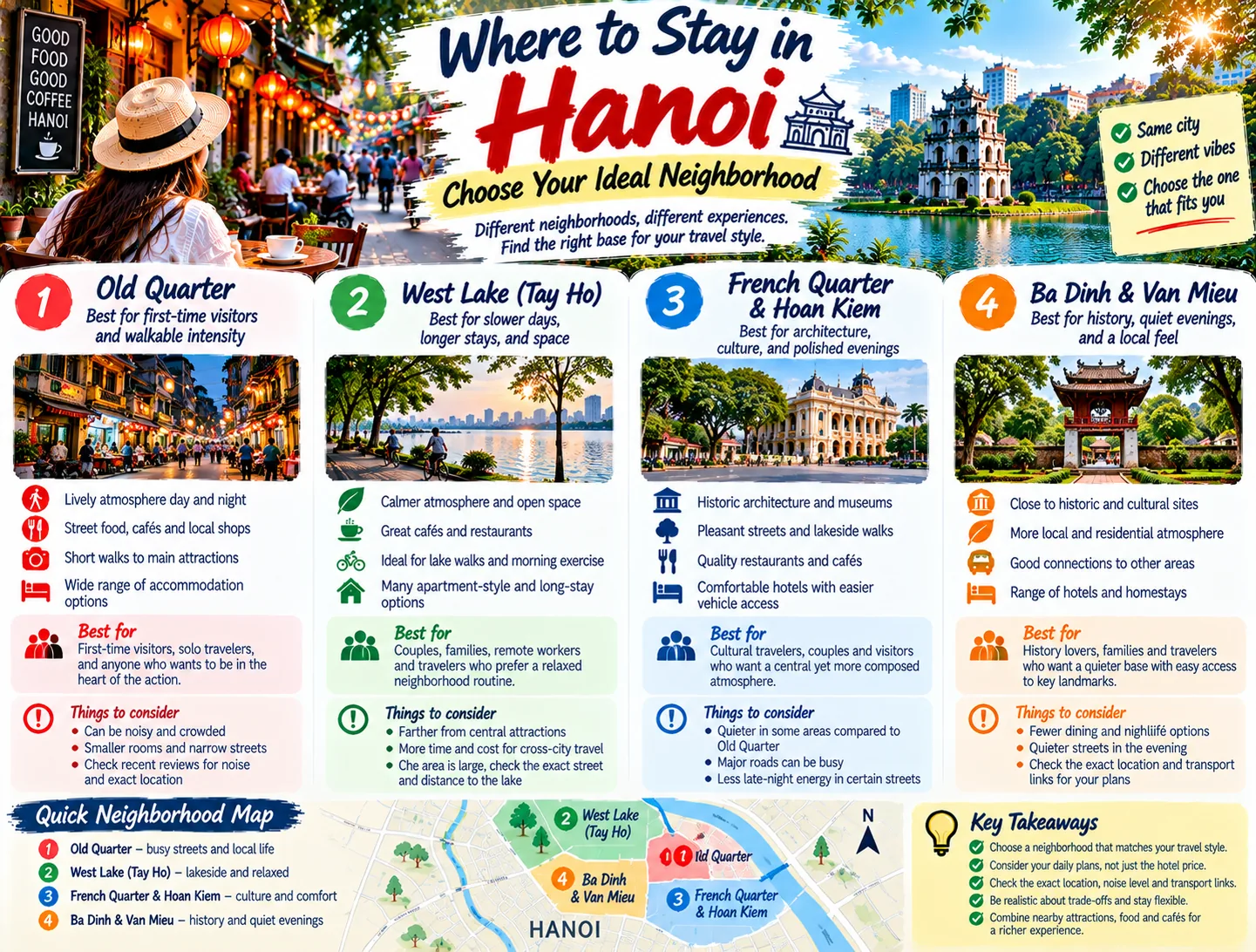
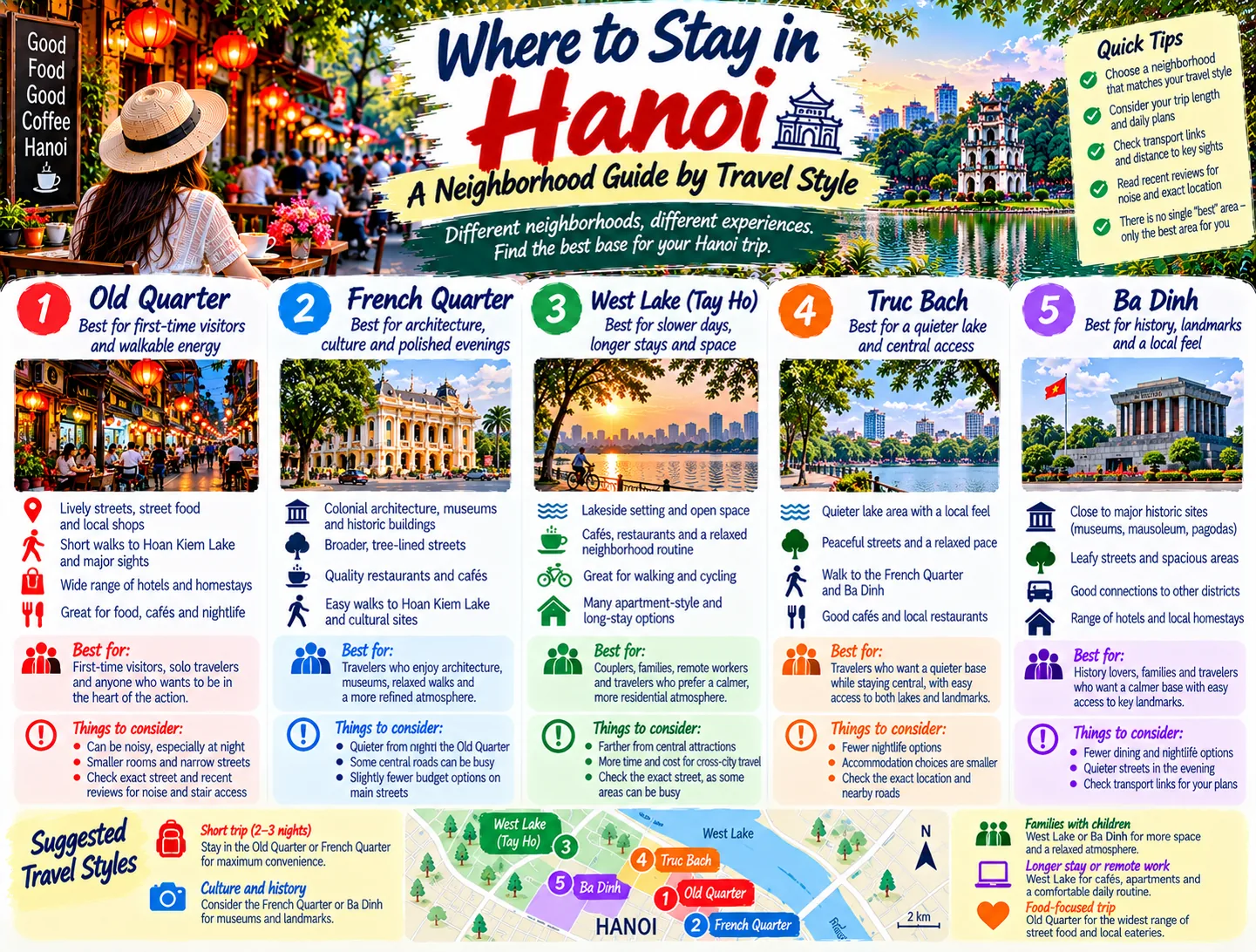
Hanoi is easiest to understand as a collection of neighborhoods rather than one sightseeing zone. The Old Quarter is busy, layered, and walkable; French Quarter streets feel more spacious and architectural; West Lake slows the day down; Ba Dinh brings major civic and historic landmarks; and Tay Ho mixes long-term residents, international life, lakeside cafés, and quieter lanes. This guide to the best neighborhoods in Hanoi helps you choose where to stay, what each area is good for, and how to link several districts without spending the whole day in traffic.
The aim is not to rank one neighborhood above the rest. It is to match the place to your travel style. Use this with our guide to getting to know Hanoi one neighbourhood at a time, then build a route around one or two areas instead of trying to cover the entire city at once.
Old Quarter: the best neighborhood for a first taste of Hanoi
Choose the Old Quarter if you want the strongest concentration of street life, casual food, small shops, heritage façades, and evening energy. Its appeal is density: a short walk can move you from a market edge to a temple courtyard, from a narrow commercial street to a lake promenade. It is the most obvious base for first-time visitors who want to step outside and immediately feel part of the city.
What to do here
- Walk early, before the streets become most crowded, and notice the different trades and shopfronts by lane.
- Use Hoan Kiem Lake as a calm reference point when the surrounding streets feel confusing.
- Plan food stops rather than one formal meal: a bowl of noodles, a small coffee, fruit, or a bakery visit can become part of the route.
- Return after dark for a different atmosphere, but keep valuables secure and leave room for motorbikes and delivery traffic.
The Old Quarter suits travelers who like spontaneity. It is less comfortable for anyone expecting broad pavements, silence, or a predictable grid. Accommodation can also vary sharply from one street to the next, so inspect the exact lane and entrance rather than judging a hotel only by its district name.
French Quarter: a slower historic center
South and southeast of the lake, the French Quarter offers wider streets, formal civic buildings, mature trees, museums, hotels, and a more spacious rhythm. It is a useful choice when you want central access without being surrounded by the Old Quarter’s tightest lanes. The area works especially well for travelers who enjoy architecture and want to combine culture with comfortable walking.
Who should choose it?
Stay or spend an afternoon here if you prefer a calmer base, are interested in Hanoi’s colonial-era urban layers, or want an easy transition between Hoan Kiem and the city’s cultural institutions. The French Quarter is also a good buffer for a mixed itinerary: start with the lake, continue through shaded streets, then head toward museums or the Opera House area without repeatedly crossing the busiest Old Quarter corridors.
Do not treat the French Quarter as a museum district that closes after lunch. Its value is in the contrast between grand façades and ordinary daily movement. Look for side streets, local cafés, office workers at midday, and the changing light on tree-lined avenues. For a broader route that balances famous sights with residential detail, see this walk through Hanoi’s landmarks and local life.
Ba Dinh: landmarks, shade, and a more civic atmosphere
Ba Dinh is the neighborhood to consider when history, national institutions, and open public spaces matter more than nightlife. It contains some of Hanoi’s most important political and historical landmarks, along with broad avenues and quieter residential streets. The district feels less compressed than the Old Quarter, making it easier to build a half-day route with pauses.
How to explore Ba Dinh thoughtfully
- Check official visitor information before setting out for major monuments, because access arrangements and opening policies can change.
- Begin in the morning if you want cooler walking conditions and a more spacious experience around the landmark zone.
- Pair formal sights with a slower street segment rather than stacking several large attractions back to back.
- Dress and behave respectfully around religious and civic sites; follow posted photography and entry instructions.
Ba Dinh is a strong fit for repeat visitors who have already sampled the center and want more context. It is also practical for families and travelers who find dense traffic tiring. The trade-off is that spontaneous restaurant-hopping is less concentrated than in the Old Quarter or Tay Ho.
West Lake and Tay Ho: the best neighborhood for breathing room
West Lake, or Ho Tay, changes the scale of Hanoi. The water, long shoreline, villa lanes, temples, restaurants, and cafés create a district where the point is often the pace rather than a checklist of attractions. Tay Ho, on the lake’s eastern and northern edges, is popular with long-term foreign residents, Vietnamese families, creative workers, and visitors looking for a longer stay.
What makes Tay Ho different
Tay Ho is not one uniform strip. Some roads are busy with restaurants and services; other lanes quickly become residential. The best experience comes from choosing a small zone and exploring it on foot, by bicycle, or with a short ride between stops. Lakeside light is particularly rewarding around late afternoon, but weather and visibility can affect the experience, so keep an indoor café or meal as a flexible backup.
This neighborhood suits travelers who want space, brunch or café culture, sunset walks, and a less compressed base. It is less ideal if your main priority is walking to every central landmark. A ride to the Old Quarter may be straightforward, but traffic conditions make journey times variable. For café decision-making across the city, read how to find a café that feels like your Hanoi regular.
Truc Bach and the lakeside transition zone
Truc Bach is a useful middle ground between central Hanoi and West Lake. The smaller lake, waterside streets, food businesses, and proximity to Ba Dinh make it appealing to visitors who want a neighborhood feel without moving as far west as Tay Ho. It can work as a gentle introduction to Hanoi’s residential side: close enough to reach major sights, but relaxed enough to reward aimless wandering.
Spend time here by following the water, looking for local meal options, and connecting the area with nearby historic sites. The district is best treated as part of a linked route rather than a single attraction. Start from the Old Quarter, move north toward the lakes, pause for food, then decide whether to continue into Ba Dinh or return toward the center.
Dong Da and the city’s everyday urban texture
Dong Da is a better choice for visitors who want to observe ordinary Hanoi away from the postcard center. It is busy, lived-in, and varied, with universities, markets, apartment areas, local eateries, and arterial roads that reveal how the city functions beyond the tourist core. The district rewards patience: the interest is in small scenes, not a compact list of headline sights.
When to visit Dong Da
Choose Dong Da for a daytime exploration when you want local markets, affordable food, and a sense of how residents move through work, study, and family routines. Avoid forcing it into a rushed evening itinerary. Traffic can make crossings slow, and the most rewarding streets are often discovered by following a practical errand rather than a fixed attraction map.
Visitors who enjoy this side of the city should also read our guide to experiencing everyday life in Hanoi. It provides useful context for observing daily routines without turning neighborhoods into a performance staged for tourists.
How to choose the right Hanoi neighborhood
For a first visit
Choose the Old Quarter or the French Quarter if you have only a few days and want central access. The Old Quarter maximizes atmosphere and convenience for spontaneous stops. The French Quarter gives you more breathing room and a smoother architectural walk.
For a longer stay
Consider Tay Ho, Truc Bach, or a quieter part of Ba Dinh. These areas make it easier to settle into a routine, revisit favorite cafés, and explore at different times of day. A longer stay rewards choosing a neighborhood with the right daily rhythm rather than the shortest possible distance to every landmark.
For food and nightlife
The Old Quarter is the easiest launch point for a first evening, while Tay Ho offers a broader restaurant and café scene for repeat visits or longer stays. For route ideas after sunset, use this local Hanoi night route and adapt it to your chosen base.
For transport
Walking is strongest in compact central routes, but do not assume every district connects comfortably on foot. Hanoi Metro’s official site provides route, station, ticket, and operating information for the Cat Linh–Ha Dong line and Line 3 resources; check it before relying on rail for a particular itinerary: Hanoi Metro’s official information. For the rest of the city, allow extra time for traffic and use the map to group nearby stops.
A practical neighborhood-hopping plan
For one day, combine the Old Quarter with the French Quarter and Hoan Kiem rather than attempting every district. For two days, add Ba Dinh and Truc Bach, keeping the route north and west of the center. For three or more days, reserve a half-day for Tay Ho and another daytime outing for Dong Da or a local market area. This structure reduces backtracking and leaves space for the unplanned details that make neighborhood travel worthwhile.
Use category guides on Hanoi walking routes and local lifestyle and daily life when you want to deepen a district visit. They are more useful than treating neighborhoods as isolated attractions because each area becomes clearer through movement, food, and ordinary routines.
Small habits that make neighborhood exploring easier
- Carry a map pin for your accommodation and the name of the next street or landmark in Vietnamese when possible.
- Cross roads steadily and predictably; watch traffic rather than assuming vehicles will stop.
- Keep a flexible plan for rain, heat, and sudden traffic delays.
- Ask before photographing people, homes, religious spaces, or businesses.
- Leave room in the schedule for a café, market stall, or quiet lane that was not in the original plan.
Conclusion: choose a rhythm, not just a location
The best neighborhoods in Hanoi are not interchangeable, and that is exactly why the city is rewarding. The Old Quarter gives you intensity, the French Quarter gives you historical breadth, Ba Dinh gives you civic and cultural context, Tay Ho gives you room to slow down, Truc Bach gives you a useful transition, and Dong Da gives you everyday urban texture. Pick one area as your anchor, add one neighboring district, and let the route develop at street level. That approach produces a more memorable Hanoi than collecting every landmark from a distance.
JOIN THE CONVERSATION
Comments (0)
No comments yet. Be the first to share a thought.