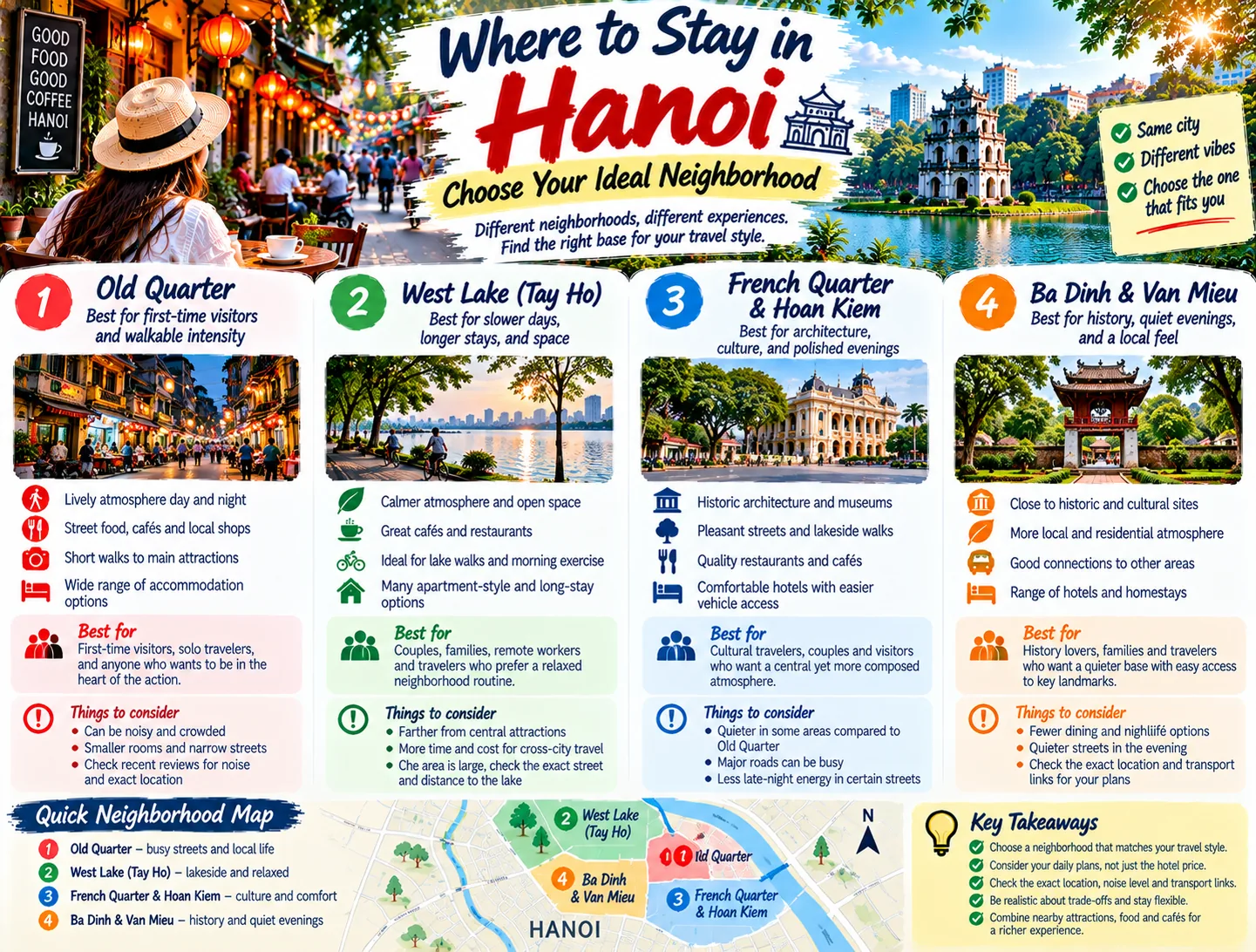
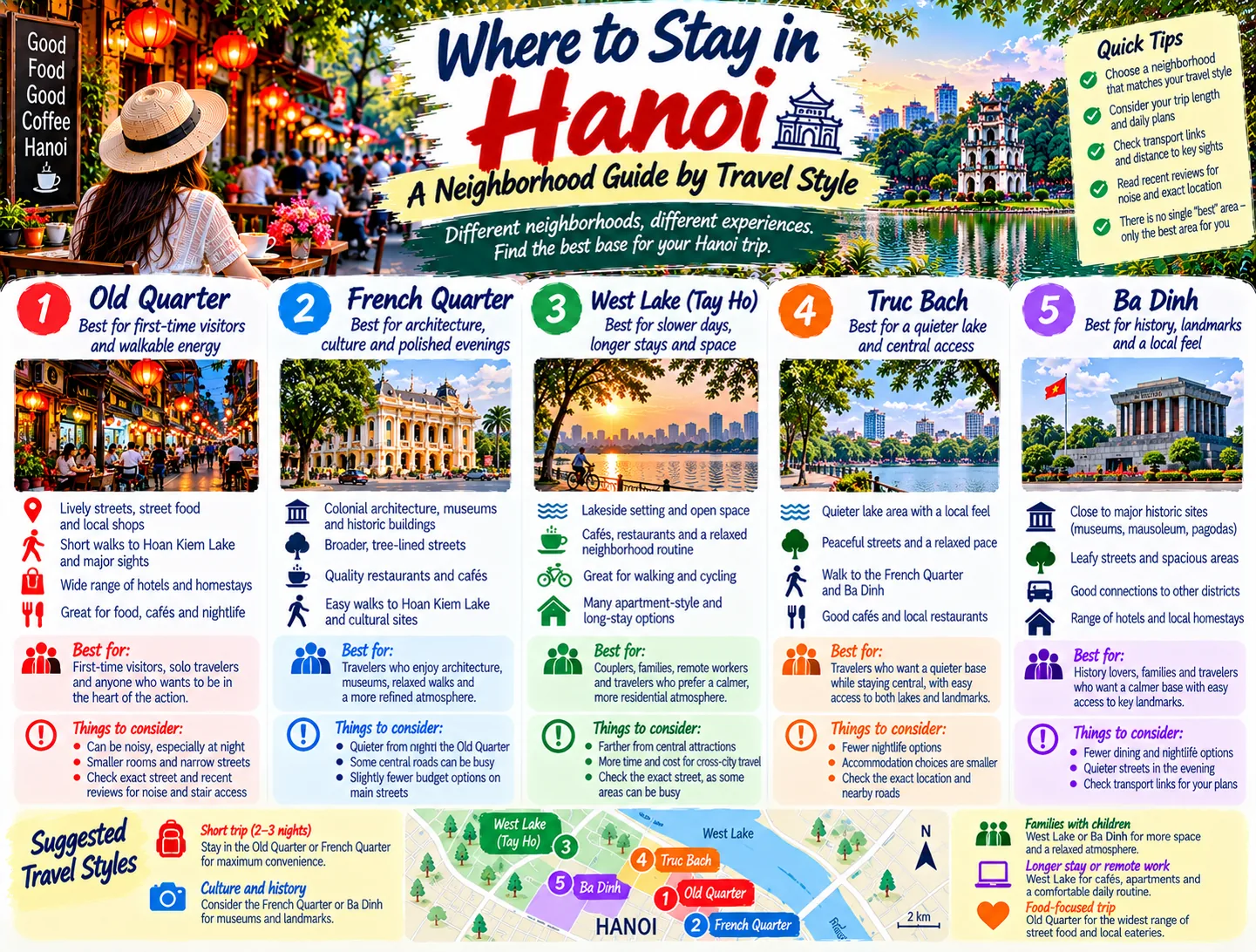
Choosing where to stay in Hanoi is less about finding one “best” neighborhood and more about matching your base to the way you want to spend each day. The Old Quarter suits travelers who want dense streets, short walks, and a lively first impression. West Lake works better for slower mornings, longer stays, and room to breathe. The French Quarter and Ba Dinh offer a calmer, more spacious city experience, while the area around Van Mieu brings history and a quieter evening rhythm. This guide compares Hanoi neighborhoods by travel style, not by a one-size-fits-all ranking.
Start with the question: what should your Hanoi base make easy?
Before comparing districts, decide what you want to reach without effort. If your priority is stepping outside into busy lanes, street food, cafés, and evening energy, choose a central base. If you prefer a neighborhood where a walk, coffee, or lake-side pause can be the main event, look west. If you want museums, civic landmarks, and a quieter hotel street, look toward Ba Dinh or the French Quarter.
This matters because Hanoi’s atmosphere changes noticeably from one cluster of streets to the next. A short taxi ride can move you from a tightly packed commercial lane to a broad, leafy avenue, but the difference is most valuable when your accommodation already supports your daily rhythm. Travelers who plan to return indoors in the afternoon may value calm and space more than being beside every landmark. First-time visitors who want to explore on foot may accept noise and smaller rooms in exchange for a more immediate sense of place.
Old Quarter: best for first-time visitors and walkable intensity
The Old Quarter is the default choice for travelers who want Hanoi to feel immediate. Its appeal is concentration: narrow streets, small businesses, food stops, cafés, and historic lanes create a setting where wandering is often more rewarding than following a strict itinerary.
Choose it if you want:
A lively atmosphere from morning into the evening.
Short, flexible walks with plenty of places to pause.
Easy access to a classic first-day Hanoi itinerary.
Accommodation choices across different budgets and room styles.
The trade-off is sensory overload. Traffic, building density, tour groups, and late activity can make the Old Quarter feel tiring if you need quiet to sleep or expect resort-like space. Streets also have different personalities, so do not judge the entire area from one hotel listing. Read recent reviews for noise, stair access, room ventilation, and the exact lane rather than relying only on the neighborhood name.
For a useful first-day plan, combine the Old Quarter with the city’s central lake area and then follow the slower pacing described in How to Experience Hanoi Like a Local in One Day. The best Old Quarter stay is not necessarily the one nearest the busiest nightlife; it is the one that lets you step into the action and retreat from it when you choose.
West Lake: best for slower days, longer stays, and space
West Lake, commonly called Tay Ho, suits visitors who want Hanoi to feel residential and unhurried. The area is known for a more open lakeside setting, a strong café and dining culture, and a mix of long-term residents and short-term visitors. It can be a comfortable choice for travelers staying a week or more, remote workers who want a neighborhood routine, or couples who prefer sunset walks and relaxed evenings to a packed sightseeing schedule.
Choose it if you want:
A calmer base with more room between major streets.
Cafés, restaurants, and a neighborhood routine rather than constant sightseeing.
A good setting for early starts, exercise, or unplanned afternoons.
Longer-stay accommodation with apartment-style options.
West Lake is less convenient if your trip is built around repeated short visits to the Old Quarter, central museums, or the French Quarter. You may spend more time and money moving back and forth, especially when weather or traffic makes a cross-city journey less appealing. The area is also varied: a lakeside address can feel peaceful, while a busy road nearby may be much louder. Check the exact street, not just “Tay Ho,” before booking.
West Lake works especially well when you plan your day around one anchor rather than many. Have breakfast near your accommodation, visit one central sight, and return for a longer afternoon. For more neighborhood-level inspiration, browse the site’s Secret Cafes & Hangouts category instead of treating the district only as a place to sleep.
French Quarter and Hoan Kiem: best for architecture, culture, and polished evenings
The French Quarter and the streets around the southern and eastern sides of Hoan Kiem are a strong middle ground. You remain central, but the atmosphere can feel broader and more composed than the busiest Old Quarter lanes. This area suits travelers who want museums, galleries, restaurants, heritage buildings, and evening walks without making nightlife the entire point of the trip.
It is a particularly good fit for a short cultural break. You can start with coffee, visit a museum or historic building, stop for lunch, and continue toward the lake without needing to cross Hanoi repeatedly. The setting also works for travelers who prefer a hotel with a more formal feel, a larger lobby, or easier vehicle access.
Watch for these trade-offs:
The streets may feel quiet at certain times, especially compared with the Old Quarter.
Some central addresses are convenient for landmarks but less atmospheric after dark.
Major roads can be wide and busy, so “central” does not always mean pleasant to cross.
If evenings are part of your plan, use the practical route in The Best Things to Do in Hanoi at Night: A Local Route as a companion. It helps you decide whether you want to stay near the night-time action or simply reach it once and return to a calmer base.
Ba Dinh: best for museums, wide streets, and a quieter city feel
Ba Dinh is a good option for travelers who want Hanoi’s political and cultural landmarks, a more spacious urban layout, and evenings that do not revolve around the Old Quarter. It can feel more orderly and less compressed, which is useful for families, repeat visitors, and anyone who prefers a measured morning over an immediate rush of vendors and traffic.
The neighborhood is also a useful base for an itinerary built around history. Rather than trying to see every central attraction in one loop, you can spend a morning with one cluster of museums, monuments, or institutional sights, then return to rest before dinner. This approach is often more comfortable in hot or rainy weather than crossing the city repeatedly.
Ba Dinh is not the best match if your main goal is spontaneous street-food hopping until late at night. Some streets are quiet after business hours, and the area’s strengths are more about space and cultural context than nonstop entertainment. Before booking, check whether your hotel is near the particular landmarks you care about; the district is large enough that a general label can hide meaningful differences in walking convenience.
Van Mieu: best for heritage, calm evenings, and a compact cultural base
The area around Van Mieu, the Temple of Literature, is worth considering when you want a neighborhood with a clear cultural identity but do not need to sleep in the center of nightlife. The official Van Mieu–Quoc Tu Giam site describes the complex as a special national historical site and lists visitor information, exhibitions, the Doctoral Stele Garden, and a current address on Quoc Tu Giam Street. That makes the area especially useful for travelers who want a heritage visit to be part of their daily routine rather than a rushed stop.
The official site also lists regular daytime opening information and special evening programming on selected days. Because schedules and ticket conditions can change, check the venue’s own visitor page close to your visit instead of treating a guidebook time as permanent.
Van Mieu suits:
History-focused travelers and thoughtful repeat visitors.
People who prefer a quieter base with central sights still within reach.
Visitors who want to combine heritage, cafés, and local streets at an unhurried pace.
Pair this area with the site’s Hanoi Walking Routes category for ideas on building a day around distance and atmosphere rather than a checklist.
Hoa Lo and the southern central streets: best for a history-led short break
The streets around Hoa Lo Prison Relic and the southern central area can work well for visitors who want a compact, history-led itinerary. The official Hoa Lo site identifies the relic at No. 1 Hoa Lo, provides visitor rules and ticket information, and lists opening hours from 8:00 to 17:00 every day. Those details make the area a practical anchor for planning, but they should still be rechecked before arrival because institutional visitor information can be updated.
Staying nearby lets you begin with a focused museum visit, continue toward the French Quarter or Hoan Kiem, and keep the day flexible. The area is central without requiring you to choose the most crowded Old Quarter lanes.
Remember that a location beside a major historical site does not automatically mean every other attraction is walkable in comfortable weather. Use the address as an anchor, then judge the rest of the itinerary by heat, rain, mobility, and how many stops you genuinely want in one day.
How to choose by trip length and travel style
For one or two nights
Stay central. The Old Quarter is the easiest choice for maximum atmosphere, while the French Quarter, Hoan Kiem, or the Hoa Lo area can give you a calmer cultural base. Avoid spending your short visit commuting simply because a distant hotel looks larger.
For three to five nights
Choose between Old Quarter intensity and West Lake breathing room. If this is your first Hanoi visit and sightseeing is the priority, stay central. If you want a repeatable routine with one major outing each day, West Lake may feel more rewarding.
For a week or longer
Prioritize daily comfort: a reliable café nearby, a room that suits working or resting, convenient laundry, and a street you will not mind walking along repeatedly. West Lake, Ba Dinh, or a quieter edge of the central districts can all work, depending on your preferred rhythm.
For families or light sleepers
Look beyond the neighborhood label. Ask about lift access, road noise, construction, room windows, and late-night businesses. A quieter street in a central district may be better than a theoretically peaceful district beside a busy arterial road.
A simple booking checklist for Hanoi neighborhoods
Check the exact map pin and the walk to the nearest main road.
Read recent reviews for noise, humidity, stairs, and water pressure.
Confirm whether the property is on a lane that vehicles can reach.
Look for a nearby breakfast option, convenience shop, and café.
Save the official pages of any museum or heritage site you plan to visit.
Have one rainy-day plan that does not depend on a long walk.
Neighborhood choice becomes easier when you treat accommodation as part of the itinerary. A hotel can be central yet inconvenient for your actual routine, while a slightly less famous area can make every morning feel simpler. The site’s Local Lifestyle & Daily Life category is useful when you want to understand the everyday texture around your chosen base.
Conclusion: choose the Hanoi rhythm you will actually enjoy
The best Hanoi neighborhood depends on the version of the city you want to live for a few days. Choose the Old Quarter for concentrated energy and easy first-time wandering, West Lake for space and routine, the French Quarter or Hoan Kiem for culture with central convenience, Ba Dinh for a calmer museum-led stay, and Van Mieu or the Hoa Lo area for a more focused heritage itinerary. Match the neighborhood to your walking tolerance, sleep needs, trip length, and preferred pace, then verify the exact street before booking.

JOIN THE CONVERSATION
Comments (0)
No comments yet. Be the first to share a thought.