
Choosing where to stay in Hanoi is less about finding one “best” neighborhood and more about matching an area to the way you want your days to feel. The city can give you busy lanes, quiet lakeside mornings, grand civic spaces, creative cafés, local markets, and late-night street life within a relatively compact visit—but not all of those experiences sit on the same doorstep. This guide uses a practical question: which Hanoi neighborhood fits your pace, interests, noise tolerance, and trip length?
If this is your first visit, begin with the wider picture in our neighborhood overview, then use the choices below to narrow your base. The goal is not to rank districts. It is to help you choose a place that makes your everyday route feel easy.
Start with the rhythm you want from Hanoi
Before comparing addresses, decide what you want to see when you walk out of your accommodation. Do you want to step into old lanes and food stalls, or begin with a quieter coffee and a longer walk? Will you spend most of your time on foot, or are you happy to cross the city for individual sights? Do you sleep lightly, or does a lively street outside feel like part of the experience?
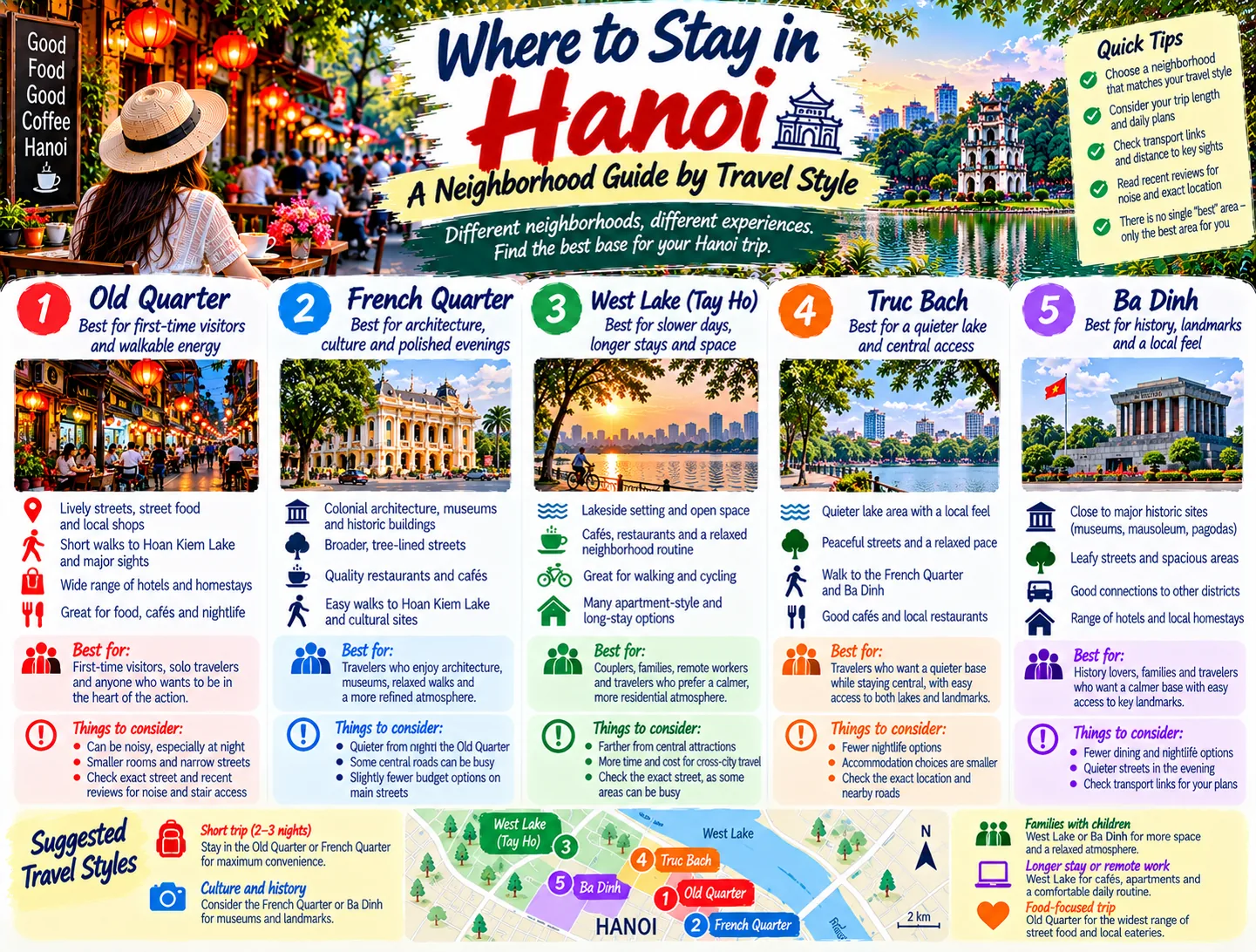
For a short first visit, central Hoàn Kiếm is usually the most efficient choice because it puts several classic experiences close together. For a slower stay, Tây Hồ can suit travelers who prefer space, water views, and an unhurried daily routine. Ba Đình works well for visitors who want a calmer, more spacious setting around major civic and cultural landmarks. Đống Đa is a useful fit for repeat visitors, food-focused travelers, and people who enjoy seeing a less postcard-shaped side of the capital. Long Biên can appeal if markets, bridges, and early-morning city life matter more to you than being in the center of the evening action.
Hoàn Kiếm and the Old Quarter: best for a first Hanoi trip
Choose the Old Quarter when you want Hanoi to begin immediately outside your door. The official Vietnam Tourism guide describes it as a neighborhood of 36 streets, green spaces, old shops, street food, and architecture that is especially easy to explore on foot. Its defining quality is density: a short walk can move you from a craft-linked street to a coffee shop, a pagoda courtyard, a market edge, or a busy evening corner.
This is the strongest base for a two- or three-night introduction. You can spend one morning circling Hoàn Kiếm Lake, one afternoon following selected streets rather than trying to cover every lane, and one evening eating or people-watching without arranging a long cross-town journey. On weekends, the lake area becomes a vehicle-free gathering place according to the tourism guide, which makes it especially appealing if you enjoy walking, informal entertainment, and watching local routines.
What the Old Quarter is best at
Compact sightseeing for a short stay.
Street-level food, cafés, shopping, and evening atmosphere.
Photographing tube-house façades, old gates, narrow lanes, and layered architecture.
Building a flexible day without depending on a fixed timetable.
The trade-off is sensory intensity. Streets can feel crowded, motorbikes are part of the movement, and popular lanes may stay active after dark. Pick a quieter side street if sleep matters, and do not assume that a map pin means a calm setting. For a walking-focused trip, pair your stay with these Hanoi walking-route ideas rather than trying to turn every landmark into a separate taxi stop.
The French Quarter edge: best for architecture and a softer central base
The southern and eastern side of the central lake area is a good compromise for travelers who want access to Hoàn Kiếm without being surrounded by the narrowest, busiest Old Quarter lanes. Think of it as a location choice for people who like centrality but want their walks to include broader streets, formal façades, museums, cafés, and a more measured transition between day and night.
This area suits couples, architecture-minded visitors, and travelers who like to start with a long breakfast and finish with an evening walk. It also works for a first visit when one person wants Old Quarter energy and another prefers a little more breathing room. The official tourism guide’s Old Quarter coverage makes clear how quickly Hanoi’s historical layers overlap: craft streets, colonial-era buildings, religious sites, lake walks, and modern retail can all sit within the same broad central itinerary.
Choose this base if your ideal day has a balance of planned culture and unplanned wandering. You can walk north into the Old Quarter, east toward market streets, or south toward civic and railway landmarks. The main compromise is that the “most atmospheric” lane may be a walk away rather than directly downstairs, which is often a benefit when you want to sleep well.
Tây Hồ: best for a slower stay, cafés, and space
Tây Hồ is the neighborhood to consider when your Hanoi trip is not a checklist. It is a better mental fit for travelers who want to read, work, linger over coffee, take an early walk, or spend several days repeating a comfortable local routine. Families and longer-stay visitors often value this kind of base because the neighborhood experience can carry more of the trip instead of serving only as a place to sleep.
The practical question is distance. If your priority is visiting the Old Quarter every morning and returning there every evening, Tây Hồ may feel less convenient than it looks on a map. If you are happy to divide your time—some central sightseeing, some neighborhood days—it can feel more restorative. Build in extra travel time when you have a timed reservation or a morning departure, and treat the lake area as your reason to stay rather than assuming it is merely a quieter version of the center.
Who should choose Tây Hồ?
Travelers staying a week or more.
Remote workers and slow travelers who want a repeatable daily rhythm.
Families who prefer a less compressed evening environment.
Visitors who care more about cafés, walks, and neighborhood texture than maximum landmark density.
If you choose Tây Hồ, plan one or two full central days instead of commuting back and forth for every small sight. That approach leaves room for the kind of everyday observation described in our guide to everyday life in Hanoi.
Ba Đình: best for landmarks, museums, and calmer mornings
Ba Đình is a strong option for visitors who want a more spacious, civic, and cultural frame for their stay. It can work particularly well for repeat visitors who have already done the Old Quarter, or for travelers who prefer to begin their mornings around major landmarks and museums before moving elsewhere for food and nightlife.
Đống Đa: best for repeat visitors and a more everyday city feel
Choose Đống Đa when you want your trip to feel less like a loop between headline attractions. The district is useful for visitors who enjoy ordinary streets, local eating, university-area energy, and exploring with a loose plan. It is also a sensible choice if you are returning to Hanoi and want to spend less time repeating the same central circuit.
The benefit is discovery without needing to label every stop a hidden gem. You can choose a market, a café, a meal, or a small cultural visit and let the surrounding streets become part of the day. The drawback is that you need a clearer sense of your own priorities. If this is your first visit and you have only two nights, the center may save time. If you have four or more nights, Đống Đa can add contrast to the better-known quarters.
Use transport pragmatically rather than romantically. Vietnam Tourism notes that cities offer taxis, buses, and cyclos, while motorbikes can be convenient for short distances but require care and proper safety habits. For most visitors, the best neighborhood is the one that reduces unnecessary crossings; you do not need to prove your independence by choosing the farthest base.
Long Biên and the eastern edge: best for markets and early city life
Long Biên is worth considering when your interests run toward markets, bridges, photography, and the working city before breakfast. It is a better fit for curious repeat visitors than for anyone who wants the simplest first-time base. The official Hanoi shopping guide highlights Long Biên Market as a major wholesale produce market and describes the surrounding early-hours activity as part of the city’s supply rhythm.
That kind of experience rewards commitment. If you want to see a market at its most active, an early start matters; if you are mainly interested in nightlife, staying farther east may create more travel than value. A useful compromise is to visit the area as a morning outing while keeping your accommodation in a central neighborhood.
How to choose by trip length and travel style
For two nights
Stay in Hoàn Kiếm or on the French Quarter edge. Your priority is reducing transfers and giving yourself several ways to fill an evening. Choose the Old Quarter for maximum atmosphere; choose the edge for a slightly calmer base.
For three to five nights
Stay central if this is your first visit. If you already know the Old Quarter, consider splitting your time between central Hanoi and Tây Hồ, or choose Ba Đình for a cultural reset. A split stay is worthwhile only when the contrast is part of your plan; changing hotels merely to move a short distance adds friction.
For a week or longer
Prioritize daily comfort over landmark density. Tây Hồ, Ba Đình, or Đống Đa can give you a more sustainable routine, while one or two deliberate central days cover the Old Quarter and lake area. Add market mornings or neighborhood walks instead of filling every day with major sights.
For light sleepers
Do not book from a neighborhood name alone. Read the immediate street description, look at the map around the property, and ask about bars, event spaces, construction, and room orientation. Central Hanoi can be lively; a quieter lane or a room away from the street may matter more than the district label.
A simple neighborhood decision checklist
How many full days do you have, and how many are first-time sightseeing days?
Would you rather walk out into activity or begin with quiet?
Is nightlife outside your door a benefit or a sleep problem?
Will you return to the same area for meals, or explore widely?
Do you want a central base, a slower neighborhood routine, or a deliberate contrast?
For more practical context, compare this decision framework with the Local Neighborhoods category, the Hanoi Walking Routes category, and the Local Lifestyle & Daily Life category. Together, they help you choose not just where to sleep, but what kind of Hanoi day you are building.
Conclusion: choose the neighborhood that makes your day easier
Hoàn Kiếm is the practical first choice for short, classic Hanoi trips. The French Quarter edge softens central access. Tây Hồ supports a slower rhythm, Ba Đình favors culture and space, Đống Đa offers a more everyday city experience, and Long Biên rewards early-market curiosity. None is universally best. The right neighborhood is the one that matches your available time, walking habits, sleep needs, and appetite for contrast. Choose that first, then let the city fill in the details.

JOIN THE CONVERSATION
Comments (0)
No comments yet. Be the first to share a thought.