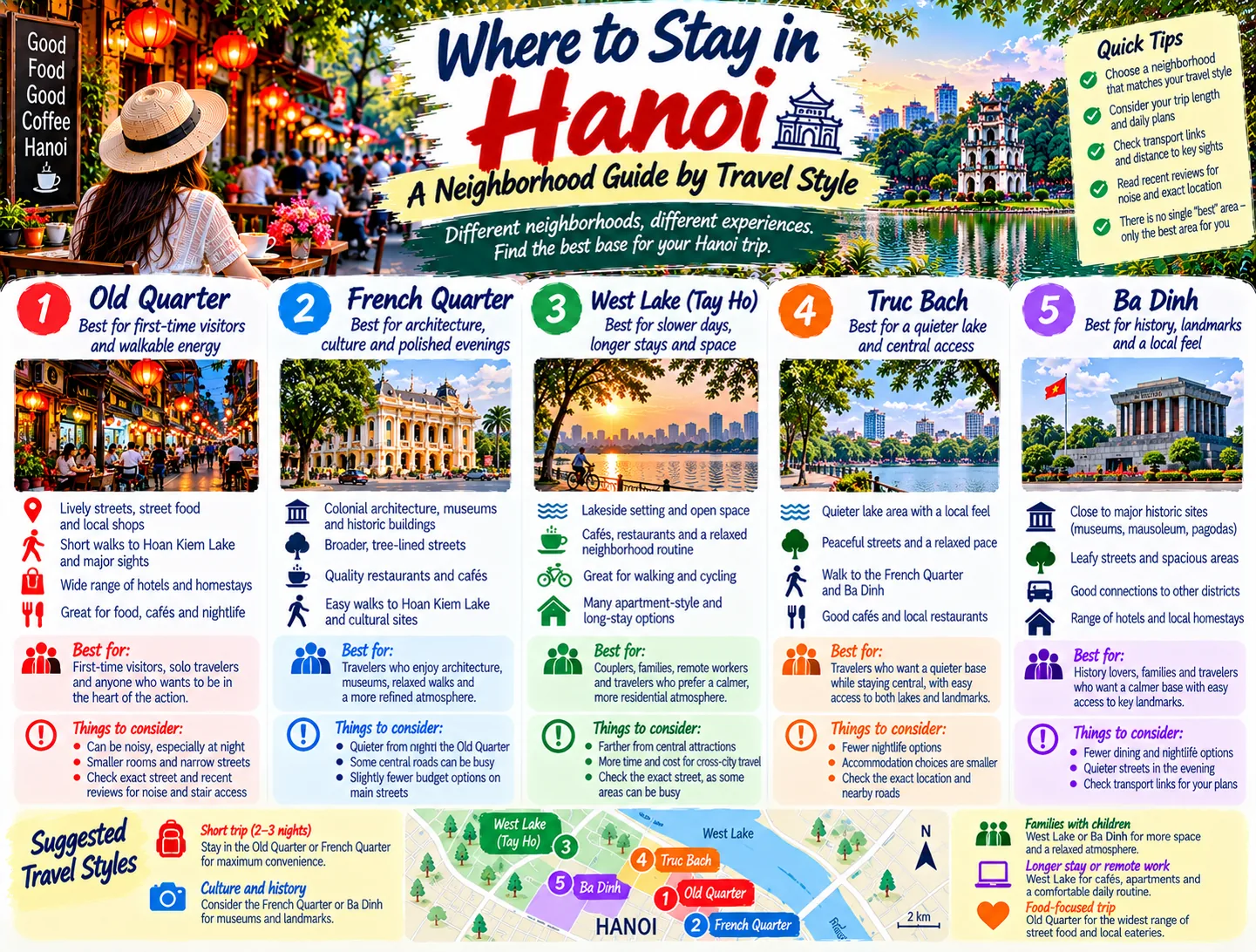
Choosing where to stay in Hanoi is less about finding a single “best” neighborhood and more about matching the city to the way you want to experience it. The Old Quarter is convenient and energetic, the French Quarter feels spacious and architectural, West Lake suits slower mornings, and areas around Truc Bach and Ba Dinh make it easier to balance lakes, landmarks, and local routines. This guide helps you choose the right Hanoi neighborhood for your trip length, interests, and tolerance for noise, rather than sending every visitor to the same few streets.
Start with the kind of Hanoi you want to wake up to
Hanoi is a city of contrasts: historic lanes sit close to broad tree-lined boulevards, quiet lakes appear beside busy markets, and traditional street life continues alongside a modern café and restaurant scene. The official Vietnam Tourism guide describes the capital through its Old Quarter streets, lakes, French-colonial architecture, heritage sites, and street food. Those ingredients are spread across different districts, so your base changes the rhythm of every day.
For a first visit of two or three nights, convenience usually matters most. Staying near Hoan Kiem gives you a strong introduction to central Hanoi without requiring a complicated plan. For a longer stay, the trade-off becomes more interesting: you can choose a neighborhood with a calmer residential feel and travel into the historic center when you want museums, markets, or nightlife.
Choose the Old Quarter for maximum central energy and short walks to classic sights.
Choose the French Quarter for architecture, wider streets, and a more polished evening atmosphere.
Choose West Lake or Tay Ho for cafés, space, and a slower stay.
Choose Truc Bach or Ba Dinh for lakeside walks, major historic sites, and a less concentrated visitor scene.
If you want a wider orientation before deciding, our guide to getting to know Hanoi one neighbourhood at a time is a useful companion. The goal here is more practical: deciding which area fits your own trip.
Old Quarter: the best Hanoi neighborhood for a first taste
Why it works
The Old Quarter is the obvious choice when you want Hanoi’s most concentrated mix of narrow streets, small shops, street food, cafés, and evening activity. Vietnam Tourism describes it as a historic maze of 36 streets traditionally associated with different crafts and trades. That history is not just a label: the area feels layered, with old tube houses, changing storefronts, local vendors, and a constant flow of people.
It is also a practical base for travelers who want to explore on foot. Hoan Kiem Lake, Ngoc Son Temple, the weekend walking areas, Dong Xuan Market, and many central museums are within a manageable central zone. The official walking-tour guide recommends routes that connect Hoan Kiem, the Old Quarter, markets, Long Bien Bridge, and nearby lakes, which makes this part of town especially useful if walking is your main transport.
Who should stay here
Pick the Old Quarter if this is your first Hanoi visit, you have limited time, or you want to step outside your accommodation and immediately find food and movement. It suits travelers who enjoy improvising: a short walk can become a coffee stop, a market detour, or an evening wandering through changing streets.
The trade-offs
Central does not mean quiet. Some streets are lively late, and the dense layout can feel intense if you prefer open space. Accommodation quality also varies from street to street, so check recent guest feedback about noise, stairs, alley access, and the exact location rather than choosing only by district name. If you want the Old Quarter’s access but a gentler daily rhythm, look toward its southern or western edges and plan your walks rather than staying on the busiest nightlife streets.
French Quarter: a calmer central base with grander surroundings
South of the Old Quarter, the French Quarter offers a different version of central Hanoi. The streets are generally broader, the architecture more formal, and the atmosphere less compressed. Vietnam Tourism’s Hoan Kiem and French Quarter walking route highlights restored cathedrals, colonial-era villas, museums, parks, Hoan Kiem Lake, Thien Quang Lake, Reunification Park, and the Opera House. That combination makes the area rewarding even when you have no single attraction on your schedule.
Best for architecture and easy daytime wandering
This is a strong choice for visitors who like to walk without feeling surrounded by the tightest lanes all day. You can build a morning around Hoan Kiem Lake and the cathedral, continue toward museums or tree-lined streets, and finish near the Opera House. The district also works well for travelers who want central dining and cafés but do not need to be in the middle of the Old Quarter’s busiest activity.
Use the French Quarter as your base if your ideal Hanoi includes photographs of architecture, unhurried lake walks, and a central location that feels a little more spacious. Travelers looking for more local daily-life context can also browse the site’s Local Lifestyle & Daily Life category before planning their mornings.
West Lake and Tay Ho: the right choice for a slower, longer stay
West Lake, often associated with Tay Ho, changes the scale of Hanoi. Instead of dense historic lanes, you get a broad body of water, longer stretches between stops, and a neighborhood identity shaped by cafés, restaurants, residences, and lakeside routines. It is not the most efficient base if every hour is dedicated to central attractions, but it can be the most comfortable choice for a week-long stay or a return visit.
Why travelers choose it
West Lake works for people who want to begin the day slowly. You can organize your schedule around coffee, a walk, a meal, and one or two central destinations rather than trying to see everything in a tight loop. It is especially appealing for remote workers, families who value space, and repeat visitors who have already covered the headline sights.
What to consider before booking
The lake is large, so “West Lake” does not describe one identical experience. A property near a busy restaurant cluster will feel different from one on a quieter residential lane. Study the map, note how far you are from the particular cafés or attractions you care about, and decide whether you are comfortable using taxis or ride-hailing for central outings. Do not book West Lake simply because it sounds peaceful; choose it because a slower, more spread-out itinerary genuinely suits you.
For neighborhood planning, this area pairs naturally with the site’s Secret Cafes & Hangouts category. It is also a good base for travelers who prefer discovering a regular café and returning to familiar streets instead of collecting a long list of attractions.
Truc Bach: lakeside atmosphere close to historic Hanoi
Truc Bach is a useful middle ground between the concentrated center and the more spread-out West Lake area. The official walking-tour guide places Truc Bach within a route that begins around Phung Hung and Phan Dinh Phung, passes the Northern Gate and Cua Bac Church, continues to Truc Bach Lake and Thanh Nien Street, and reaches Quan Thanh Temple and Ngu Xa. Those connections show why the area works well for travelers who want scenery and heritage in the same day.
A good fit for walkers and food-focused travelers
Truc Bach rewards a flexible plan. You can walk beside the lake, continue toward historic sites, and stop in Ngu Xa, which the official guide identifies as a local food area known for dishes such as pho cuon and pho chien phong. The value is not that every stop must be completed; it is that the neighborhood gives you a coherent route with water, temples, streets, and food.
Ba Dinh: heritage, broad avenues, and a more residential rhythm
Ba Dinh suits visitors who place Hanoi’s political and historical landmarks high on their list. The official destination guide includes the Ho Chi Minh Mausoleum Complex and the Imperial Citadel of Thang Long among the city’s top places to visit, while its walking guidance connects the northern historic area with the Citadel and the Mausoleum. This makes Ba Dinh a practical choice when you want to spend substantial time with Hanoi’s heritage rather than staying only around the central lake.
Who benefits most from staying here
Ba Dinh is a good match for repeat visitors, families, and travelers who prefer a less nightlife-focused base. The broad avenues and institutional surroundings create a different atmosphere from the Old Quarter, and the area can make early starts for landmark visits feel straightforward. It also works for people who want to combine major sites with leafy streets and local cafés rather than shopping streets alone.
The trade-off is that Ba Dinh is not one compact tourist village. Attractions are more spread out, so you should group them geographically and allow time for each visit. A neighborhood choice is helpful only when your daily route matches it; if your priority is late-night food and spontaneous central wandering, the Old Quarter will probably feel easier.
How to choose between Hanoi neighborhoods
For two nights
Stay near Hoan Kiem, in the Old Quarter or French Quarter. You will spend less time crossing the city and can combine a central walk with one longer excursion. Our article on experiencing Hanoi like a local in one day can help you shape a compact schedule without treating the city like a checklist.
For four to seven nights
Consider West Lake, Truc Bach, or a quieter edge of the Old Quarter. A longer stay gives you room to trade a little convenience for better mornings, repeat visits, and neighborhood routines. You can still spend selected days in Hoan Kiem and the French Quarter rather than commuting there every day.
For a walking-focused trip
Choose Old Quarter, French Quarter, Truc Bach, or Ba Dinh according to the sights you want to connect. The site’s Hanoi Walking Routes category is useful for turning a neighborhood choice into a realistic day plan. Think in clusters: lake and market, architecture and museums, or historic sites and food.
For a quieter evening
Look first at West Lake, Truc Bach, or the French Quarter, then verify the exact street. Hanoi neighborhoods are varied within their own boundaries, and a calm district can still contain a busy block. Read the map as carefully as the property description.
Practical booking checks that matter more than a district label
Check the exact street, not only the neighborhood name.
Read recent comments about traffic noise, construction, stairs, and alley access.
Confirm whether you want to walk most days or are happy to use ride-hailing.
Group attractions by area so your base actually saves time.
Leave space for ordinary mornings; a neighborhood is part of the experience, not just a place to sleep.
Hanoi’s official tourism guidance emphasizes that the city combines heritage, lakes, food, arts, and energetic street life. No single neighborhood contains all of it. The best base is the one that makes your preferred version of Hanoi easy to repeat.
Conclusion: choose the rhythm, then choose the address
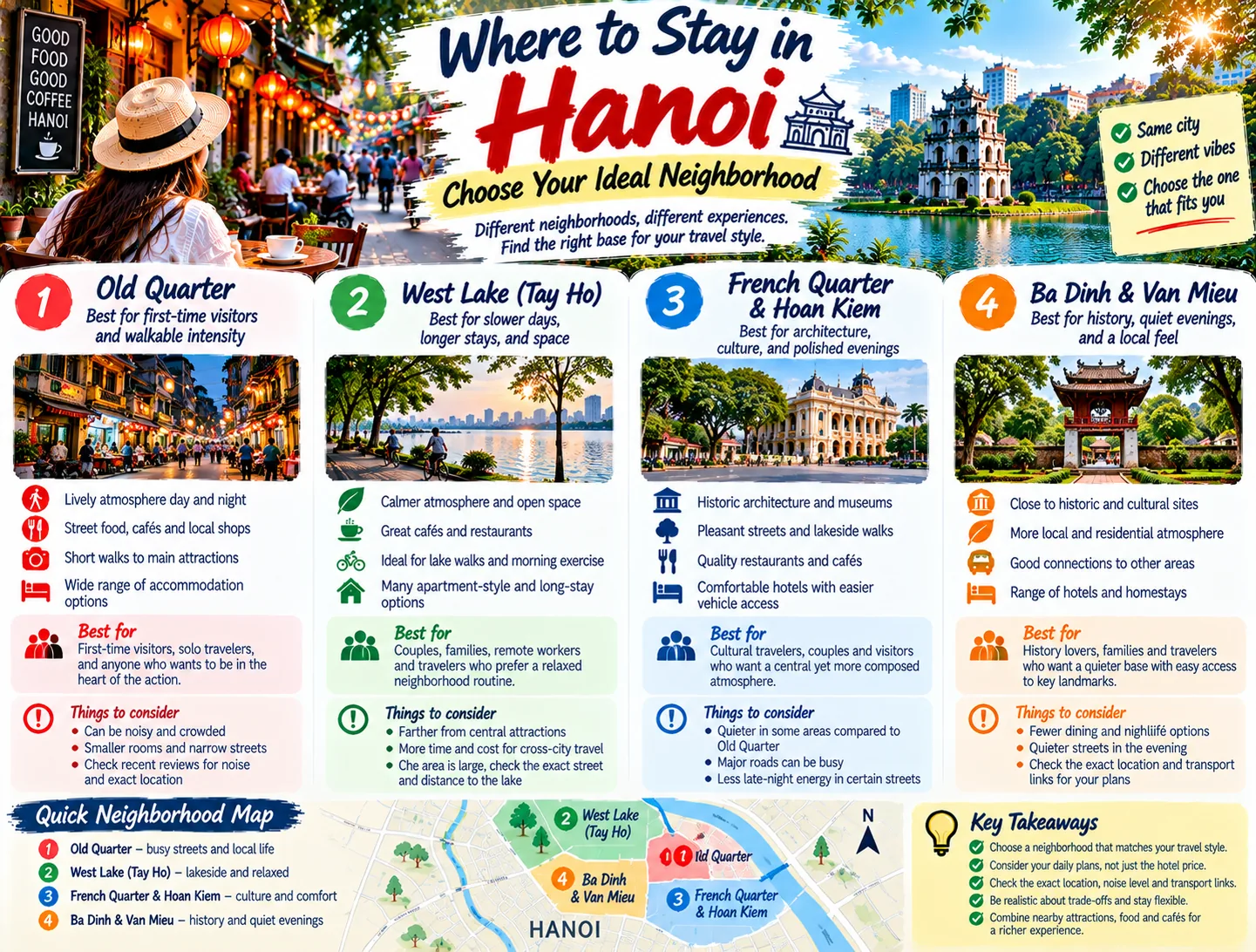
The Old Quarter is the strongest all-round base for a first visit, the French Quarter offers central access with more architectural calm, West Lake suits longer and slower stays, Truc Bach balances lakeside life with historic walks, and Ba Dinh places major heritage sites closer to your doorstep. Start with the rhythm you want—busy, elegant, residential, scenic, or heritage-focused—then check the exact street and build your itinerary around nearby clusters. That approach will give you a more satisfying Hanoi stay than choosing a neighborhood only because it appears on every list.

JOIN THE CONVERSATION
Comments (0)
No comments yet. Be the first to share a thought.