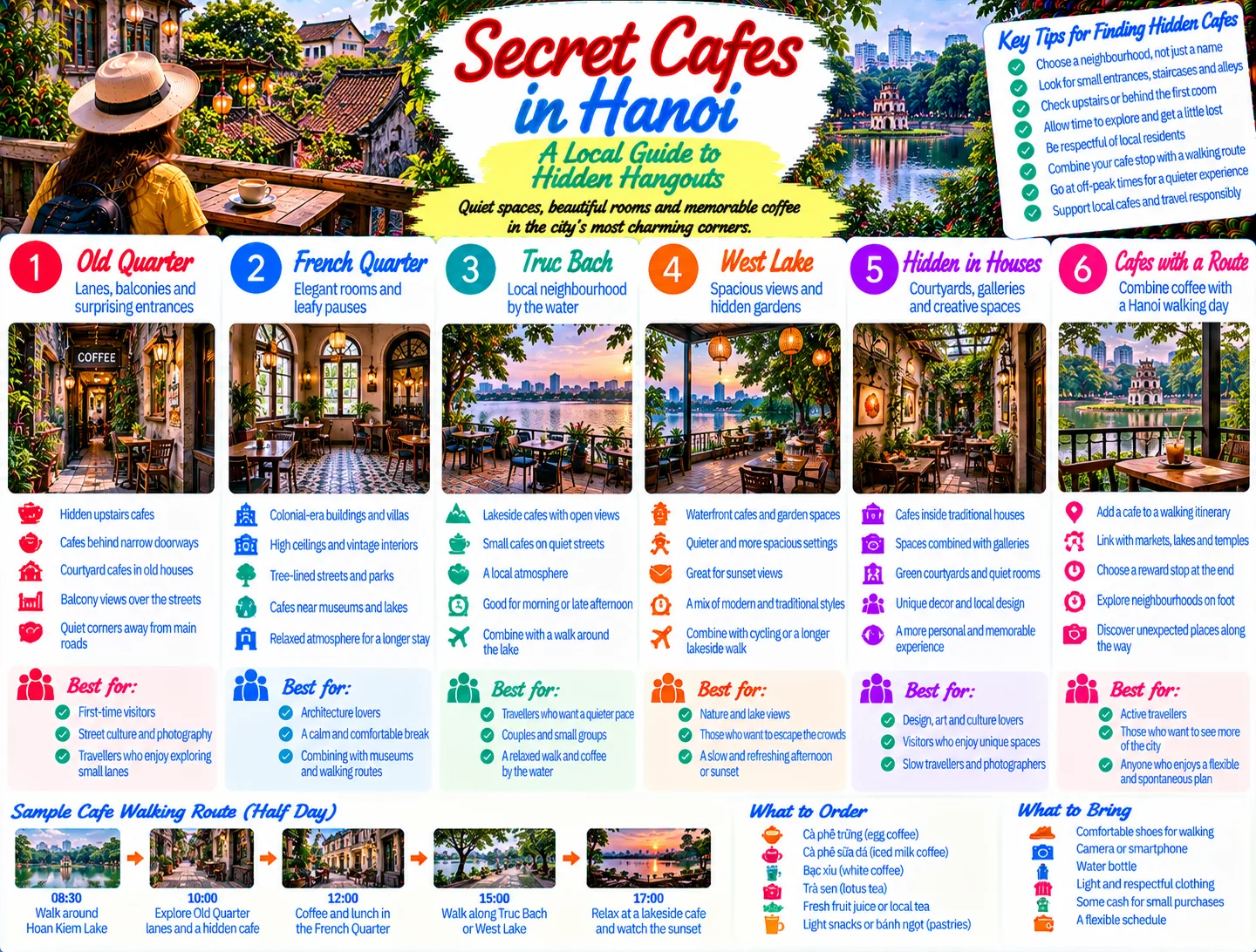
Hanoi’s most rewarding cafe experiences are often not the places with the biggest signs. They are upstairs behind a narrow doorway, tucked into an old courtyard, hidden on a quiet lane, or connected to a gallery, house, or small garden. This guide to secret cafes in Hanoi is for travellers who want more than a checklist: a calm seat, a memorable room, and a better sense of how the city’s neighbourhoods fit together.
What makes a cafe feel secret in Hanoi?
“Secret” does not always mean undiscovered. In Hanoi, it often means easy to miss. A cafe may sit above a shop, occupy one room of a tube house, share an entrance with a gallery, or open onto a courtyard that cannot be seen from the street. The experience comes from the transition: leaving a noisy lane, climbing a staircase, passing through a small alley, and arriving somewhere unexpectedly still.
The best hidden cafes also reward a slower pace. You may need to look for a doorway rather than a large sign, check a house number twice, or accept that the first room is not the best room. That small amount of effort is part of the pleasure. It turns coffee into a neighbourhood activity instead of a quick stop between major sights.
Vietnam’s official tourism guide describes Hanoi through its old streets, lakes, architecture, street culture, and cafe balconies. That combination is the key to choosing a good hangout: look for a cafe that gives you a view into the city, not one that could be anywhere.
Choose your hidden cafe by the kind of afternoon you want
For quiet conversation
Choose a smaller room away from the busiest pedestrian routes. Older residential lanes around the Old Quarter, the French Quarter, and Truc Bach can work well because the atmosphere changes quickly from main road to side street. Look for cafes with several small rooms, a courtyard, or an upper floor rather than a single open frontage. Those details usually give you more choice when one table feels too exposed.
For architecture and atmosphere
Search for converted houses, restored villas, balconies, patterned tiles, high ceilings, or narrow tube-house layouts. The official tourism guide’s cafe feature is useful here because it treats the buildings as part of the experience: some cafes occupy colonial-era houses, some sit in art deco interiors, and others show how narrow urban homes extend deep behind a small entrance.
For a walk with a reward at the end
Build the cafe into a route instead of travelling directly to it. The official guide to walking tours in Hanoi links cafes with markets, lakes, old streets, bridges, parks, and French-colonial architecture. That is a better model for a secret cafe day: walk first, stop when the city feels busy, then disappear into a small room for coffee.
Three Hanoi areas where hidden cafes make sense
Old Quarter: lanes, balconies, and surprising entrances
The Old Quarter is the obvious starting point, but it is still possible to find quiet corners if you move away from the widest streets and look above street level. Hanoi’s official destination page describes the Old Quarter as a historic maze associated with traditional crafts and trades. For cafe hunters, that maze-like structure is useful: a short turn can take you from traffic and shopfronts to a courtyard, an upstairs balcony, or a narrow residential passage.
Do not judge an Old Quarter cafe only by its frontage. The interesting seat may be behind the first room, at the end of a corridor, or upstairs. If the entrance looks shared with a shop or house, check the sign carefully and ask politely whether the cafe is open. A small phrase such as “cafe upstairs?” can save you from walking past the place you came to find.
French Quarter and south of Hoan Kiem: elegant rooms and leafy pauses
South of Hoan Kiem, the streets become more spacious and the architecture changes. The official walking guide highlights tree-lined boulevards, French-colonial buildings, museums, parks, and lakes in this part of the city. It also mentions sidewalk cafes along the route, which makes the area suitable for travellers who want a hidden cafe combined with a longer, less crowded walk.
Here, choose cafes for the room as much as the menu. A high ceiling, old windows, a balcony, or a view toward a leafy street can make a short coffee feel like a small architectural visit. This area is especially good for a late-morning break after visiting a museum or walking through a park.
West Lake and Truc Bach: slower water-side detours
West Lake and Truc Bach offer a different kind of cafe search. Instead of hunting for a dramatic entrance in a dense shopping lane, look for a place that lets you slow down after walking beside the water. The official walking guide describes Truc Bach as one of Hanoi’s scenic corners and connects it with lakeside life, Thanh Nien Street, Quan Thanh Temple, and the food area around Ngu Xa.
West Lake is also useful when you want a more spacious afternoon. A hidden cafe here may be modest rather than historic, but the reward can be a quieter table, a longer stay, or a view that makes time feel less hurried. Treat the neighbourhood as a sequence of small detours rather than a single attraction.
How to find a hidden cafe without wasting an hour
Start with a neighbourhood, not a venue. Pick Old Quarter, the French Quarter, Truc Bach, or West Lake and give yourself a compact search area.
Look at the entrance before the branding. Search for staircases, shared doorways, deep alleys, upper-floor signs, and courtyards.
Use the room layout as your clue. If the cafe has one busy front room, check whether there is another floor or a rear space.
Confirm before settling in. Ask whether the room is open, whether upstairs seating is available, and whether there is a minimum order if you plan to stay.
Keep a second option nearby. Small cafes can be full, closed for a private event, or quieter than you expected. A backup within walking distance keeps the afternoon relaxed.
Online maps can help you find a street or building, but they do not always explain the entrance. Read recent visitor notes carefully, compare the visible house number with the map pin, and be willing to walk around the block. A cafe guide is a starting point, not a guarantee of a particular table or atmosphere.
What to order when the cafe is part of the experience
Hanoi’s cafe culture is broad enough that the drink can match the setting. Egg coffee suits a historic Old Quarter stop, especially when the cafe presents it as part of its identity. Traditional Vietnamese drip coffee works well when you want to sit and watch the brewing process rather than rush. Yoghurt coffee or a lighter cold drink can be a sensible choice for a longer walk, particularly in warm weather.
Order with curiosity, but keep the practical question simple. If you are unsure about sweetness, dairy, ice, or ingredients, ask before ordering. If you have an allergy or dietary restriction, explain it clearly and ask what the cafe can safely prepare; do not assume that a familiar-looking drink has the same ingredients as one at home.
A hidden cafe is also a good place to notice small details: the metal filter on the table, the sound of a fan, a tiled floor, family photographs, or a balcony facing a busy lane. You do not need to turn every stop into a review. Let the space tell you how long to stay.
Build a cafe crawl around a walk, not a checklist
Old Quarter to a lake-side pause
Begin in the Old Quarter and choose one cafe with an upstairs or courtyard setting. After coffee, continue toward Hoan Kiem Lake and then decide whether you want the French Quarter or a quieter street. This works well when you want a first introduction to Hanoi’s contrasts: dense lanes, open water, historic buildings, and small rooms hidden in between.
French Quarter to a green break
Use the boulevards and parks south of the lake as the main experience, then stop at a cafe with a balcony or old-house interior. The official walking route points out parks, museums, lakes, sidewalk cafes, and the Opera House, so the cafe can function as a flexible pause rather than the only destination.
Truc Bach to Ngu Xa
Follow the water around Truc Bach, pause at a cafe when the weather or traffic calls for it, and continue toward Ngu Xa for food. This is a useful plan for travellers who want a secret cafe and a neighbourhood meal in the same outing. It also keeps the route compact enough that you can change plans without losing the day.
For a wider itinerary, connect this approach with how to find a cafe that feels like your Hanoi regular, then use the site’s Hanoi Walking Routes category for another route that matches your energy level. If you want to continue after dark, the guide to an easy evening out in Hanoi offers a natural next step, while the Hidden Gems in Hanoi category is useful when you want to keep exploring beyond cafes.
Small etiquette choices that make the experience better
Secret cafes are often small businesses operating in mixed residential and commercial spaces. Keep your voice low when the room is quiet, avoid blocking a narrow entrance while taking photos, and ask before photographing staff or other guests. If a staircase leads through a family home or shared building, follow the cafe’s directions rather than exploring private doors.
Be realistic about what a small cafe can offer. Seating may be limited, Wi-Fi may not be the main point, and a beautiful balcony may have only one or two chairs. If you need to work for several hours, choose a place designed for that purpose; if you want atmosphere, give the cafe room to be what it is. A short, considerate visit is often more enjoyable than trying to turn every hidden corner into a workspace.
How to choose the right secret cafe for your day
Choose the Old Quarter when you want discovery, narrow lanes, and the possibility of a tucked-away room above the street. Choose the French Quarter when architecture, shade, and a slower walking route matter most. Choose Truc Bach or West Lake when you want water, space, and a less compressed afternoon. In every area, the best cafe is the one that fits the reason you are stopping.
That is the real search intent behind secret cafes in Hanoi. Travellers are not only asking for a list of names. They want to know how to recognise a worthwhile place, how to combine it with a walk, and how to avoid a disappointing detour. Follow the building, the lane, and the neighbourhood mood, and the city will usually provide the surprise.
Conclusion: let the cafe be the discovery
Hanoi’s hidden cafes are memorable because they connect coffee with the city’s layered spaces: old houses, narrow lanes, leafy streets, lakes, markets, and neighbourhood life. Pick one area, leave room for a wrong turn, and look beyond the front door. The best secret cafe may not be the one with the strongest online profile; it may be the one that gives your walk a quiet ending and makes you feel, briefly, like you found the city’s private rhythm.
JOIN THE CONVERSATION
Comments (0)
No comments yet. Be the first to share a thought.