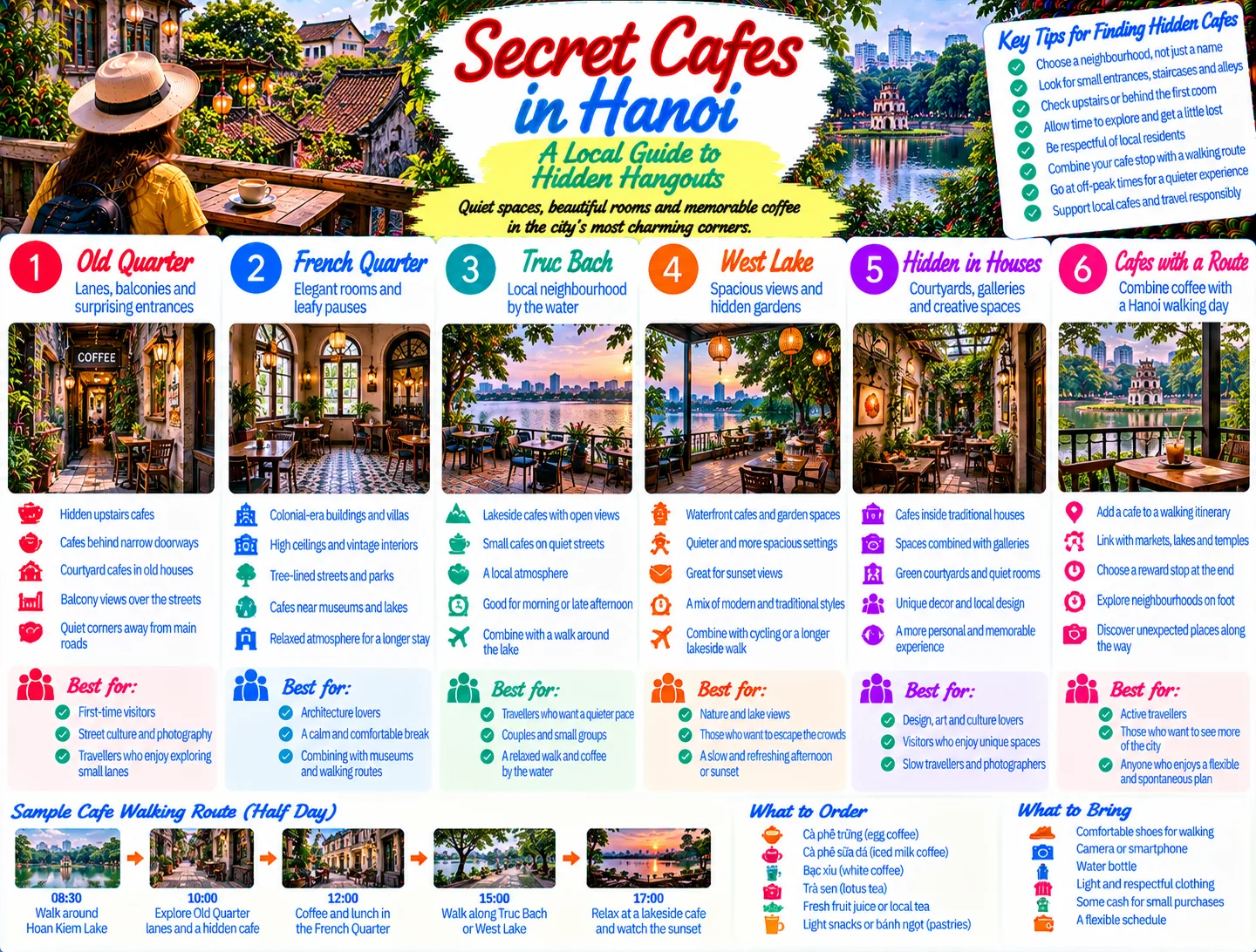
Hanoi’s most memorable coffee stops are often easy to miss. A narrow entrance, an upstairs room above a busy shop, a courtyard behind an ordinary doorway, or a quiet table down a lane can feel more rewarding than a polished café with a large sign. This guide explains how to find secret cafes in Hanoi without turning the search into a checklist. You will learn how to read neighbourhood clues, choose the right kind of hidden hangout, order with confidence, and build a relaxed café crawl around the city’s everyday rhythm.
What makes a cafe feel secret in Hanoi?
“Secret” does not always mean undiscovered. In Hanoi, it usually means a place that is easy to overlook from the pavement or known more by regulars than by passing visitors. The entrance may be set back from the street, the seating may be upstairs, or the café may share a building with a home, shop, studio, or small business. Some hidden cafes are quiet because they serve a focused crowd: readers, remote workers, neighbours, students, or people meeting for a long conversation.
The best secret cafes in Hanoi are therefore less about collecting obscure names and more about noticing how the city is arranged. The historic Old Quarter grew around specialised streets, trade, commerce, and dense mixed-use buildings. That layered urban pattern helps explain why a café can be lively at street level and surprisingly calm one floor above. It also makes wandering part of the experience rather than a failure of navigation.
Look for the transition, not just the sign
- Doorways set behind a shopfront or at the end of a narrow passage.
- Staircases leading to a second-floor room with no café branding at eye level.
- Small handwritten menus, plants, books, or stools that suggest a local routine.
- Buildings where several businesses appear to share one entrance.
If a place looks residential or unusually quiet, pause before entering and check for a visible café sign, menu, or open door. Hidden should never mean intrusive. A good visitor reads the space, keeps voices low in shared buildings, and accepts that some doors are private rather than public.
Choose your Hanoi hidden cafe mood
Search intent around secret cafes in Hanoi is broad. One traveller wants a photogenic hidden cafe; another wants a peaceful place to write; someone else wants traditional Vietnamese coffee away from the busiest streets. Decide what you want before you start walking, because the right neighbourhood and time of day depend on the mood.
For old-school coffee and conversation
Choose a compact, lived-in room with low tables, simple furniture, or a menu built around Vietnamese coffee. Egg coffee is one of Hanoi’s signature café experiences. It is commonly described as coffee topped with a sweet whipped egg mixture, and its Hanoi origin gives the drink a strong connection to the city’s café culture. The texture is part of the appeal: spoon a little of the creamy top first, then mix it with the darker coffee underneath if that is how the café serves it.
For reading, journaling, or a slow afternoon
Look for a café with natural light, separated tables, a courtyard, or an upstairs room. These spaces are rarely guaranteed to be silent, so think “unhurried” rather than “library quiet.” A seat away from the entrance can make a bigger difference than a fashionable interior. If you plan to stay, order something, keep your belongings compact, and avoid occupying a large table during a busy period.
For design, art, and creative energy
Some hidden hangouts are less about coffee technique and more about the setting: a small gallery-like room, a workshop atmosphere, vintage objects, or local artwork. Pair this search with the site’s Art & Creative Spaces category for ideas beyond cafés. You can also make the café stop part of a broader creative afternoon by following this practical guide to Hanoi’s art and creative spaces.
Where to look for hidden coffee rooms
You do not need a fixed list of addresses to explore. Instead, use a few types of urban landscape as starting points. The Old Quarter is the obvious place for narrow-fronted buildings, upper-floor rooms, and cafés tucked into dense commercial streets. Its history as a residential, manufacturing, and trading centre is visible in the way shopfronts, homes, workshops, and food businesses sit close together. That makes it especially rewarding for a slow, observant café walk.
West of the busiest Old Quarter lanes, quieter residential streets can offer a different version of a secret cafe: leafy, spacious, and less tied to the visitor circuit. Around lakes and villa-lined areas, you may find cafés designed for longer stays, but the atmosphere changes quickly from one street to the next. In newer neighbourhoods, hidden usually means “inside a creative compound or upper floor” rather than “historic.”
Use a three-layer search
- Start with a neighbourhood, not a café name. Pick an area you already want to walk through.
- Scan the street at walking pace. Notice stairs, side alleys, courtyards, and signs placed above eye level.
- Choose one promising doorway, then keep a second option nearby. Small venues can be full, closed for a private event, or difficult to identify from the pavement.
This approach leaves room for discovery while protecting your time. It also avoids the common mistake of crossing the city for one unverified recommendation when the real pleasure is finding a good room along the way.
How to read a hidden cafe before you sit down
A little observation can prevent an awkward stop. First, check whether the space looks open and whether other customers are being served. Then look for a menu, ordering point, or staff member. In a narrow building, the café may be upstairs, so do not assume an empty ground floor means the place is closed. If you are unsure, a polite “cà phê?” with a questioning gesture is usually enough to confirm that you are in the right place.
Menus may be bilingual, partly bilingual, or entirely in Vietnamese. Useful terms include cà phê đen for black coffee, cà phê sữa for coffee with condensed milk, bạc xỉu for a milkier coffee, trà for tea, and cà phê trứng for egg coffee. Ask about hot or iced if the menu does not make the choice clear. For allergies or dietary restrictions, do not rely on the name of a drink alone; ask what is in it before ordering.
Small etiquette choices matter
- Keep entrances, stairways, and shared corridors clear.
- Ask before photographing people, family areas, artwork, or private-looking corners.
- Use headphones for calls or work, especially in a tiny room.
- Do not treat a quiet residential café as a backdrop for a loud group session.
- Carry small cash as a backup, but confirm the accepted payment method before ordering if you need to plan carefully.
These habits are practical, not ceremonial. Hidden cafes often depend on trust and repeat customers, so visitors who behave like temporary regulars tend to have a better experience.
Build a self-guided secret cafe crawl
A good café crawl is short enough to stay flexible. Choose one anchor area and two or three possible stops rather than creating a city-wide route. Begin with coffee in the morning, pause for a walk, then return to a quieter room in the afternoon. If you want more structure, connect the crawl to Hanoi Walking Routes and use the local walking-route guide to balance café time with streets, lakes, and everyday neighbourhood scenes.
A simple half-day pattern
- Choose a starting street near your accommodation and walk for 15–20 minutes without opening a map for every doorway.
- Stop at the first café that matches your mood, not necessarily the one with the most dramatic entrance.
- Order one local-style drink and notice the room, pace, and view before deciding whether to stay.
- Walk through a market street, lane, or waterside area between stops.
- Make the second café a contrast: upstairs instead of street-level, bright instead of dark, or modern instead of traditional.
For a wider local-life angle, connect the route with this guide to experiencing everyday life in Hanoi. It encourages the same useful mindset: observe first, make room for ordinary moments, and resist rushing from one attraction to the next.
How to search without losing the local feeling
Online maps and social platforms can help you identify a neighbourhood, but they are not the whole experience. A listing may be old, a venue may have changed its name, or a popular room may be busy when you arrive. Treat online results as leads, then confirm the basics on the ground: location, visible opening status, menu, and whether the atmosphere suits your plan.
Search phrases such as “hidden cafes in Hanoi,” “secret cafes in Hanoi Old Quarter,” “quiet cafes in Hanoi,” “Hanoi egg coffee,” and “Hanoi cafes with a view” cover different needs. Combine a broad phrase with a neighbourhood when you want practical results. Add “upstairs,” “courtyard,” “quiet,” or “local” only when those qualities genuinely matter to you. This is more useful than searching for “best” alone, because the best café depends on the time, weather, company, and purpose of the visit.
Before leaving, save the café name in the original spelling if possible and note a nearby landmark. Narrow lanes can make map pins confusing, while a landmark helps you orient yourself without repeatedly stopping in the middle of a busy path. If the venue is inside a shared building, allow extra time to find the entrance and be prepared to ask a nearby shop politely.
What to expect from the drink itself
Vietnamese coffee can be stronger, sweeter, and slower than visitors expect, especially when brewed through a phin filter or combined with condensed milk. That is part of the café rhythm: the drink may arrive gradually, and the table is often a place to sit rather than a quick service counter. If you prefer a lighter drink, ask for tea, fruit drinks, or a milkier coffee instead of ordering blindly.
Egg coffee deserves special attention because it is both a drink and a small piece of Hanoi food history. The familiar version combines coffee with a sweet egg-based cream, and it may be served hot or cold depending on the café. Recipes vary, so focus on the experience rather than expecting every cup to taste identical. If you are avoiding eggs, dairy, or high-sugar drinks, ask before ordering and choose another option when needed.
When a hidden cafe is not the right choice
Sometimes the most local decision is to leave. A room may be too crowded for the quiet afternoon you wanted, a staircase may be unsafe for your group, or the venue may clearly be part of a private home. Do not force the stop because an article, map, or photograph promised a secret find. Move on to the next street, choose a visible café, or change the plan completely.
Weather also changes the equation. On a hot or wet day, a café near your current route is usually better than a distant “must-visit” address. In the evening, consider whether the lane will remain easy to navigate and whether the venue still appears open. Current hours, payment options, and temporary closures can change, so verify them directly when they matter rather than relying on an old post.
Conclusion: let Hanoi reveal the doorway
The best secret cafes in Hanoi are found through a combination of curiosity and restraint. Start with a neighbourhood, look for the small signals of a working café, choose a mood, and leave enough time to wander. Order a drink that interests you, respect shared spaces, and accept that one missed doorway may lead to a better discovery. Hanoi rewards visitors who slow down: the memorable hangout is often not the most famous café, but the room you notice because you were paying attention.
JOIN THE CONVERSATION
Comments (0)
No comments yet. Be the first to share a thought.