Hanoi’s most memorable coffee experiences are not always the ones with the biggest signs or the longest online review pages. A narrow doorway, an upstairs room above a repair shop, a shaded courtyard, or a café hidden behind a row of old houses can offer a closer look at how the city actually pauses. The challenge is knowing how to search without turning every quiet place into a checklist.
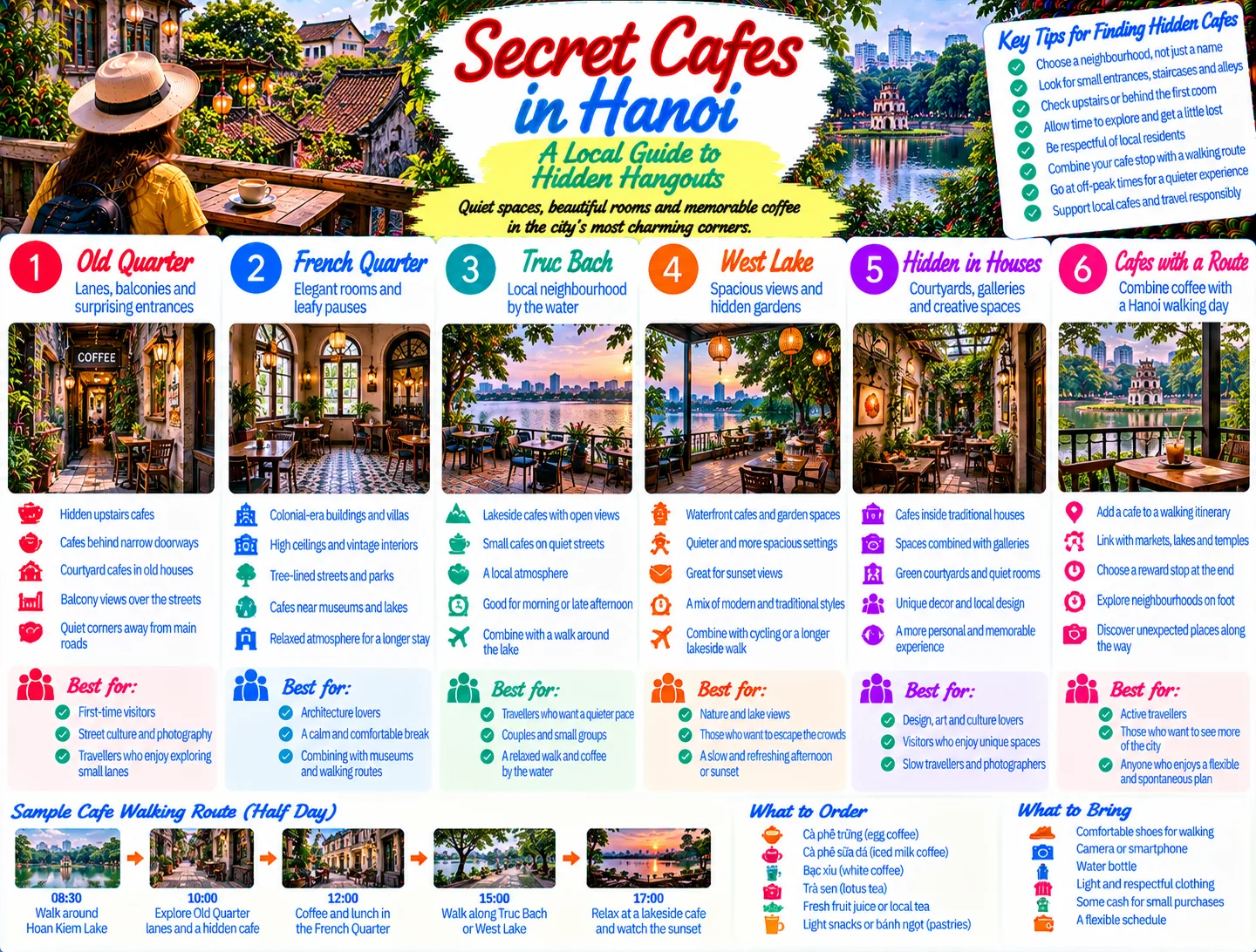
This guide is for travelers looking for secret cafes in Hanoi: places with atmosphere, character, and a sense of discovery rather than a famous photo spot. It explains which neighborhoods reward wandering, how to judge a hidden café before committing, what to order when the menu is unfamiliar, and how to build a relaxed café route that respects residents and working locals.
What makes a Hanoi café feel secret?
“Secret” does not necessarily mean unknown. In Hanoi, it often means easy to miss. The entrance may be set back from the street, the sign may be small, or the café may occupy a converted home where the best room is on an upper floor. Some places are popular with local regulars but remain invisible to visitors who only follow major roads.
The strongest hidden cafes in Hanoi usually have at least one of these qualities:
- A discreet entrance through a lane, courtyard, or shared doorway.
- A setting that preserves the scale of an older Hanoi house.
- A regular crowd of students, freelancers, neighbors, or creative workers.
- A menu focused on a few dependable drinks rather than a large international list.
- A mood that changes during the day, such as a bright morning room becoming a quiet evening hideout.
Do not treat the word “secret” as a promise of silence. Hanoi is lively. A hidden café may still include motorbike sounds, family conversation, construction, or a busy coffee bar. The appeal is usually intimacy and texture, not perfect quiet.
Choose the right neighborhood for your café mood
Old Quarter: layers, stairs, and small discoveries
The Old Quarter is the easiest place to begin if you want café-hopping on foot. Its narrow streets contain old shop houses, courtyards, hotels, residences, and businesses sharing the same block. Look above eye level for small signs, notice entrances that appear to lead to several businesses, and be willing to walk one street away from the busiest tourist flow.
The best Old Quarter café route is not a race between famous addresses. Start with one place that has a clear reason for visiting, then leave room for an unplanned turn. A café reached through an unremarkable passage can be more rewarding than a heavily photographed venue because the journey makes you notice how buildings and businesses overlap.
For a broader walking structure, connect your search with these Hanoi walking routes for curious travellers. The point is not to follow every recommendation; it is to use the neighborhood’s pedestrian rhythm to find places naturally.
Trúc Bạch and West Lake: slower tables and longer stays
Near Trúc Bạch and West Lake, café culture often feels more spacious. The streets are less compressed than the Old Quarter, and many cafés are chosen for a view, a breeze, a generous table, or the ability to sit with a book. This is a good area for travelers who want one carefully chosen stop rather than a rapid sequence of drinks.
Morning and late afternoon are especially useful times to explore this side of the city, but conditions vary by building and orientation. A lakeside table may be beautiful yet exposed to sun or traffic noise. If you want to work or read, inspect the seating before ordering and ask politely whether a quieter room is available.
Ba Đình and Đống Đa: local routines and creative corners
Ba Đình and Đống Đa reward visitors who are curious about ordinary Hanoi rather than a single landmark district. Here, a café may share a street with offices, schools, clinics, apartment blocks, and small food stalls. The most interesting places may not look “hidden” online; their local character comes from who uses them and how the space fits into the neighborhood.
These districts also work well for a café stop combined with galleries, studios, bookstores, or design spaces. If that mix appeals to you, pair your search with Hanoi’s Art & Creative Spaces category rather than treating coffee as an isolated activity.
How to find hidden cafes without wasting an afternoon
Use online maps as a starting point, not as the final authority. Search around a neighborhood, then compare the written description, photographs, entrance views, and recent activity. A place with beautiful interior images but no clear entrance may take time to locate. That is not automatically a problem, but it changes the kind of visit you are planning.
Before walking over, check five practical clues:
- Entrance: Is the door visible from the street, or will you pass through a shared building?
- Access: Does the café appear to be upstairs, inside a lane, or behind another business?
- Purpose: Do photographs show conversation, reading, work, or quick takeaway?
- Fit: Does the menu suit your mood, especially if you avoid dairy, sugar, or strong coffee?
- Recent signals: Are there recent posts or visitor comments suggesting the place is still operating?
When a listing is unclear, ask a hotel host, local shopkeeper, or café neighbor for directions. Keep the question simple and show the name on your phone. If nobody recognizes the place, treat that as a reason to verify the address rather than proof that you have discovered an untouched secret.
Read the room before you order
Hidden cafés often have fewer seats than their photographs suggest. Pause at the entrance and look for the service point, stairs, and available tables. If the café is full, do not block a narrow doorway while deciding. A quick smile and a gesture toward an empty table can make the process easier when language is limited.
Pay attention to the room’s social purpose. Some places are designed for conversation; others are used by students or remote workers; some are quiet because customers are reading, not because the café is formally silent. If you need to take a video call, choose a larger modern venue instead of a tiny family-run room. A place can be visually appealing and still be the wrong choice for a long work session.
Hanoi’s café culture also rewards patience. Drinks may arrive at different times, especially when coffee is prepared individually. Use the pause to watch the street, notice the house layout, or ask about the ingredients. The experience is less about maximizing stops and more about learning why the table feels worth keeping.
What to order at a less familiar café
If you already enjoy Vietnamese coffee, begin with a style you recognize and then try one variation. Cà phê đen is black coffee, while cà phê sữa combines coffee with condensed milk. Bạc xỉu is generally milk-forward and can be a gentler choice for visitors who find strong coffee intense. Menus differ, so confirm what is included if you have dietary restrictions.
Egg coffee is associated with Hanoi, but quality and sweetness vary. Ask whether it is served hot or cold and whether the café prepares it in-house. Coconut coffee, fruit drinks, tea, and yogurt-based drinks are common alternatives, though the exact recipe is not standardized from one café to another.
At a small independent café, ordering one drink per person is the safest assumption unless staff indicate otherwise. If you want to share a table for a long time, avoid arriving during a crowded period with only one small order. The practical rule is simple: support the space in proportion to the time and seating you use.
Build a secret-café route by time of day
Morning: look for light and local rhythm
Morning is ideal for courtyards, balconies, and street-facing rooms. The city is already active, but the pace may feel less compressed than later in the day. Choose one café near a market, lake, or residential lane, then continue on foot instead of planning three fixed stops. A morning route can connect naturally with this look at everyday Hanoi mornings.
Afternoon: choose shade, space, and a reason to linger
Afternoon heat and traffic make comfort more important. Prioritize shade, ventilation, a seat with back support, and a clear plan for the next part of your day. An upstairs café may be atmospheric, but stairs and heat can make a short visit less relaxing than expected. This is the best time to combine coffee with creative spaces, a bookstore, or a slow neighborhood walk.
Evening: find atmosphere rather than caffeine
At night, the café may be a starting point for a larger outing. Choose a place near the next neighborhood you want to explore, and consider tea, a dessert, or a lighter drink if you have already had coffee. For ideas beyond cafés, see this local route for Hanoi at night.
Getting around while keeping the route relaxed
Walking works best within a compact neighborhood. For longer jumps, use a ride-hailing service, taxi, or public transport and allow extra time for traffic and finding the exact entrance. Hanoi Metro’s official site provides route, station, ticket, and operating information for the lines it serves, so check it directly when a café route connects with a metro station: Hanoi Metro’s official information.
Do not build a route around unrealistic cross-city timing. One hidden café can take longer to locate than a famous venue, and a wrong entrance may send you around a block. Two good stops in one district are usually more enjoyable than four stops separated by long transfers.
Etiquette that keeps hidden hangouts welcoming
Quiet cafés are shared spaces, not private photo studios. Ask before photographing people, staff, artwork, or residential details. Keep tripods and large bags out of narrow passages. If a café occupies a converted home, remember that the surrounding doorway, stairwell, or courtyard may also serve residents.
Do not assume that an empty upstairs room is available. It may be reserved, used by staff, or closed at a particular time. Follow signs, wait to be seated when appropriate, and accept a no-photo request without debate. These small habits matter because the charm of a hidden café depends on the place remaining comfortable for the people who use it every week.
For more practical ways to move through Hanoi respectfully, browse the Insider Tips & Local Stories category. It complements café hunting with the everyday details that make neighborhood travel smoother.
A simple decision guide for your next stop
Choose an Old Quarter café if you want architectural texture, short walking distances, and the possibility of finding an upstairs room. Choose West Lake or Trúc Bạch if you want air, views, and a longer sit. Choose Ba Đình or Đống Đa if you prefer local routines, creative neighborhoods, and fewer obvious tourist signals.
Then match the café to your purpose. For conversation, choose a room with comfortable spacing. For reading, inspect the light and sound before ordering. For photographs, ask permission and visit outside peak periods. For a truly local-feeling stop, order simply, stay observant, and allow the café to be part of a wider neighborhood walk.
Conclusion: let the search stay part of the experience
The best secret cafes in Hanoi are not necessarily the hardest to locate. They are the places that make you slow down, notice the building around you, and understand how coffee fits into daily life. Search by neighborhood and mood, verify the practical details, and leave enough time for a wrong turn. A hidden café becomes memorable when the discovery feels earned—and when your visit leaves the space just as welcoming for the next regular.
JOIN THE CONVERSATION
Comments (0)
No comments yet. Be the first to share a thought.