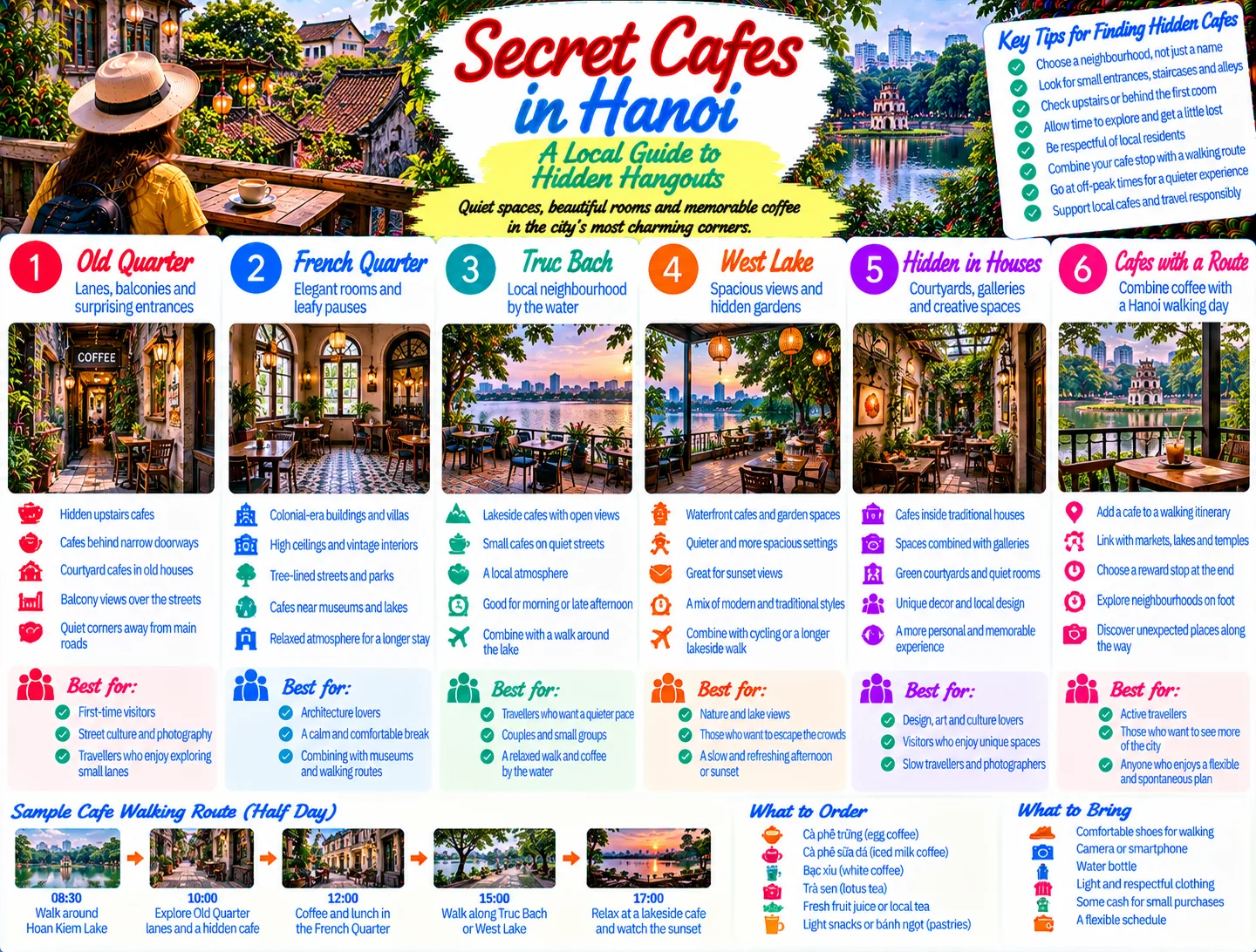
Hanoi’s most memorable coffee stops are often not the ones with the biggest signs. They may be upstairs behind a narrow doorway, tucked into a quiet lane, hidden inside a bookshop, or spread across a leafy courtyard where the city noise softens. This guide to secret cafes in Hanoi is for travellers who want more than a quick drink: places with a sense of discovery, a comfortable pace, and enough character to become part of the day.
What makes a Hanoi cafe feel “secret”?
Secret does not have to mean impossible to find. In Hanoi, it usually means a cafe is easy to miss if you are moving too quickly. The entrance may be modest, the menu may be short, and the room may reveal itself only after a staircase, a courtyard, or a passage through another building. That small moment of discovery is part of the pleasure.
The best hidden cafes in Hanoi also offer a reason to stay. Some are ideal for reading; others reward a slow conversation, a notebook, people-watching, or a pause between sightseeing stops. A good secret cafe is not simply photogenic. It has a distinct mood, a thoughtful layout, or a drink that makes the detour worthwhile.
That is why it helps to think in terms of atmosphere rather than a fixed list of “top” venues. A quiet cafe near the French Quarter suits a different afternoon from a tiny Old Quarter counter or a garden-like space near West Lake. Begin with the kind of break you want, then choose the neighbourhood and style that fit it.
Start with the right Hanoi neighbourhood
Old Quarter: compact, atmospheric, and easy to combine
The Old Quarter is the natural starting point for a hidden cafe hunt. Its narrow streets, specialist shopfronts, markets, and dense pedestrian life make it rewarding to explore on foot. Time Out describes the area as Hanoi’s cultural and economic heart, with quirky cafes alongside shops and markets. That mix is exactly what makes an unplanned coffee stop work: you can turn down a side street, notice a small sign, and discover a room that was invisible from the main road.
Old Quarter cafes are best approached with flexible expectations. Some are designed for a quick cup and a view of the street; others are above street level and feel unexpectedly calm. Look up as you walk, check the entrance carefully, and allow extra time for stairs or narrow passageways. If you are building a wider day around the area, pair your cafe search with the ideas in our guide to Hanoi walking routes.
French Quarter: elegant streets and slower coffee breaks
The French Quarter works well when you want a more spacious, polished pause after museums, galleries, or architectural walks. Time Out recommends exploring the area on foot from the Old Quarter and mentions Tranquil Books as a local coffee stop, including egg coffee and modern brewing styles. Whether or not you choose that particular venue, the wider lesson is useful: the French Quarter is a good place to look for cafes that combine books, design, and a quieter rhythm.
West Lake: room to breathe
West Lake suits travellers who want to make the cafe itself the destination rather than squeeze a drink between landmarks. The area is more spread out, so a hidden cafe here may involve a longer walk or a short ride between stops. In return, you are more likely to find balconies, courtyards, gardens, and rooms designed for lingering. Plan one or two cafes rather than trying to cover the whole district in a single afternoon.
Five kinds of secret cafes worth seeking out
1. Rooftop and upper-floor hideaways
Upper-floor cafes are among Hanoi’s most satisfying discoveries. From street level, the doorway can look like an office, shop, or residential entrance. Inside, a staircase may lead to a compact room, balcony, or roof terrace. These places are especially appealing when you want a change in perspective: the traffic becomes a background sound, rooftops replace shop signs, and the city feels less hurried.
Before committing, check whether the space is comfortable for the weather. A roof terrace can be wonderful in a mild evening and less appealing in strong sun or rain. Ask staff about indoor seating, and avoid assuming that every rooftop has a wide panorama. The charm may be the intimate view of nearby rooftops rather than a dramatic skyline.
2. Book cafes and creative hideouts
Book cafes are a strong choice for solo travellers and anyone who wants a genuinely quiet hour. They often have a different social code from a busy coffee counter: people read, work, browse shelves, and speak softly. In a city known for street-level energy, that contrast can make a small book cafe feel like a refuge.
Look for spaces connected to independent design, illustration, photography, or local publishing. They may overlap with Hanoi’s creative scene, so the Art & Creative Spaces category is a useful companion when you want to turn coffee hunting into a broader culture-focused afternoon. Treat the room respectfully: keep calls short, ask before photographing people, and do not occupy a large table during the busiest period if you are ordering only one drink.
3. Courtyard and garden cafes
A courtyard cafe gives you something Hanoi’s busiest streets cannot: a buffer. Plants, shade, old walls, and layered rooms can make the venue feel much farther from the traffic than it really is. These cafes are particularly good for a late-morning reset or an early evening conversation.
Do not judge a courtyard from the entrance. Some of the best spaces are hidden beyond a narrow passage, behind a restored house, or at the back of a working building. Walk slowly, follow visible cafe signs, and confirm that you are entering a public venue rather than a private residence. If the route feels unclear, ask politely instead of wandering through closed doors.
4. Coffee bars for local flavours
A secret cafe does not need elaborate decor. A tiny bar with a focused menu can be more memorable than a large venue built for photographs. Hanoi is strongly associated with coffee culture, including egg coffee, condensed-milk coffee, and robusta-based drinks. Time Out’s Hanoi guides also point to specialty coffee and egg coffee as part of the city’s food-and-drink experience.
Use a small coffee bar to try one drink slowly. If you are new to Vietnamese coffee, ask whether a drink is sweet, strong, served hot, or served over ice. Egg coffee is closer to a dessert-like treat than a plain black coffee, while a traditional iced coffee can be intense and refreshing. The point is not to order everything; it is to notice how the drink fits the place.
5. Neighbourhood hangouts
The most local-feeling cafes may be the least “secret” to residents. They are simply everyday meeting places: modest, comfortable, and busy at predictable times. You may see students sharing a table, neighbours catching up, or regulars ordering without looking at the menu. These venues are excellent for observing daily life, but they reward patience and flexibility rather than a checklist mentality.
For a wider sense of how ordinary routines shape a visit, browse our guide to everyday life in Hanoi. Then choose a cafe where you can sit at the edge of the action without treating local customers as a show.
How to find hidden cafes without wasting an afternoon
Use a three-layer search
Start with a neighbourhood, narrow it to a street or cluster, then search for a mood. “Quiet cafe in the French Quarter” is more useful than “best cafe in Hanoi” when your real goal is a calm break. Add terms such as book cafe, courtyard cafe, rooftop coffee, local coffee bar, or cafe for reading. These phrases describe the experience you want and make it easier to compare options.
Next, inspect recent photos and written reviews for practical clues: Is the entrance easy to recognise? Are there stairs? Does the room look suitable for a long stay? Is the atmosphere genuinely quiet or simply decorated with books? Treat opening hours, menus, and availability as details to verify before setting out, because small independent venues can change their routines.
Build a two-stop plan
Choose one reliable first stop and one flexible discovery stop nearby. This prevents a closed door from ruining the afternoon and leaves room for a place you notice while walking. A two-stop plan is also better for comparing moods: perhaps a bright coffee bar first, followed by a shaded courtyard or book cafe.
Keep the route compact. Hanoi’s traffic, heat, rain, and uneven pavements can make a long list tiring. A short walk between two good possibilities is more enjoyable than crossing the city for a single photograph.
How to order and behave like a considerate guest
Small cafes often have limited seating, so your order and your timing matter. If you plan to work, read, or write for a while, buy a drink and choose a table that matches your group size. Move when staff need the space, and avoid taking calls on speaker. In a very small venue, a friendly greeting and a simple question can solve more than an elaborate translation app search.
- Ask whether the drink is hot, iced, sweet, or strong if the menu is unfamiliar.
- Check the payment method before settling in, especially at independent cafes.
- Ask before photographing interiors, staff, or other customers.
- Keep doorways and staircases clear, particularly in narrow upper-floor venues.
- Return cups, napkins, and small items as staff indicate rather than assuming every cafe works the same way.
These habits are not about performing as a “local.” They simply make it easier for a small business to welcome you and for other guests to enjoy the same calm atmosphere.
Pair cafe hunting with a fuller Hanoi day
A hidden cafe works best as part of a loose sequence. Begin with a walk, pause for coffee, then continue toward a market, gallery, temple, or evening food stop. If you prefer a more spontaneous itinerary, the site’s Hidden Gems in Hanoi category can help you find other low-key detours without turning the day into a rigid checklist.
For evening plans, do not assume that a cafe and nightlife are interchangeable. A quiet reading room may close early, while a neighbourhood hangout can become livelier later. Use our guide to an easy evening out in Hanoi when you want to continue from coffee into dinner, a walk, or a relaxed night route.
You can also use coffee as a deliberate reset between major sights. The Old Quarter and Hoan Kiem area are compact enough to combine with walking, while the French Quarter can support a slower architecture-and-cafe loop. West Lake is better treated as its own half-day mood. The best plan is the one that leaves enough space to sit without watching the clock.
What to expect from a genuinely good hidden cafe
Do not measure a secret cafe only by how hidden it is. A difficult entrance is not automatically a rewarding experience, and a venue with a visible sign can still feel wonderfully personal. Look for a balance of three things: a clear reason to visit, a comfortable place to stay, and an atmosphere that feels connected to its neighbourhood.
Sometimes the reason is a drink with real local character. Sometimes it is a garden, a record collection, a shelf of Vietnamese books, or a view over a lane. Sometimes it is simply the feeling that you have found a room where the city’s ordinary rhythm is easier to notice. That is the kind of discovery worth remembering.
Final tips for a better secret-cafe crawl
- Save two or three options in the same area instead of one “perfect” cafe.
- Recheck current hours and access before leaving your accommodation.
- Carry a little patience: small entrances and slow service are part of the experience in some venues.
- Choose quieter times if you want to read or take photos of the space.
- Let the neighbourhood guide the day; a good cafe is often a pause, not the only destination.
Hanoi’s secret cafes are rewarding because they make the city feel discovered rather than consumed. Follow a promising doorway, stay curious about the room behind it, and leave enough time for the ordinary details around your drink. The most memorable hangout may not be the one that tops a list. It may be the place that gives your day a little more breathing room.
JOIN THE CONVERSATION
Comments (0)
No comments yet. Be the first to share a thought.