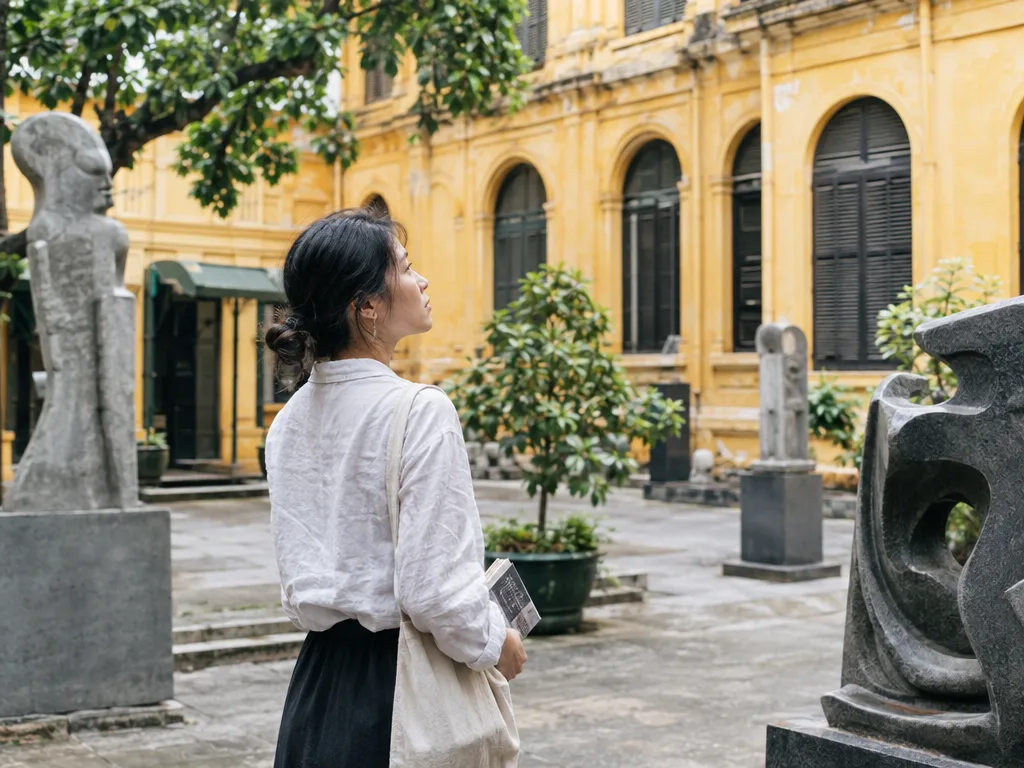
Hanoi’s art scene is easiest to enjoy when you stop treating it as a list of famous addresses. A better approach is to build a half-day around one substantial museum, one slower cultural stop, and enough unplanned time to notice the city between them. This Hanoi art itinerary is designed for first-time visitors, curious beginners, and travellers who want more context than a quick photo but do not want to spend an entire day indoors.
The route starts with the Vietnam National Fine Arts Museum, then broadens the idea of “art” through the Vietnam Museum of Ethnology. The two institutions offer different ways to look: one follows Vietnamese fine-art traditions across periods and media, while the other places objects, making, community life, and cultural interpretation in a wider frame. Treat the schedule as a flexible structure rather than a timed tour.
What this Hanoi art itinerary is designed to do
The dominant search intent behind a Hanoi art itinerary is practical: visitors want to know where to go, how to combine places sensibly, and what kind of experience each stop offers. Many quick guides name galleries without explaining how to choose between a museum, a temporary exhibition, a creative café, or a workshop. This route solves that problem by giving each stop a role.
- For visual history: begin with Vietnamese painting, sculpture, ceramics, folk art, and applied art.
- For cultural breadth: add a museum where objects are connected to communities, traditions, and everyday life.
- For a creative pause: leave time for a café, bookshop, small gallery, or independent space you discover nearby.
- For a low-pressure day: choose one main museum and one optional second stop instead of rushing through five venues.
This is especially useful in Hanoi, where a short distance on a map does not always feel short in traffic, heat, rain, or crowded streets. The best creative day has room for changing pace.
Stop one: start with the Vietnam National Fine Arts Museum
The Vietnam National Fine Arts Museum is the strongest first stop when you want a clear introduction to Vietnamese art. Its official English-language site describes displays spanning Vietnamese art from prehistory to the present, with areas covering periods, folk art, traditional applied art, ceramics, and modern media. The museum also identifies collections including lacquer, oil, silk, paper, folk paintings, sculpture, and Vietnamese ceramic art.
That range makes the museum valuable even if you do not already know the difference between Vietnamese lacquer, silk painting, or folk print traditions. Instead of trying to see everything, choose a question for your visit: how materials change across periods, how daily life enters art, or how older visual languages appear in modern work.
How to visit without museum fatigue
- Give yourself a generous first section, then pause before continuing.
- Choose a few works to look at closely rather than photographing every room.
- Read labels selectively: focus on the artist, material, date, and cultural context.
- Compare two works made in different materials and ask what the material changes.
- Keep the final part of your visit open for a temporary display or a gallery that catches your attention.
The museum’s current visitor information lists opening hours of 8:30–17:00 from Tuesday to Sunday and gives the address as 66 Nguyen Thai Hoc, Ba Dinh. These details can change, so check the official site before setting out, especially around public holidays or special exhibitions.
Build your visit around materials, not just masterpieces
A useful way to make a fine-arts museum feel approachable is to follow materials. Lacquer can lead you toward questions about surface, layering, colour, and patience. Silk paintings invite attention to line, translucency, and the relationship between empty space and detail. Ceramics and sculpture make you notice weight, texture, firing, carving, and the physical presence of an object.
This materials-first approach is better than searching for a single “must-see” work because it gives you a way to understand unfamiliar rooms. It also helps families and mixed-interest groups: one person can follow technique, another can follow stories, and everyone can compare what they notice.
Keep a small note on your phone with three prompts: What is this made from? What does the surface make me feel? What part of Vietnamese life or history might this work be responding to? You do not need a formal art vocabulary to have a meaningful answer.
Stop two: widen the frame at the Vietnam Museum of Ethnology
If you want the second half of the itinerary to connect creative work with living culture, the Vietnam Museum of Ethnology is a strong contrast to a fine-arts museum. Its official visitor information presents the museum as a place to learn about Vietnam’s 54 ethnic groups through exhibitions, research, educational activities, performances, and changing displays. Its permanent and temporary exhibition areas create a different rhythm from rooms organised mainly around art-historical periods.
This stop is useful for travellers who enjoy design, craft, architecture, textiles, performance, or material culture but do not necessarily want another conventional gallery. Look at how objects are made for use, ceremony, clothing, work, or social life. Notice how display choices shape your understanding: a tool, garment, house, or musical object can tell a story through function as much as through appearance.
Plan this stop as a slower cultural visit
- Read the introductory panels before moving quickly into individual objects.
- Compare an object made for daily use with one made for ceremony or display.
- Look for links between materials, climate, landscape, and local techniques.
- Allow time for educational or performance spaces if they are operating during your visit.
- Do not treat ethnic cultures as decorative themes; read the museum’s explanations and follow its presentation.
The museum’s English-language visitor page lists hours of 8:30–17:30 every day except Mondays and the New Year holiday, with an address on Nguyen Van Huyen Street in Nghia Do. It also lists a 40,000 VND admission fee. Confirm current details on the official site before visiting, since exhibitions, fees, and access arrangements may change.
Where to add a gallery, creative café, or workshop
After one or two institutions, the most rewarding creative space may be a small, less formal stop. Hanoi’s independent galleries, artist-led projects, creative cafés, bookshops, and workshops do not all work in the same way. Some are built around a scheduled exhibition; others are places to meet, browse, make something, or see how local creative communities use a room.
Choose this optional stop according to your energy. If you want conversation and ideas, look for a gallery or artist-run programme with a clear exhibition statement. If you want to make something with your hands, choose a workshop and check whether advance booking is required. If you need a quiet reset, a design-focused café or bookshop may be the better choice.
- Gallery: best for focused viewing and contemporary work.
- Workshop: best when you want a guided, hands-on activity.
- Creative café: best for a low-commitment pause and informal atmosphere.
- Bookshop or design store: best for continuing your research through books, prints, objects, or local publications.
Check the venue’s own current announcement before going. A creative space may have a new exhibition, a private event, a changed location, or a temporary closure. Avoid building your whole itinerary around a venue whose current details you have not confirmed.
Three ways to adapt the route
For a first-time visitor
Spend most of your time at the Vietnam National Fine Arts Museum, take a meal or coffee break, and add only one carefully chosen creative stop. This gives you a strong foundation without turning the day into a checklist.
For families and mixed-age groups
Use shorter viewing blocks and alternate looking with movement. The Museum of Ethnology’s educational activities, performance areas, and varied displays can make a useful second stop, but check what is operating on the day you visit.
For contemporary-art followers
Use the national museum for historical context, then spend your flexible afternoon time on a current exhibition or artist-led space. Search for the venue’s latest programme rather than relying on an old list of Hanoi galleries.
For rainy days
Keep the route museum-led, carry a light layer, and leave generous transfer time. Rain is a good reason to reduce the number of stops, not to pack in more. A careful two-venue day usually feels richer than a hurried indoor marathon.
Practical habits for a better creative day
- Check the date: museums may close on regular weekly days, holidays, or for installation work.
- Check the programme: temporary exhibitions and educational activities can change the character of a venue.
- Carry water: moving between indoor and outdoor spaces can be tiring even on a short route.
- Dress for respect and comfort: choose clothing that works for museums, neighbourhood streets, and weather.
- Ask before photographing: some exhibitions or works may have restrictions.
- Support the space: buy a catalogue, postcard, book, or workshop place when it feels useful rather than treating every venue as free entertainment.
- Leave room for discovery: the most memorable creative stop may be the one you find between planned destinations.
Most importantly, look at the people and processes around the work. A creative city is not only a collection of polished exhibitions. It is also made by teachers, conservators, designers, craftspeople, students, musicians, and small organisations that keep ideas moving.
A simple half-day schedule
Begin in the morning at the Vietnam National Fine Arts Museum, when you have the most attention for a substantial collection. Take a break for lunch or coffee, then decide whether you want a second museum or a lighter creative stop. If you choose the Vietnam Museum of Ethnology, allow enough time to read and explore instead of treating it as a quick add-on. If you choose an independent space, verify its current programme first.
End with a short reflection: which material, story, or display stayed with you? That answer can guide your next Hanoi visit more effectively than a ranking of “best” galleries. You might return for contemporary art, seek out a craft demonstration, explore a neighbourhood studio, or simply spend longer with one collection.
Final take: choose depth over a creative-space checklist
A good Hanoi art itinerary balances structure and curiosity. Start with a museum that gives you historical and material context, add a cultural institution that broadens the story, and leave space for an independent creative stop if it genuinely suits your interests. Check current visitor information, respect the institutions and communities you visit, and let the city between venues become part of the experience. You will see more by looking carefully at a few places than by rushing through every address on a map.
JOIN THE CONVERSATION
Comments (0)
No comments yet. Be the first to share a thought.