Hanoi is a rewarding city for travellers who would rather spend an afternoon looking closely than racing between landmarks. Its art scene is spread across museums, independent galleries, small studios, design-led cafés, bookshops, and older streets where creative work sits naturally beside everyday life. The challenge is not finding something interesting; it is choosing a rhythm that leaves room for discovery.
This self-guided Hanoi art day is designed for curious visitors who want context as well as photographs. It begins with the Vietnam National Fine Arts Museum, then moves through the central city at an unhurried pace. You can use it as a complete itinerary or as a framework for selecting two or three stops. For a broader introduction before you go, read our practical guide to art and creative spaces in Hanoi, then return here for a more focused day plan.
Why plan a Hanoi art day around a route?
Hanoi’s creative spaces do not form one compact museum district. A major collection may sit on a formal avenue, while a contemporary exhibition is tucked behind a narrow entrance or announced only through a venue’s current social channels. Treating the city as a route helps you avoid two common mistakes: trying to visit every gallery and assuming that every creative space operates like a conventional attraction.
A route also gives the day a useful contrast. Start with an institution that offers historical depth, continue with one smaller or more experimental space, and finish somewhere that lets you reflect. The result is more memorable than collecting a long list of names. It also makes the itinerary resilient: if a gallery is closed, you can spend longer with the museum collection, walk through a nearby neighbourhood, or pause at a café instead of losing the whole day.
For orientation, the site’s Art & Creative Spaces category is useful for finding related stories, while the Hanoi Walking Routes category can help you turn the gaps between venues into part of the experience.
Begin at the Vietnam National Fine Arts Museum
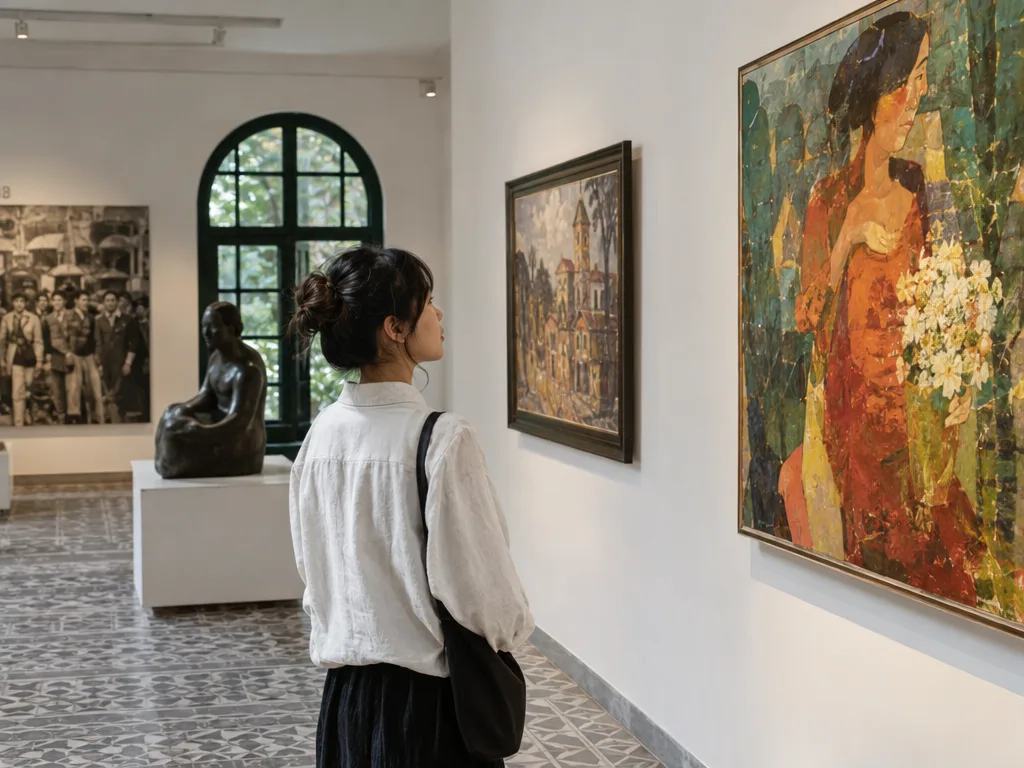
Make the Vietnam National Fine Arts Museum your anchor rather than a quick photo stop. Its official English website presents collections and displays covering Vietnamese art across long historical periods, including prehistoric and early historical art, art from the eleventh to the nineteenth centuries, and work from the early twentieth century to the present. It also highlights Vietnamese lacquer painting, folk art, traditional applied art, ceramics, sculpture, silk, oil, and paper paintings.
That range makes the museum especially valuable for visitors who are still learning how to look at Vietnamese art. Instead of meeting contemporary work without context, you can notice how materials, subjects, and visual traditions change over time. Lacquer, ceramics, silk, folk painting, and sculpture do not need to be treated as isolated categories; together they offer clues about craft, belief, daily life, and changing ideas of modernity.
How to visit without museum fatigue
- Choose three themes before entering, such as lacquer, ceramics, and twentieth-century painting.
- Spend more time with a few works than with every label. Ask what material you are seeing, how the surface has been built, and what the composition makes you notice first.
- Take a short pause between historical sections. A slower visit usually produces better memories than trying to remember an entire collection.
- Check the museum’s official visitor information on the day of your visit. Its English site currently lists opening hours of 8:30–17:00 from Tuesday to Sunday and gives the address as 66 Nguyen Thai Hoc Street in Ba Dinh.
The museum also maintains information about exhibitions, events, online exhibitions, and a three-dimensional tour. Those resources are useful if you want to preview a temporary show or decide whether a return visit is worthwhile. Because exhibitions and visitor arrangements can change, use the museum’s own site for the latest details rather than relying on an old itinerary.
Read Hanoi’s art history through materials
One of the strongest ways to understand a Hanoi art museum is to follow materials rather than dates. Vietnamese lacquer is a good example. Look for the depth of the surface, the relationship between sheen and darkness, and the way a scene can feel both decorative and atmospheric. With silk, pay attention to softness, transparency, and the quiet handling of colour. Ceramics invite a different kind of attention: shape, glaze, firing marks, and the relationship between an object’s use and its visual character.
This approach is practical for travellers because it turns a large collection into a manageable conversation. You do not need specialist vocabulary. Compare two works made with different materials and ask which one feels intimate, which one feels public, and which one depends most on craftsmanship. Then connect those observations to Hanoi itself: a city where food, architecture, domestic objects, street signs, and workshop traditions all carry visual information.
If you are travelling with someone who is less interested in museums, make the visit collaborative. Each person can choose one work and explain what drew them to it. A short conversation often reveals details that a hurried solo visit would miss.
Move from institutions to independent creative spaces
After the museum, shift scale. Independent galleries and creative venues can feel less formal, but that does not mean they are less serious. Some concentrate on emerging artists; others work with photography, illustration, design, craft, architecture, or multidisciplinary projects. A small room may contain only a handful of pieces, yet the curator’s choice and the arrangement of the space can tell you as much as the number of works.
Do not build this part of the day around a fixed list of “must-see” galleries. Instead, select one venue with a current exhibition that genuinely interests you. Check its official page before setting out for the address, opening status, and any visitor instructions. In Hanoi, exhibition schedules can change, and a creative venue may have a different rhythm from a public museum.
What to look for in a small gallery
- Read the exhibition title and short curatorial statement before looking at individual works.
- Notice how the room controls movement. Is the show asking you to follow a sequence, compare works, or linger in one area?
- Look beyond the most immediately attractive piece. The quieter work may explain the exhibition’s idea more clearly.
- Ask politely whether photography is allowed. Rules vary, especially for works on loan or exhibitions with sensitive materials.
For more background on the city’s broader creative network, our story on where to find Hanoi’s creative side is a useful companion. It is deliberately wider than a single museum visit, so you can adapt the route to the exhibitions available during your stay.
Use the walk between venues as part of the itinerary
The spaces between art venues are not dead time. Central Hanoi’s streets offer a changing visual field of façades, balconies, shopfronts, repair work, signs, trees, and improvised displays. Walk with a simple assignment: photograph only textures, only thresholds, or only objects that show evidence of handwork. This keeps the walk attentive without turning it into a hunt for famous landmarks.
Keep the walking section flexible. Hanoi’s heat, rain, traffic, and pavement conditions can change the feel of a route quickly. Use a map for orientation, but do not insist on following a perfect line. A shaded side street, a bookshop, or a small exhibition notice may be a better discovery than the next planned pin.
If you want a more structured way to connect neighbourhoods and landmarks, browse the guide to Hanoi walking routes for curious travellers. The key idea is to make the city itself part of the viewing experience: art does not stop when you leave the gallery.
Add one creative pause, not five
A café or design-minded hangout can give the day a necessary change of pace, but choose one pause intentionally. The best stop is somewhere you can sit without feeling pressured to move on immediately. Use the break to write down the works you remember, look up an artist whose name caught your attention, or sketch a doorway and its surrounding details.
This is also a good moment to decide whether you want a second exhibition. If you are still curious, continue. If your attention is fading, stop. Art travel is not improved by turning every room into an endurance test. A quiet meal, a short rest, or an early evening walk may leave you more receptive the next day.
Travellers who enjoy pairing creative stops with local routines can also explore the Secret Cafes & Hangouts category. It offers a natural way to extend an art-focused afternoon without forcing every stop to be officially labelled an art venue.
Build three versions of the day
The focused version
Spend most of the day at the Vietnam National Fine Arts Museum, take a thoughtful walk afterwards, and visit one independent gallery if its current exhibition matches your interests. This is the best choice for first-time visitors who want historical grounding.
The rainy-day version
Keep outdoor walking short, confirm opening information in advance, and prioritise the museum plus one indoor creative venue. Carry a small notebook rather than planning a long route. If the weather improves, add a brief neighbourhood walk at the end.
The repeat-visitor version
Skip the pressure to see the major collection again. Choose a temporary exhibition, a design or craft space, and a café where you can review what you saw. Return to the museum only for a specific collection or material, such as lacquer or ceramics.
Practical etiquette for Hanoi’s art spaces
Dress comfortably and keep your belongings manageable. Ask before photographing, especially when staff are present or a show includes private loans. Do not touch surfaces, lean on plinths, or block a narrow room while composing a picture. In a small gallery, a quiet greeting and a little patience go a long way; staff may be preparing an exhibition rather than operating a conventional ticket desk.
Save venue addresses in both Vietnamese and English where possible. Showing the exact address to a driver or checking it against the venue’s own page is more reliable than relying on a translated name alone. Also check whether a venue is open on the particular day you plan to visit. The Vietnam National Fine Arts Museum, for example, lists Tuesday-to-Sunday visiting hours on its official site, so Monday planning requires a different anchor.
How to make the day feel personal
Before bed, choose three works or details that stayed with you and write one sentence about each. You might remember a lacquer surface, the restraint of a silk painting, the shape of a ceramic vessel, or an ordinary street detail that suddenly looked composed. This small practice turns an itinerary into a personal record rather than a collection of locations.
You can also return to one neighbourhood at a different time of day. Morning light, afternoon activity, and evening illumination change the way façades and public spaces read. That repeat visit is often where Hanoi’s creative character becomes clearest: not as a separate attraction, but as a way the city’s residents use, repair, arrange, and reinterpret their surroundings.
Conclusion
A good Hanoi art day does not require a packed schedule. Begin with the Vietnam National Fine Arts Museum for historical and material context, choose one current independent exhibition, and let the walk between them remain open to visual discoveries. Add one comfortable creative pause, check official venue information before travelling, and leave enough time for your attention to settle. The reward is a richer understanding of Hanoi’s art scene—and a day that feels lived rather than merely completed.
JOIN THE CONVERSATION
Comments (0)
No comments yet. Be the first to share a thought.