Hanoi is easiest to understand through contrasts: imperial forms beside modern apartments, careful craft beside experimental installation, and quiet rooms of paintings beside cafés where artists, students, and curious visitors linger. If you are searching for Hanoi art galleries and museums, the challenge is not finding one place to visit. It is choosing a small group of spaces that gives you a sense of the city without turning your day into a checklist.
This guide builds a flexible art day around three different experiences: a substantial museum collection, a contemporary exhibition venue, and a smaller independent art space. You can follow the route in one day, spread it over a weekend, or use it as a framework when exhibitions change. For a wider first look at the city’s creative scene, pair it with Where to Find Hanoi’s Creative Side, then use the suggestions below to slow down and look more closely.
Start with the Vietnam National Fine Arts Museum
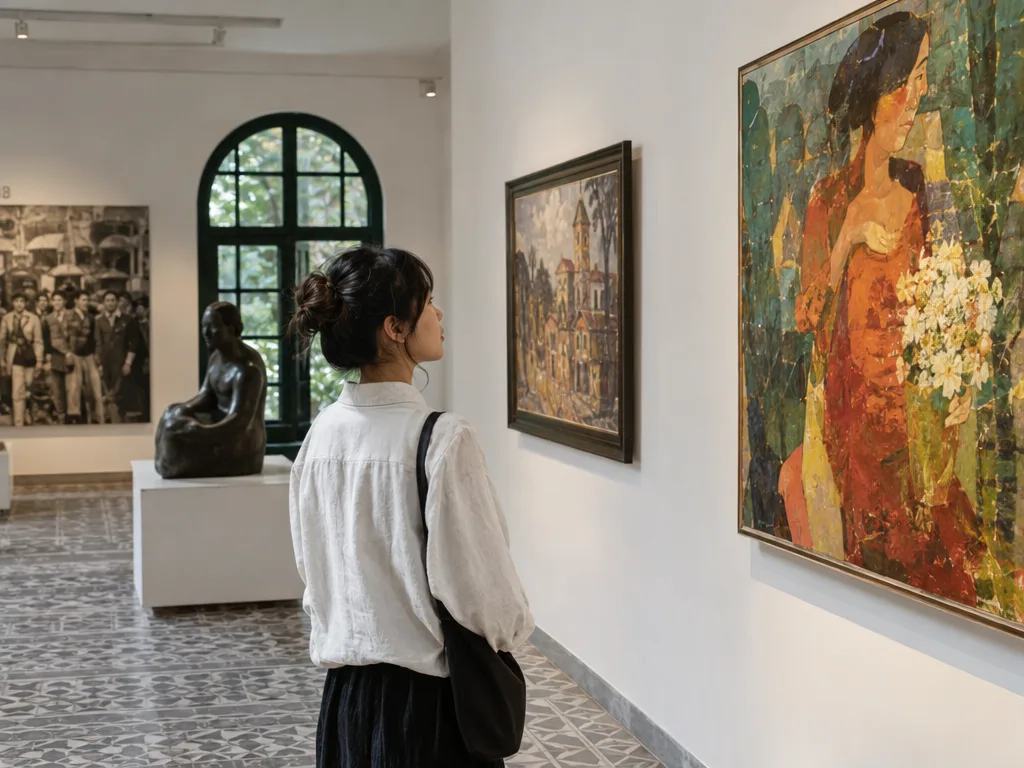
The Vietnam National Fine Arts Museum is the strongest starting point when you want context rather than a quick photo stop. Its collection covers Vietnamese art from prehistory and early history through the nineteenth century, the early twentieth century, and the present day. The museum also presents traditional applied art, folk art, ceramics, lacquer, oil, silk, paper paintings, and sculpture. That range matters because it helps you see how materials and visual ideas developed across different periods instead of treating contemporary art as separate from Vietnam’s longer artistic history.
The museum’s official visitor information lists its address as 66 Nguyen Thai Hoc Street in Ba Dinh and its regular visit period as Tuesday to Sunday, 8:30 to 17:00. Monday is therefore a poor day to build your entire art plan around this stop. Opening information and exhibition schedules can change, so check the museum’s own visit and events pages before setting out.
How to look without rushing
Give yourself at least ninety minutes if you want more than a highlights tour. Begin with one historical section, then choose a material that interests you. Lacquer is a useful thread for first-time visitors because it connects surface, craft, color, and modern Vietnamese painting. Ceramics and folk art offer another route into the relationship between everyday objects, ritual, and design.
Do not try to remember every artist or date. Instead, note three things: how a work uses space, which materials appear repeatedly, and what feels distinctively local to you. This approach makes the museum more approachable for visitors who do not usually study art. The museum also highlights educational and interactive activities, so families and travelers who prefer participation should check current programming rather than assuming the visit is only about silent galleries.
Move from collection to contemporary art at VCCA
For a different rhythm, visit the Vincom Center for Contemporary Art, commonly known as VCCA. Its official site places the center at B1-R3, Royal City, 72A Nguyen Trai Street, Thanh Xuan, Hanoi. The venue focuses on contemporary exhibitions and also lists talks, tours, and workshops among its activities. That makes it useful when you want to see how current artists and curators frame questions about society, identity, science, place, or visual culture.
VCCA works well after a museum because the contrast is immediate. In a museum, the building’s collection gives you a long historical arc. In a contemporary art center, the exhibition itself usually supplies the frame: a particular theme, artist, medium, or argument. Read the wall text, but do not feel obliged to agree with it before you form your own response. Ask what the installation makes you notice, what it leaves out, and whether the room changes as you move through it.
Plan around the exhibition, not a permanent checklist
Contemporary programs are temporary by nature. VCCA’s website publishes exhibitions and events, including talks and educational activities, so check the current listing before travelling across the city. A space may be worthwhile on one visit and less relevant on another depending on what is showing. This is not a drawback; it is part of how contemporary art spaces work.
Royal City is a large complex, so allow extra time to find the correct level and entrance. If your group has mixed interests, the surrounding complex can make this a practical stop, but keep the art visit as the main purpose. A short exhibition can be more rewarding when you spend ten focused minutes with one work than when you hurry through every room.
Choose an independent atmosphere at Manzi Art Space
Manzi offers a smaller, more intimate experience. Its official site describes the Hanoi operation as an art space, exhibition space, and café, and lists Manzi Art Space at 14 Phan Huy Ich Street with Manzi Exhibition Space at 2 Ngo Hang Bun, both in Ba Dinh. Because the two Hanoi locations serve different functions, check the current listing before you go rather than assuming every exhibition or café feature is at the same address.
This is the kind of place to use when you want to spend time with a modest number of works. Independent spaces can feel less ceremonial than major museums: you may encounter a focused solo show, a group exhibition, a talk, or a quieter café setting where the art is part of the atmosphere rather than the entire building. That informality is valuable, but it also means you should be considerate. Keep voices low during exhibitions, ask before photographing anything, and do not treat a working art space as a backdrop.
What makes a small gallery worth your time?
Look for evidence of a clear curatorial idea. Does the exhibition use the room well? Do the works speak to one another, or are they simply placed together? Is the artist exploring material, memory, urban life, ecology, or personal experience in a way that rewards patience? You do not need specialist vocabulary to answer these questions. A small gallery is successful when it gives you one or two ideas that stay with you after you leave.
Build a route that matches your energy
The three spaces above are not a single compact walking loop. They sit in different parts of Hanoi, so the best route depends on your starting point, the day’s opening information, and how much time you want to spend travelling. Treat them as anchors rather than promises of a perfectly walkable itinerary.
A full art day
- Morning: start at the Vietnam National Fine Arts Museum while your attention is fresh. Focus on one historical sequence and one material tradition.
- Early afternoon: take a break for lunch and travel toward your next area rather than trying to add another attraction immediately.
- Afternoon: visit VCCA if the current exhibition matches your interests. Read the program details before going.
- Late afternoon or evening: choose Manzi only if a current exhibition or event appeals to you. A smaller space deserves a slower visit, not a rushed final tick.
If this feels too ambitious, choose two venues. A museum plus an independent gallery usually creates a better balance than three hurried stops. Travelers who enjoy walking can connect part of the day with ideas from The Best Hanoi Walking Routes for Curious Travellers, but use a taxi or ride-hailing service when the heat, rain, or traffic makes the transfer uncomfortable.
A half-day plan
For a shorter visit, choose the Vietnam National Fine Arts Museum if you want historical depth, VCCA if you prefer a current exhibition, or Manzi if you value a compact independent setting. Do not choose based only on which name appears most often online. Choose based on the kind of attention you have available. A tired visitor may enjoy one focused gallery more than a large collection.
Use Hanoi’s neighbourhoods as part of the art experience
Art spaces do not exist outside the city around them. Ba Dinh gives you a chance to notice embassies, older villas, institutional buildings, and tree-lined streets between visits. Thanh Xuan feels more modern and commercial around Royal City. These contrasting surroundings can help you understand why Hanoi’s creative scene is varied: artists and audiences move between inherited urban fabric, new developments, cafés, studios, and cultural institutions.
If you want to extend the day beyond galleries, browse Hanoi’s Local Neighborhoods for ideas about seeing the city through its districts, or use the Local Events & Weekend Activities category when your dates allow room for talks, workshops, or temporary programs. These links are useful because the most interesting creative experience may be an event that was not on your original list.
Practical etiquette for Hanoi art spaces
Check the official venue website or social channels on the day of your visit, especially for temporary exhibitions, talks, and workshops. Do not rely on an old blog post for opening hours, admission arrangements, or venue details. If a page is in Vietnamese, browser translation can help, but confirm the date and location carefully.
Dress comfortably for walking and indoor air-conditioning. Carry water, but follow each venue’s rules about drinks inside exhibition rooms. Ask before using flash photography or photographing people. If an artist or staff member is present, a simple question about the exhibition is often more welcome than a long attempt to sound knowledgeable. And if a work does not make sense immediately, give it a little longer before moving on.
What to do when a venue is closed
Have a flexible backup rather than forcing the day to continue. You can spend time in the surrounding neighbourhood, visit a café, or switch from a large museum to a small gallery. For a broader city plan, How to Experience Hanoi Like a Local in One Day offers a useful framework for combining cultural stops with ordinary street life. The point is not to collect venues; it is to leave with a more textured impression of Hanoi.
How to choose the right art experience
Use the museum when you want historical grounding, the contemporary art center when you want a current curatorial conversation, and the independent space when you want intimacy and discovery. Families may prefer a museum with educational activities or a workshop. First-time visitors who feel uncertain about contemporary art may find it easier to begin with the museum and then try one temporary exhibition. Repeat visitors can reverse the order and let a new gallery show shape the rest of the day.
It is also worth separating “famous” from “interesting.” A famous venue may be essential for context, while a small show may become the most memorable part of your trip. Leave room for that possibility. Hanoi’s creative spaces are not a single attraction with a fixed route; they are a changing network of collections, exhibitions, conversations, cafés, and people making things.
A slower, better way to see Hanoi’s creative side
The best Hanoi art itinerary is selective. Start with one institution that gives you context, add one contemporary or independent space, and protect enough time to notice the streets between them. Confirm current details before travelling, especially when your plan depends on a temporary exhibition or event.
Whether you spend a full day or only a few hours, let the visit be guided by curiosity rather than completion. A painting that changes how you see Hanoi’s colors, a sculpture that makes you think about craft, or a conversation overheard after a talk can be more valuable than another rushed stop. That is the real appeal of exploring Hanoi’s art galleries and museums: the city’s creative life becomes easier to feel when you give it room.
JOIN THE CONVERSATION
Comments (0)
No comments yet. Be the first to share a thought.