Hanoi’s art scene rewards curiosity rather than speed. You can spend a morning with Vietnamese painting, find a quiet contemporary exhibition after lunch, and still have time to notice the studios, bookshops, cafés, and small cultural rooms that give the city its creative texture. The best way to explore is not to chase every venue, but to understand what each kind of space offers and build a day around your interests.
This guide to Hanoi art spaces is designed for travelers who want more than a checklist. It explains where to begin, how to combine formal museums with independent spaces, what to look for in different neighborhoods, and how to plan a creative outing without relying on unverified schedules. For a broader orientation, pair it with our practical guide to art and creative spaces in Hanoi, then use the ideas below to make the experience more personal.
Start with the kind of art experience you want
“Art spaces in Hanoi” can mean very different things. A national museum offers historical context and a substantial collection. A contemporary gallery may focus on one artist or a temporary exhibition. An artist-run project can feel closer to a conversation than a conventional visit. Craft workshops, design stores, and creative cafés add another layer: they show how making, collecting, and everyday life overlap in the city.
Before leaving your hotel, choose one main purpose:
- Build context: begin with Vietnamese art history, materials, and major periods.
- See current work: look for temporary exhibitions and contemporary practice.
- Meet the creative city: explore studios, workshops, design-led cafés, and small project spaces.
- Make something: choose a hands-on activity such as printmaking, ceramics, lacquer, drawing, or craft.
This simple choice prevents a common mistake: trying to fit a museum, several galleries, a workshop, and a long cross-city transfer into one rushed afternoon. Hanoi is more enjoyable when you leave room for discovery.
Begin at the Vietnam National Fine Arts Museum
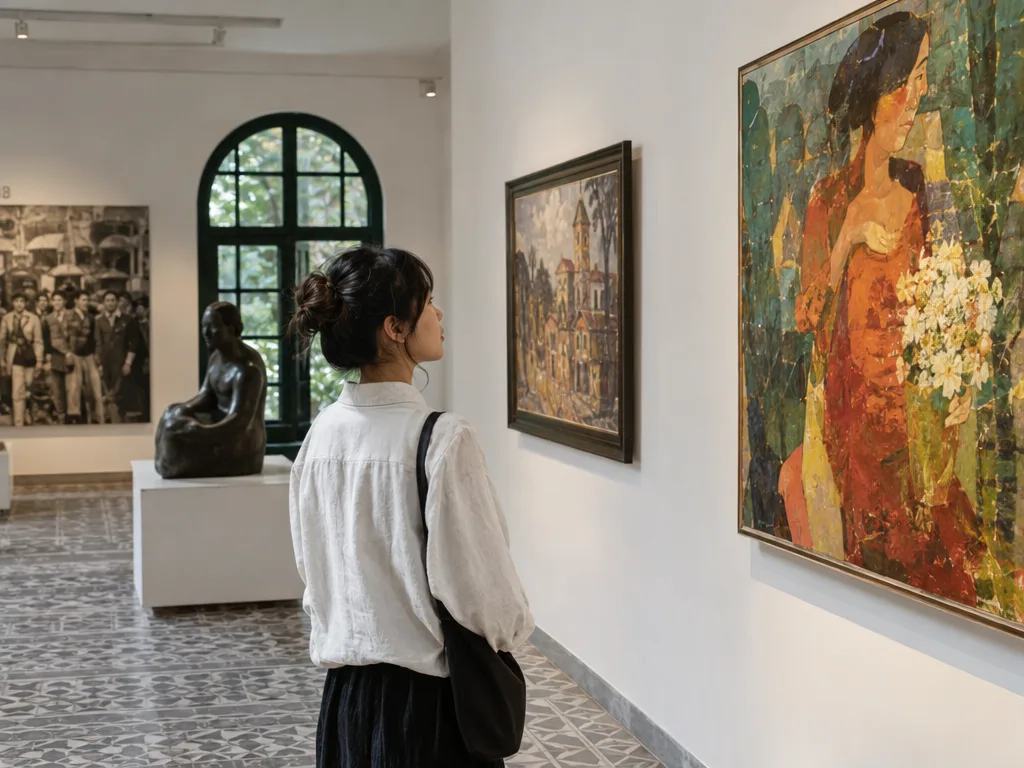
For travelers new to Vietnamese art, the Vietnam National Fine Arts Museum is the most useful anchor. Its official site describes displays ranging from prehistoric and early historical art to work from the eleventh through nineteenth centuries, early twentieth-century art, traditional applied art, folk art, and Vietnamese ceramics. Its collection also includes lacquer, oil, silk, paper paintings, folk paintings, sculpture, and ceramics.
The museum’s range matters because it gives you visual references for the rest of your trip. You start noticing the qualities of lacquer, the importance of silk and paper, the relationship between religious imagery and daily life, and the way modern Vietnamese artists respond to earlier traditions. Even if you are not an art specialist, this context makes a later gallery visit more rewarding.
The museum’s official visitor information lists its address at 66 Nguyen Thai Hoc in Ba Dinh and gives visiting hours of 8:30 to 17:00 from Tuesday to Sunday. Treat that as a planning reference, not a substitute for checking the official site before you go: exhibitions, closures, and service arrangements can change.
How to visit without becoming tired
Do not try to read every label. Choose a small theme, such as lacquer painting, sculpture, folk art, or the development of modern Vietnamese art. Spend longer with works that hold your attention, and note three details: material, subject, and technique. A short break afterward will help you remember what you saw better than another hurried gallery.
The museum also highlights education activities, conservation and restoration, and a café among its services. Those details are a reminder that a museum is not only a storage place for old objects; it is also a working cultural institution. If you are visiting with children or someone who prefers making to looking, check whether an educational activity is available during your dates.
Use contemporary galleries to see Hanoi now
After a museum, a contemporary art space can change your sense of scale. Instead of moving through a long historical story, you may encounter a focused exhibition, a new body of work, or a curatorial idea that asks you to slow down. Some spaces are polished and commercial; others are experimental, intimate, or attached to a wider cultural program.
When choosing a gallery, look for information about the current exhibition rather than relying only on a venue’s reputation. Ask:
- Is the exhibition open during your visit dates?
- Is the space showing one artist, a group show, or a themed project?
- Are labels available in English or Vietnamese only?
- Is photography allowed?
- Does the venue expect visitors to reserve, or can you walk in?
These questions are especially useful in Hanoi, where small programs may be announced through social media or change more quickly than a printed guide. If a venue does not publish clear information, treat it as an optional stop and keep a flexible alternative nearby.
For a neighborhood-based approach, browse the site’s Art & Creative Spaces category alongside our article on where to find Hanoi’s creative side. The two resources work well together: one helps you identify the type of place, while the other encourages you to notice the city beyond formal institutions.
Look for the connection between art and craft
Hanoi’s creative identity is not limited to paintings on gallery walls. Craft, design, architecture, publishing, food presentation, and street life all influence how the city looks and feels. A craft workshop may teach you more about patience and materials than a quick stop at several exhibitions. A design shop may reveal how traditional motifs are adapted for contemporary objects. A bookshop or cultural café can show how artists, writers, students, and designers share ideas.
Choose an activity that matches your energy
- Low energy: visit a museum, browse a design shop, or sit in a café with an exhibition program.
- Medium energy: walk between galleries, sketch architectural details, or join a short guided visit.
- Hands-on energy: book a workshop and accept that making something imperfect is part of the experience.
Workshops deserve advance checking. Confirm the duration, language, materials included, meeting point, cancellation policy, and whether the finished object can be taken home. Avoid assuming that a workshop is available every day or that a venue accepts spontaneous participants.
Build an art walk around one neighborhood
A creative outing works best when geography supports it. Rather than crossing Hanoi repeatedly, choose one anchor and explore the nearby streets on foot. Ba Dinh is a natural starting point for a museum-led day. The Old Quarter can add bookshops, cafés, architecture, and small cultural stops, although busy streets and traffic make it better for short, intentional walks than for wandering without a plan. Areas around West Lake can suit visitors who prefer a slower rhythm, independent cafés, and a more spacious feeling.
Think in layers:
- Anchor: one museum, gallery, or booked workshop.
- Companion stop: a second place that offers a different kind of experience.
- Reset: food, coffee, or a quiet street where you can discuss what you saw.
- Open time: at least one unplanned hour for a shop, exhibition poster, or unexpected doorway.
If you enjoy walking between creative stops, our Hanoi Walking Routes category can help you think about distance, pace, and street-level detail. Do not treat an art walk as a race. The visual experience often continues outside the venue: faded shop signs, tiled façades, repair work, plants on balconies, and the changing light on old walls are all part of Hanoi’s creative atmosphere.
Plan around exhibitions, not permanent assumptions
Permanent collections provide the safest foundation, but temporary exhibitions are often the reason to revisit a venue. The Vietnam National Fine Arts Museum maintains official pages for exhibitions and events, and its homepage shows that programs can include contemporary displays, cultural exchange, and special exhibitions. Check the venue’s own calendar close to your visit and record the date, location, and language information.
Do not build an itinerary around a headline alone. Confirm whether the event is open to the public, whether the listed dates are opening dates or the full run, and whether a talk or workshop requires registration. If a page looks outdated, contact the venue or choose a permanent collection as your dependable alternative.
For weekend planning, you can also browse Local Events & Weekend Activities. It is a useful companion category when your art day includes a talk, market, performance, screening, or pop-up that does not fit neatly inside a gallery visit.
Simple etiquette for Hanoi art spaces
Most art visits become easier when you behave as though the space is both public and cared for. Keep your voice low, follow photography signs, and ask before touching materials or furniture. In small galleries, greet the person at the desk; they may be the curator, artist, or organizer. If you do not understand a work, “I’m still looking” is a perfectly good response. You do not need specialist vocabulary to participate.
Dress comfortably for walking and bring a small bag rather than a large backpack when possible. Keep drinks outside exhibition rooms unless the venue clearly permits them. If you are sketching, use a pencil and check whether stools or tripods are allowed. When attending a workshop, arrive early enough to find the location without interrupting the session.
A flexible one-day creative itinerary
Start in the morning with the Vietnam National Fine Arts Museum, using one collection theme as your guide. Afterward, take a proper break rather than immediately adding another large attraction. In the afternoon, choose one contemporary gallery or small project space whose current exhibition genuinely interests you. End with a design shop, bookshop, café, or craft activity close to your final stop.
If your priority is making, reverse the order: take the workshop first, then visit a museum or gallery while the materials and techniques are fresh in your mind. If you are traveling with children, replace a second formal exhibition with a short creative activity and keep the route compact. If rain changes your plans, use the museum and an indoor café or gallery as your dependable core.
How to leave with more than photographs
Before you finish, write down three things: one material you noticed, one question you still have, and one place you would return to. Buy only what you can carry and care for; a small print, postcard, book, or locally made object can be a more meaningful souvenir than a rushed shopping list. Most importantly, allow the city’s creative life to remain partly unresolved. The point of exploring Hanoi art spaces is not to collect proof that you visited everywhere. It is to become more attentive to how history, craft, experimentation, and ordinary life meet in the same streets.
Hanoi’s creative scene is easiest to enjoy when you combine one reliable institution with one current or independent space, then leave room for the neighborhood between them. Start with context, follow your curiosity, verify practical details, and let the day move at a human pace.
JOIN THE CONVERSATION
Comments (0)
No comments yet. Be the first to share a thought.