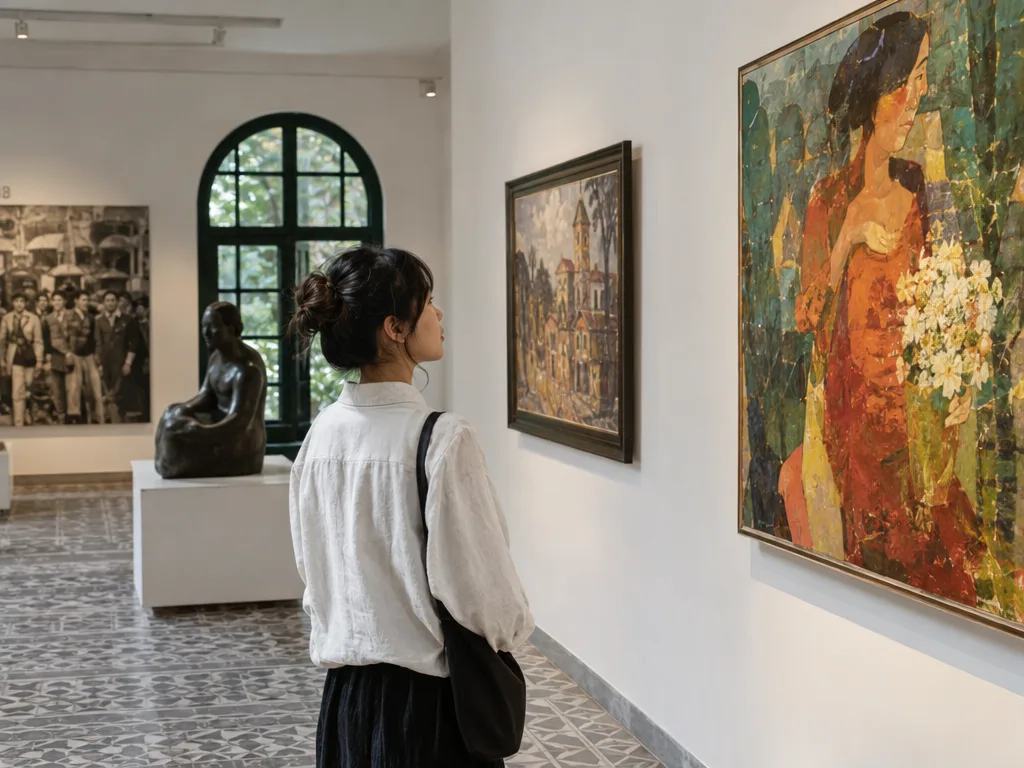
Hanoi’s art scene is easier to enjoy when you treat it as a route rather than a checklist. A museum visit can give you historical context, a contemporary art centre can show how artists are working now, and a small gallery or workshop can make the city’s creative life feel more personal. This self-guided Hanoi art gallery route is designed for curious visitors who want a manageable day of looking, learning, and leaving room for discovery.
What this Hanoi art route is designed to do
The aim is not to name every gallery in the city. Exhibition programmes change, independent spaces move, and a venue that suits one visitor may feel quiet or inaccessible to another. Instead, build your day around three kinds of stop: one institution for context, one contemporary venue for a more focused encounter, and one flexible creative stop chosen after you see what interests you.
This approach also prevents a common mistake: rushing through several rooms simply to collect addresses. Art rewards attention. Two thoughtful stops with time for coffee, notes, or a second look can be more memorable than six hurried visits. If you are travelling with someone who is less confident around art, the route works well because each stop has a different purpose.
Start with the Vietnam National Fine Arts Museum
For a first stop, the Vietnam National Fine Arts Museum is the strongest place to establish context. Its official visitor information lists the museum at 66 Nguyen Thai Hoc in Ba Dinh and gives visiting hours of 8:30 to 17:00 from Tuesday to Sunday. Check the museum’s own site before setting out, especially around public holidays or special programmes.
The museum’s collection is broad rather than narrowly contemporary. Its official overview says it preserves around 20,000 objects and artworks, while its displays include approximately 2,000 special works representing Vietnamese art from prehistory to the present. That range makes the museum useful even if your main interest is modern painting: you can see how materials, subjects, symbols, and techniques developed over time.
How to look without becoming overwhelmed
- Choose one thread before you enter, such as lacquer, ceramics, folk art, sculpture, or the relationship between everyday life and painting.
- Give yourself permission to skip rooms. A museum visit is not an exam, and you do not need to remember every artist.
- Write down three works that held your attention and one question each work raised.
- Reserve energy for the later stop. The point of the route is comparison, not exhaustion.
The museum also highlights a contemporary gallery with more than 60 works created from the 1980s onwards, across painting, graphic art, and sculpture. That makes it a useful bridge between historical collections and the newer work you may encounter elsewhere in Hanoi.
Continue with a contemporary art centre
After a museum, a contemporary venue can change the pace of the day. Vincom Center for Contemporary Art, known as VCCA, lists its Hanoi location at B1-R3, Royal City, 72A Nguyen Trãi, Thanh Xuan, on its official website. Its programme combines exhibitions with art talks, tours, and workshops, so it is worth checking the current calendar rather than assuming every visit will offer the same experience.
A contemporary exhibition often asks you to spend longer with fewer works. You may encounter installations, mixed media, photography, video, or an arrangement that makes more sense after reading the curatorial text. Do not worry if the first room feels unfamiliar. Start by asking simple questions: What materials are being used? What changes when I move around the work? Is the artist telling a story, building an atmosphere, or asking me to notice a social issue?
How to make the second stop useful
- Read the exhibition introduction, but do not let it replace your own first impression.
- Look for a work that connects, contrasts, or argues with something you saw at the museum.
- Ask staff whether talks, guided tours, or educational activities are running during your visit.
- Take notes on the space as well as the art: scale, lighting, sound, and how visitors move through it.
The contrast between a long historical timeline and a focused contemporary exhibition is the main value of this pairing. One gives you a vocabulary; the other shows how that vocabulary can be questioned or extended.
Choose a smaller gallery or artist-led space for the final stop
Use the third stop to follow your own curiosity. Rather than selecting a gallery because it appears on a generic list, look for a current programme whose subject, medium, or artist interests you. Independent galleries and artist-led spaces can be excellent places to see emerging work, but they may have different opening patterns and event schedules. Verify the venue’s current information through its official page or social channel before travelling across town.
This is also the point where a creative café, design shop, print studio, or hands-on workshop may fit better than another formal exhibition. The Art & Creative Spaces category is broad for a reason: Hanoi’s creative life is not limited to white walls. A workshop can help you understand process; a design-focused stop can reveal how local visual ideas move into objects; a small gallery can offer a direct conversation with the city’s current art community.
Questions to ask before committing
- Does the venue show a current exhibition or clearly describe its regular activity?
- Is the visit primarily for viewing, buying, learning, or meeting people?
- Would the space be comfortable for your group and available at the time you plan to arrive?
- Can you visit respectfully without interrupting a working studio or residential building?
When information is limited, treat the stop as an optional detour rather than the anchor of your day. That keeps your route flexible and avoids turning an outdated listing into a disappointment.
Plan the route around attention, not distance
Hanoi traffic and weather can make a short map distance feel longer than expected. Plan one main museum or exhibition before lunch, a genuine pause, and one later venue. If you want a third stop, choose it only after checking the day’s programme. A route with breathing room is especially helpful in the hotter months, when moving between air-conditioned galleries and busy streets can be tiring.
Use broad time blocks rather than a rigid minute-by-minute schedule. For example, you might spend the morning at the national museum, pause for lunch or coffee, and use the afternoon for a contemporary centre or smaller gallery. The exact order can change depending on opening days, temporary exhibitions, and where you are staying. Always confirm current hours and access details directly with each venue.
A simple decision rule
If the first stop leaves you interested in technique and history, choose a museum collection or craft-focused space next. If it leaves you thinking about social themes or new media, look for a contemporary exhibition. If you mainly enjoyed the atmosphere and meeting people, choose a talk, workshop, or artist-led venue. Let your response guide the next choice instead of following a fixed “best of” ranking.
When one excellent stop is better than three
Not every art day needs a full itinerary. Choose one main venue when you are travelling with children, working around a short museum opening window, or visiting during heavy rain or heat. A single institution can still feel substantial if you slow down, take a break, and return to a room that caught your attention. It is also the better choice when a temporary exhibition is central to your plans and you want time for talks, reading, or a workshop.
Use the three-stop structure when you want comparison and variety. Use the one-stop version when you want depth. The useful question is not how many places you can fit in, but whether you will have enough attention left to understand what you are seeing. A flexible plan makes it easier to change course without feeling that the day has gone wrong.
Art etiquette that makes visits better
Creative spaces are often working environments, not just attractions. Speak quietly when others are viewing, follow photography instructions, and ask before taking pictures of artworks, staff, or visitors. Do not touch a work unless the venue clearly invites interaction. At a workshop, arrive ready to listen to the facilitator and accept that the finished object may be less important than learning the process.
In smaller spaces, a little awareness matters. Avoid blocking a doorway or using a narrow room as a photo set. If an artist or curator is present, a specific question about the work is more useful than a request for a quick performance. Buying a catalogue, print, or small object is optional; respectful attention is not.
What to pack and what to check
- A phone with the venue’s official page saved, plus a way to take brief notes.
- Comfortable shoes and water for the streets between stops.
- A small amount of flexibility in case an exhibition changes or a venue is closed.
- Enough time to read labels and sit with one or two works.
- A translation app if you want help with Vietnamese exhibition text, while remembering that visual interpretation does not require perfect language access.
Before leaving your accommodation, check the official museum or venue page for the address, opening status, ticket information, photography rules, and programme. Do not rely on a social post from an old season or a third-party listing that has not been updated.
How to turn the day into a personal creative map
At the end of the route, review your notes while the experience is still fresh. Group what you saw by material, mood, subject, or question rather than by venue. You may discover that a lacquer painting, a contemporary installation, and a small design object share an interest in texture or memory. That connection is often more valuable than a list of names.
You can also use the day to plan a second visit. Perhaps you want to explore Vietnamese ceramics in more depth, return for an artist talk, or seek a workshop that lets you handle materials. Hanoi’s creative spaces become easier to navigate once you know what kind of attention you enjoy giving them.
A flexible Hanoi art itinerary to remember
A good Hanoi art route has three qualities: it begins with context, makes room for a contemporary response, and leaves one choice open for discovery. Start at the Vietnam National Fine Arts Museum, compare that experience with a current programme at a contemporary art centre such as VCCA, then choose a smaller gallery, studio, workshop, or design-led stop based on your interests and the day’s verified information. You will see more clearly, travel with less pressure, and leave with a stronger sense of how Hanoi’s creative life connects past and present.
JOIN THE CONVERSATION
Comments (0)
No comments yet. Be the first to share a thought.