Some Hanoi walks are built around a checklist of famous sights. This one is better understood as a change of pace: begin near the old commercial heart, follow streets that gradually become quieter, and finish among the formal spaces of Ba Dinh. It is a Hanoi walking route for travellers who want history, shade, small street scenes, and enough flexibility to stop when the city becomes interesting.
The route works best as a half-day plan rather than a race. Start in the morning, carry water, and treat the sequence as a framework. You can shorten it around Hoan Kiem or extend it towards the Imperial Citadel of Thang Long. For a wider first-day plan, pair it with How to Experience Hanoi Like a Local in One Day, then return here when you want a slower walk.
Why this Hanoi walking route feels different
Hanoi changes character within a few blocks. Around the Old Quarter, shopfronts, scooters, coffee counters, and narrow lanes create a close, lively rhythm. As you move west and north, the streets open up. Government buildings, mature trees, museums, lakes, and historic compounds make the walk feel more spacious without removing the everyday life that makes Hanoi distinctive.
The route links three useful ideas for a visitor: the city’s trading past, its public civic spaces, and the places where older layers of Vietnamese history remain visible. You do not need to enter every attraction to enjoy it. The value is in noticing the transitions between them: how shop signs give way to villas, how traffic changes near broad avenues, and how people use pavements differently from one neighbourhood to the next.
It is also a good alternative to a generic “top attractions” itinerary. If you prefer local texture over rushing between ticket gates, browse the site’s Hanoi walking routes category for more ways to explore on foot.
Start at Hoan Kiem and let the Old Quarter wake up
The first stretch: lake edge to market streets
Begin at the northern or eastern side of Hoan Kiem Lake, depending on where you are staying. Walk beside the water before turning into the Old Quarter. This opening gives you a calm orientation point: look across the lake, watch early exercise groups, and notice how quickly the atmosphere changes once you reach the commercial streets.
Rather than trying to cover every lane, choose a loose westward direction. Streets around Hang Be, Hang Bac, Ma May, and the neighbouring blocks offer a useful introduction to Hanoi’s old trading identity. The point is not to memorise names. Look for the way businesses still cluster by trade, the narrow building fronts, the layers of signs, and the mix of homes, workshops, cafés, and small hotels.
Keep your walking line flexible. A lane that appears unimportant may contain a shaded courtyard, a family altar behind an open doorway, or a tiny breakfast counter. Ask before photographing people or private spaces. The most rewarding Old Quarter walking is observant rather than intrusive.
How to pace the Old Quarter
- Walk on the pavement where one exists, but expect parked motorbikes and sudden interruptions.
- Cross in a steady, predictable way and watch traffic from every direction.
- Pause at a coffee shop or food stall instead of treating refreshments as a separate stop.
- Keep valuables secure in dense areas and avoid blocking shop entrances.
If you enjoy the social details of this part of the city, the guide to everyday life in Hanoi like a local adds useful context without turning the neighbourhood into a museum.
Move west through changing streets
From the Old Quarter, continue west towards the French Quarter and the wider roads around Ba Dinh. You can choose a direct line or make a gentle detour through quieter residential streets. This is where the route becomes less about named attractions and more about reading the city’s layout.
Expect a gradual shift in scale. Older tube houses and dense shopfronts give way to larger façades, tree-lined streets, institutional buildings, and occasional pockets of quiet. Do not assume every attractive building is open to visitors. Many are working offices, homes, schools, or protected properties, so enjoy their architecture from public space.
This middle section is an excellent time for a longer pause. Find a café, bakery, or simple lunch place that looks busy with local customers, but keep enough energy for the heritage stops ahead. Hanoi’s heat can make a route feel much longer than it looks on a map, especially when you are walking on exposed pavement.
A useful decision point
At this stage, decide what kind of walk you want. For a shorter heritage route, head directly towards the Temple of Literature. For a more spacious city walk, continue towards Ba Dinh first and approach the citadel from the west. Both options preserve the central idea of the itinerary: a movement from commerce into history.
Travellers who want more neighbourhood atmosphere can save the detailed Old Quarter exploration for another morning and use this route as a connector. The site’s local neighbourhoods guide is helpful when you want to understand how Hanoi’s districts feel beyond the central visitor circuit.
Make the Temple of Literature your first major stop
The Temple of Literature and National University is a natural anchor for this walk because it rewards a slower visit. Its official visitor information lists regular opening hours from 8:00 AM to 5:00 PM, and the site presents the complex as a special national historical site. Check the official website before setting out, since visitor information and programmes can change.
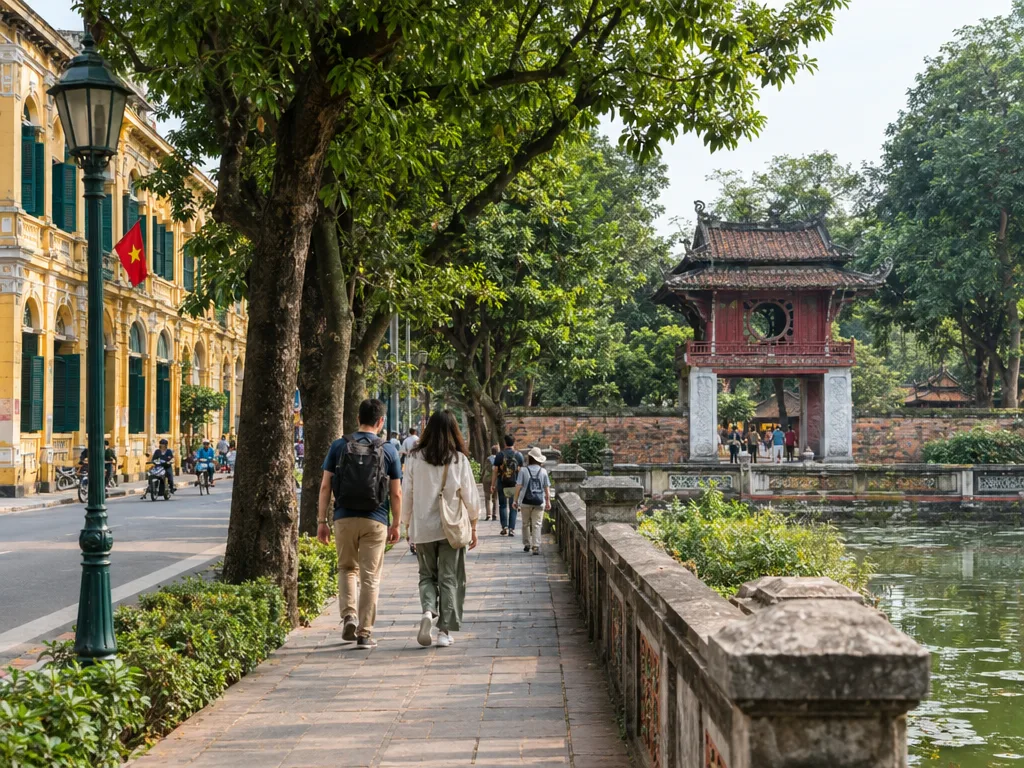
Enter with enough time to move through the courtyards rather than taking a single photograph and leaving. Notice the sequence of gates, ponds, trees, pavilions, and the Doctoral Stelae garden. The architecture creates a deliberate sense of progression: each courtyard narrows your attention and then opens it again. It is one of the best places in central Hanoi to slow down after the traffic of the Old Quarter.
The official site also lists a standard adult ticket and reduced or free admission categories with documentation requirements. Treat those details as practical guidance, not a substitute for checking the current ticket page on the day you visit. If you are travelling with children or older relatives, the shaded courtyards and clear internal sequence can make this a more comfortable stop than a long, unstructured street walk.
What to notice inside
- The contrast between enclosed courtyards and open sky.
- How water, trees, and gateways shape the visitor route.
- The stone stelae and the relationship between scholarship, memory, and architecture.
- The difference between visiting for quiet observation and visiting during a busy cultural programme.
Leave through the exit that best suits your next direction rather than automatically retracing your steps. The official visitor information identifies entrances and exits on different streets, so confirm the current arrangement on site.
Continue to Ba Dinh and the Imperial Citadel
From the Temple of Literature, walk north-west towards the broad civic landscape of Ba Dinh. This section feels more spacious and formal. Trees and open verges give your eyes a break from the dense Old Quarter, while the changing road pattern helps you understand Hanoi as a capital city as well as a historic trading centre.
The Imperial Citadel of Thang Long is the strongest finish for this version of the route. Its official website describes the central sector as a place of outstanding historical importance and gives the sightseeing address as 19C Hoang Dieu. The same visitor information currently lists opening from 8:00 AM to 5:00 PM on all days of the week. Confirm details before visiting, particularly if you plan around a special event or night programme.
Allow time for the site’s scale. The citadel is not a single object but a layered historic complex. Walk slowly between the gates, archaeological areas, buildings, and interpretive displays. The official site highlights the location’s long role as a seat of power and its multiple cultural layers; that idea is easier to understand on foot than from a quick exterior visit.
How to finish well
Do not force the walk to continue after the citadel. If your energy is good, explore the surrounding Ba Dinh streets at an unhurried pace. If the heat has built up, stop at the end of the visit and arrange transport from a convenient main road. A walking itinerary should leave you curious about Hanoi, not exhausted by it.
Practical planning for a comfortable walk
Best time and weather
Morning is the easiest default, especially if you want the Temple of Literature and Imperial Citadel on the same outing. Start early enough to enjoy the Old Quarter before the strongest heat. In cooler months, a late-afternoon version can work, but check attraction hours carefully and leave enough time for entry.
Wear shoes with grip rather than delicate fashion footwear. Pavements can be uneven, crowded, or partly occupied by parked motorbikes. A compact umbrella is useful in changeable weather, and a small bag is easier to manage than a large backpack on busy streets.
Food, water, and pauses
Plan one proper pause in the middle rather than relying only on quick drinks. Carry sealed water, refill where you trust the source, and choose food stops with a clear turnover of customers. If you have allergies or dietary restrictions, communicate them simply and do not assume that a familiar-looking dish contains only the ingredients you expect.
For a more food-focused day, pair this route with the site’s practical approach to local markets and small shops in Hanoi, but keep the walking article’s sequence intact. The route works because the transitions are manageable; too many detours turn it into a list.
Respectful walking
Hanoi’s streets are lived-in spaces. Keep voices low in temple and heritage areas, dress respectfully inside religious or historic compounds, and follow staff instructions about barriers and photography. Do not climb, touch, or lean on fragile structures. When a pavement becomes someone’s workplace or home entrance, give way without making the interaction a performance.
Three ways to adapt the route
- Short version: Hoan Kiem Lake, a selective Old Quarter loop, then the Temple of Literature. Choose this when the weather is hot or you want a relaxed half-day.
- Heritage version: Move from the Old Quarter to the Temple of Literature, continue to Ba Dinh, and finish at the Imperial Citadel. This is the most balanced option for first-time walkers.
- Slow local-life version: Spend longer around Hoan Kiem and the Old Quarter, take a café break, and treat the western section as optional. This suits repeat visitors who prefer observation to collecting landmarks.
Whichever version you choose, remember that a Hanoi walking route is not a timed test. Leave room for a street you did not expect, a shaded bench, or a shop that makes you curious. The city’s character appears between the formal stops.
Conclusion: walk for the transitions
This route connects Hanoi’s busy centre with two of its most meaningful heritage spaces, but its real subject is the journey between them. Hoan Kiem and the Old Quarter show commerce and daily movement; the Temple of Literature offers ordered courtyards and scholarly memory; Ba Dinh and the Imperial Citadel widen the frame to the capital’s political and historical layers.
Start early, keep the route flexible, verify current attraction information, and let the streets set the pace. You will finish with more than a list of sights: you will have a clearer sense of how Hanoi changes block by block.
JOIN THE CONVERSATION
Comments (0)
No comments yet. Be the first to share a thought.