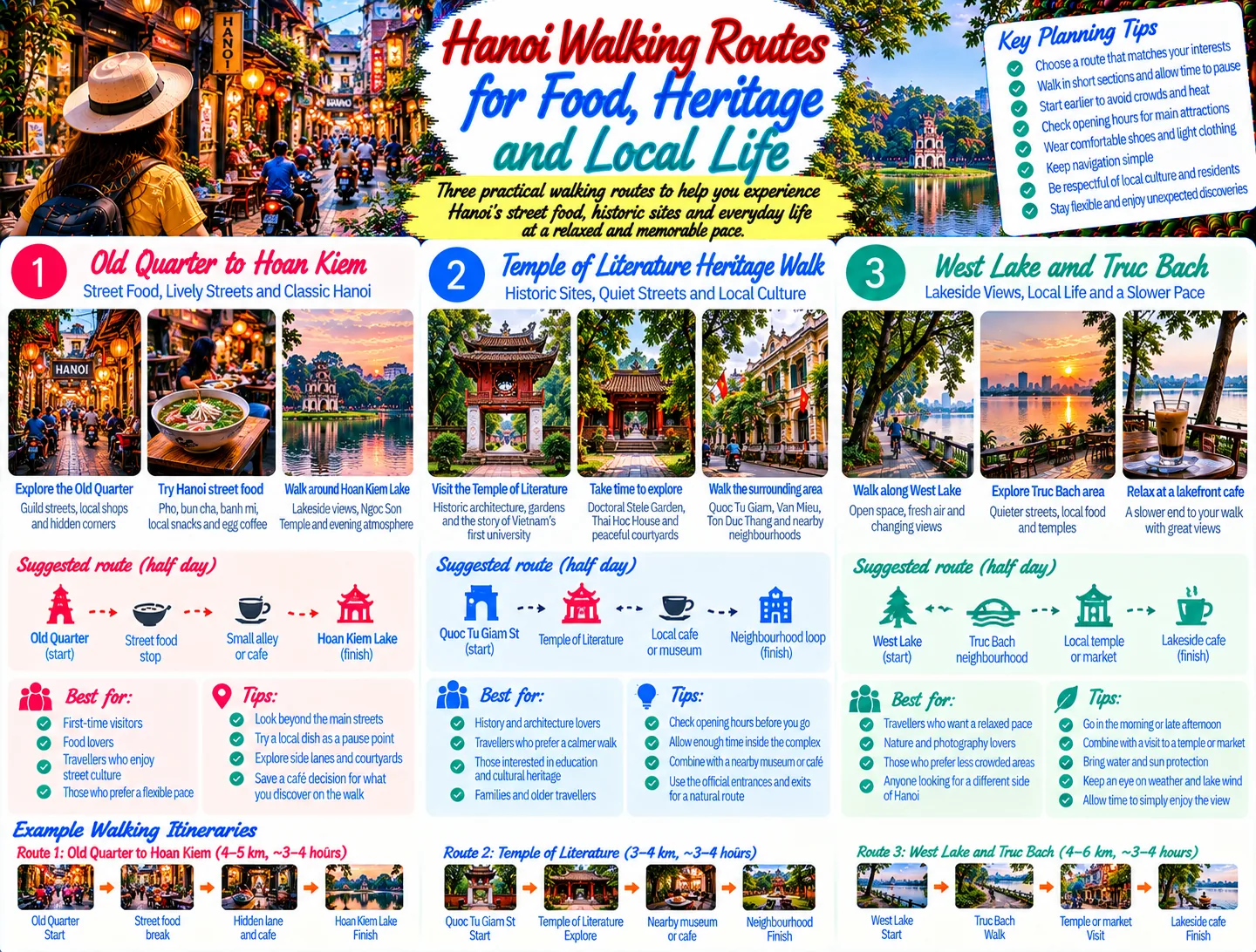
Hanoi is easiest to understand on foot, but the best walk is rarely a race between famous sights. A good Hanoi walking route gives you a clear starting point, a reason to pause, and enough flexibility to follow a busy lane, a shaded courtyard or the smell of lunch. This guide turns the city into three practical walks: a compact Old Quarter and Hoan Kiem circuit, a heritage route around the Temple of Literature, and a slower West Lake-style afternoon. Choose one, combine two, or use the pacing advice to build a self-guided walking tour that fits your energy.
How to choose a Hanoi walking route
Start with the kind of day you want rather than a list of landmarks. The Old Quarter route suits first-time visitors who want dense street life, coffee and easy opportunities to stop. The Temple of Literature route is calmer and more reflective, with a stronger heritage focus. A West Lake walk works best when you want open space, water views and a less compressed rhythm. These are planning frameworks, not timed races: traffic, heat, rain, meals and unexpected invitations all change how long a walk takes.
For a broad overview before choosing your angle, see The Best Hanoi Walking Routes for Curious Travellers. This new guide goes narrower by matching routes to mood, time and walking style.
Three simple rules for a better walk
Pick one anchor sight and two flexible pauses rather than filling every minute.
Walk in short sections, with a café, market, courtyard or meal as a reset point.
Keep navigation simple: remember the next named street or landmark, then look up the following turn when you are ready.
Route one: Old Quarter to Hoan Kiem for first-time visitors
This is the most useful Hanoi walking tour itinerary when you want a concentrated introduction. Begin in the Old Quarter and let the route move gradually toward Hoan Kiem Lake. The point is not to cover every guild street. It is to notice how commerce, homes, food stalls, cafés and small religious spaces share the same narrow urban fabric.
Start with the streets, not the checklist
Choose a central Old Quarter starting point and spend the first part of the walk looking upward and sideways. Shopfronts change quickly, signs overlap, and a lane that appears ordinary may reveal a courtyard or a tiny food counter. If you are walking early, watch how deliveries and breakfast service shape the street. If you start later, accept that the experience will be louder and more crowded.
Use food as your first pause. Vietnam Tourism describes Hanoi’s street food as a way to connect food, history and everyday life, and specifically notes the role of small eateries, fresh herbs and low-key street-side dining in the city’s character. You do not need to turn the walk into a formal food tour. A bowl of pho, bun cha, banh mi or a carefully chosen coffee stop can simply give the route a local rhythm.
Move toward the lake at an unhurried pace
As you approach Hoan Kiem, let the streets widen into a different kind of public space. The lake is useful as a navigation anchor and as a place to slow down after the density of the Old Quarter. Walk part of the shoreline, sit for a while, and observe how residents use the area. The best photographs are often not the most obvious ones: look for reflections, older buildings at the edge of the district, and the contrast between moving traffic and people lingering near the water.
This route is also a natural companion to the site’s Secret Cafes & Hangouts category. Save a café decision until you have walked for a while; choosing from what you actually notice is more rewarding than crossing a preselected address off a list.
Who should choose this route?
Pick it if you have a half-day, want the classic first impression, or prefer frequent options to stop. It is less suitable if you dislike crowds, need long uninterrupted stretches of quiet, or are trying to avoid midday heat. In those cases, start earlier, shorten the Old Quarter section, or move to the heritage route below.
Route two: a heritage walk around the Temple of Literature
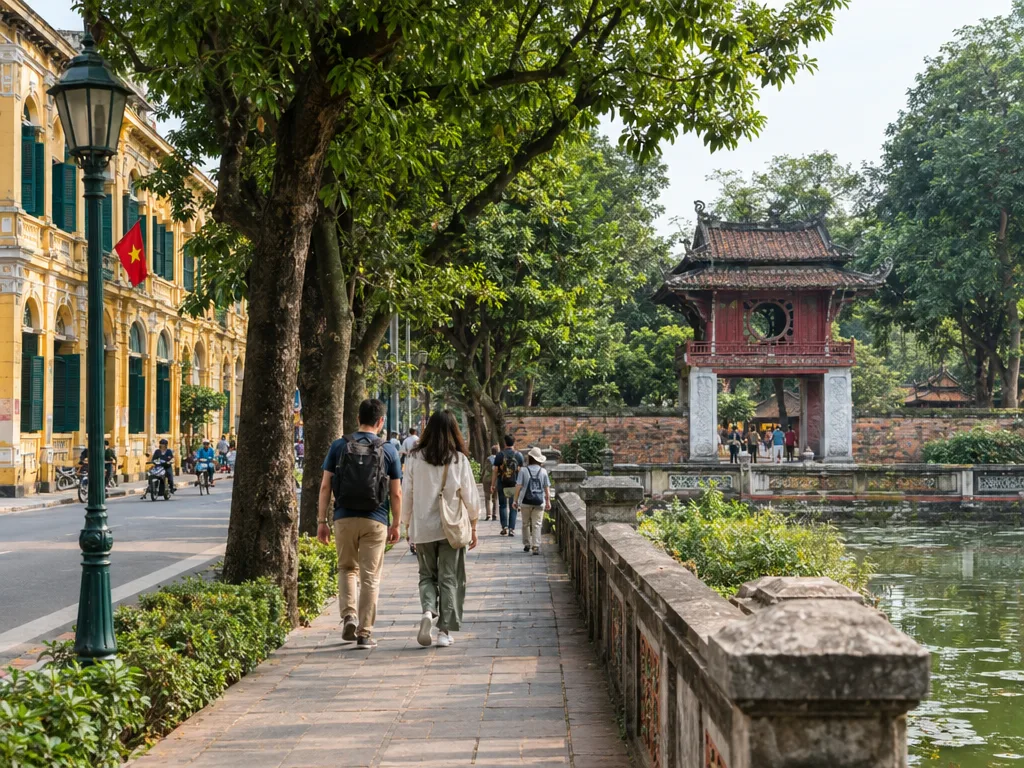
The Temple of Literature route offers a different answer to the search for Hanoi walking routes. Instead of treating heritage as one quick photo stop, build the walk around time spent inside a historic complex and the quieter streets around it. The official Van Mieu–Quoc Tu Giam site identifies the complex as a special national historical site and describes exhibitions and areas including the Doctoral Stele Garden, Thai Hoc House and the historic national university story.
Plan the visit as the route’s centre
The official site currently lists general visiting hours as 8:00 AM to 5:00 PM every day, while also describing an evening programme on Wednesday, Saturday and Sunday. Because schedules and programme access can change, check the official visitor information before setting out rather than relying on an old guide. The same source lists the main entrance at No. 58 Quoc Tu Giam Street and gives exit points on Van Mieu Street and near Ton Duc Thang Street, which is useful when planning where your walk should continue.
Inside, resist the urge to move straight through. Give each courtyard a distinct pause. Read the site as a sequence of thresholds, gardens, gates and learning spaces. If you are travelling with children or someone who prefers a slower pace, the complex provides natural moments to stop without blocking the flow of the visit.
Add a neighbourhood loop before or after
After the complex, make the surrounding streets the second half of the heritage walk. Keep the loop modest: notice the relationship between institutional buildings, homes, cafés and everyday traffic rather than chasing distant sights. A small lunch or coffee stop works better here than trying to add another major attraction. If you have energy, use the route to connect with other cultural interests covered in Art & Creative Spaces, but keep the walk’s main identity centred on history and attention.
This route is especially good for travellers who want a quieter Hanoi self-guided walking tour, photographers who prefer architectural details, and repeat visitors who have already completed the Old Quarter circuit. It also makes a useful hot-weather adjustment: spend the most focused part of the day at the heritage site, then shorten the outdoor loop if the streets become uncomfortable.
Route three: a slower West Lake-style afternoon
A West Lake walk is less about completing a defined circuit and more about giving yourself room. Choose a waterfront starting point, walk a manageable section, and make the route about changing views rather than collecting landmarks. This is the option for travellers who want a more spacious afternoon after several dense days in central Hanoi.
Use the lake as a pacing tool
Set a turnaround point before you begin. It can be a café, a meal, a viewpoint or simply a time when you want to return. That small decision prevents the common mistake of treating a large waterfront area as if it were a short central-city stroll. Walk in one direction, pause when the scenery changes, and turn back while you still have energy for dinner.
West Lake also suits people who like to combine walking with observation. Notice how cafés, apartment buildings, older lanes and waterside activity meet. The route feels different in the late afternoon than in the morning, so choose the light and atmosphere you want rather than assuming one universal best time.
Make it a local-life route
For a practical companion to this slower approach, browse How to Experience Everyday Life in Hanoi Like a Local. The useful connection is the mindset: allow ordinary details to be the destination. A drink, a short conversation, a small shop or a change in weather can be enough reason to adjust the plan.
If you want a more social evening after the walk, the site’s Hanoi Nightlife & Entertainment category can help you continue without forcing nightlife into the walking route itself. Keeping the two decisions separate makes the afternoon easier to enjoy.
How to combine the routes in one day
Trying to complete all three as full walks is unnecessary. A better one-day plan is to choose one central route as the main experience and borrow one element from another. For example, begin with a short Old Quarter breakfast walk, visit the Temple of Literature as the day’s focused heritage stop, then finish with a relaxed café or meal. Alternatively, make the Old Quarter your morning introduction and reserve West Lake for a late-afternoon change of pace.
Match the plan to your energy
Low-energy day: choose one anchor, one meal and one short neighbourhood loop.
Curious first day: take the Old Quarter to Hoan Kiem route and keep the evening open.
Culture-focused day: centre the Temple of Literature route and add only nearby pauses.
Repeat visit: choose West Lake or revisit a familiar district at a different time of day.
Hanoi rewards flexible sequencing. If rain arrives, move indoors for food or coffee. If the traffic feels stressful, shorten the crossing between two districts rather than treating the plan as a test. If a street feels especially alive, stay longer. A walking route should help you notice the city, not make you hurry past it.
Practical details that make walking easier
Wear shoes that can handle uneven pavement and frequent stops. Carry water, but plan to refill or buy drinks locally instead of carrying a heavy bag all day. Keep phones and wallets secure when crossing busy streets, and use marked crossings where available. Cross with steady, predictable movement rather than sudden changes of direction; if you are unsure, watch how people around you move and wait for a comfortable gap.
Build in shade and indoor pauses. Hanoi’s weather can make the same route feel completely different, and no itinerary deserves discomfort. A morning start is often easier for dense central streets, while late afternoon can make open waterfront areas more pleasant. Check current venue information directly for any attraction with timed entry, special programming or changing hours, especially the Temple of Literature’s evening experiences.
Food stops need the same common sense as the rest of the walk. Choose places that look active and well maintained, order what you can finish, and ask about ingredients if you have allergies or dietary restrictions. The goal is not to find the most famous stall; it is to find a stop that fits your route and lets you keep exploring comfortably.
What makes a Hanoi walking route memorable?
The strongest route usually has three layers: a recognisable place, a stretch of ordinary life, and enough unplanned space for discovery. Hoan Kiem gives you a clear centre; the Old Quarter supplies texture and food; the Temple of Literature adds historical depth; West Lake changes the scale of the city. You do not need to see every layer in one day.
Before leaving, write down one detail you would have missed from a car: a breakfast routine, a sign above a shop, the sound of a courtyard, or the way people use a public space. That is the real value of a self-guided walk. It turns Hanoi from a sequence of attractions into a city you have started to read.
Conclusion
Choose the Old Quarter and Hoan Kiem route for energy, the Temple of Literature route for heritage, or a West Lake-style walk for breathing room. Keep the plan flexible, use food and cafés as natural pauses, and let the city’s everyday scenes shape the day. The best Hanoi walking route is the one that leaves you curious enough to keep going tomorrow.
JOIN THE CONVERSATION
Comments (0)
No comments yet. Be the first to share a thought.